Vladimir Putin’s War Spreads Resignation and Despair Among Ordinary Russians
Pro-Putin pollsters maintain that most Russians support the “special military operation” against Ukraine. But artificial efforts to stir public enthusiasm can’t hide the disastrous effects the war is having on ordinary Russians.
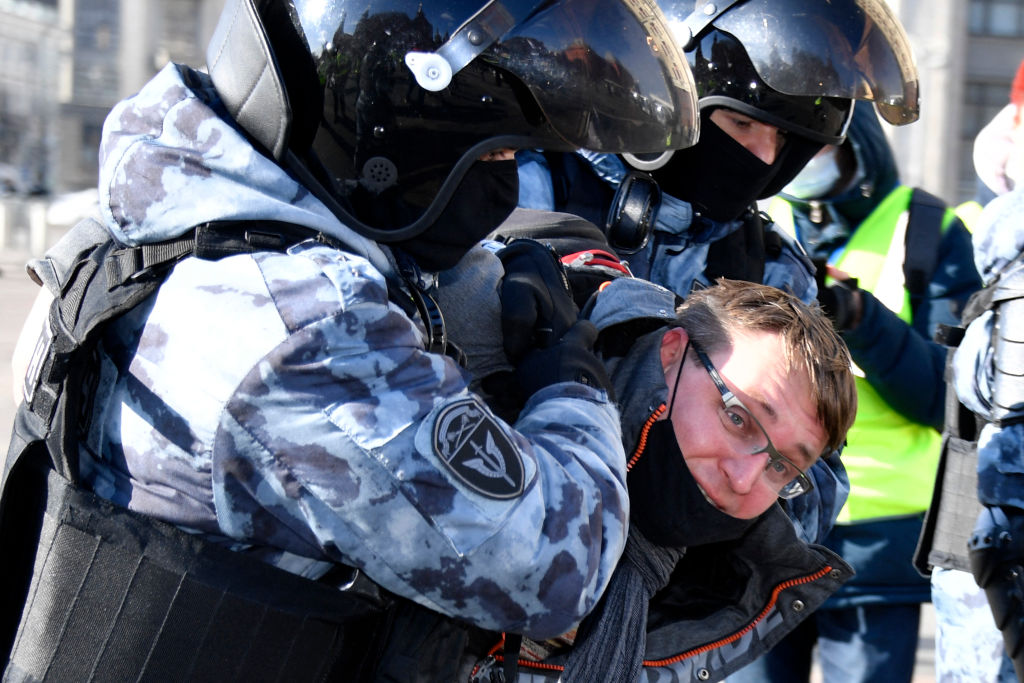
Police officers detain an antiwar protester in Manezhnaya Square, Moscow, March 13, 2022. (AFP via Getty Images)
The beginning of the military conflict in Ukraine came as a shock to Russian society. Even before people were able to recover, they were informed that they supported the war almost unanimously. The government-controlled Russian Public Opinion Research Center published a report on the fourth day of the war, according to which 68 percent of Russians “somewhat support the decision to conduct the special military operation,” with only 22 percent against. Similar results were published by another large sociological center — the Public Opinion Foundation — whose main contractor has consistently been Vladimir Putin’s own administration.
The poll results show that respondents don’t have a clear understanding of the goals of the Russian operation. A quarter assumed that the military is “protecting the Russian-speaking population of Donbass”; 20 percent think that its purpose is to not allow NATO bases on the territory of Ukraine; another 20 percent believe that the operation is carried out to demilitarize Ukraine; 7 percent think that Russia wants to “denazify” Ukraine and change its political orientation; 6 percent believe the aim is to change the country’s political regime from the current “unneighborly” one; and, finally, 4 percent think the idea is to split Ukraine into parts and establish Russian control in the country’s southeast.
Such comprehensive data about Russian citizens’ overwhelming support is demoralizing for opponents of the war. However, a vital correction must be made: the data does not reflect everyday experience. Indeed, some people support the invasion of Ukraine, but the number of two-thirds is quite astonishing. If they are so numerous, why don’t we see them anywhere?