Capitalism and Orientalism
A new book examines the work of Edward Said in the light of Marxism, showing why imperialism can’t be understood in terms of culture alone.
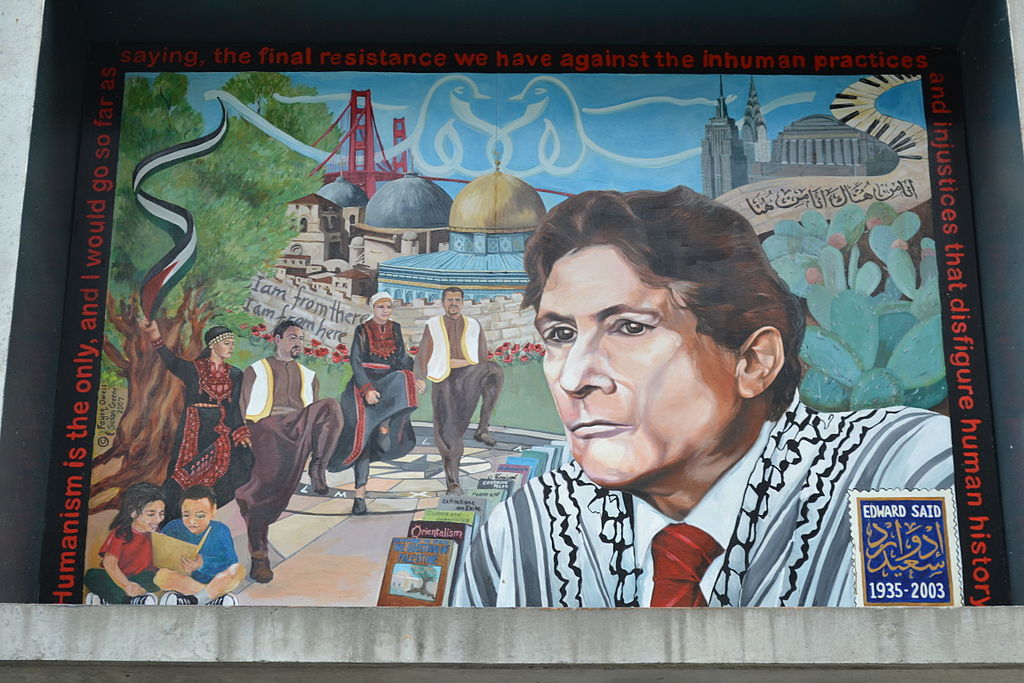
Palestinian Cultural Mural honoring Edward Said, at San Francisco State University, July 27, 2012.Briantrejo / Wikimedia
Edward Said was one of the most influential and terrain-shifting intellectuals of the twentieth century. With a prodigious output of seventeen books and a staunch commitment to the Palestinian cause, Said is recognized throughout the academy as the founding father of postcolonial theory. His work has left a deep mark not only upon literary criticism, where his career took wing, but also with historians, musicologists, and social scientists.
Orientalism (1978), arguably Said’s most popular work, is a pioneering interrogation of the way the West constructs myths about the Orient and then turns those myths into systems of knowledge and justifications for imperial control. In his sequel Culture and Imperialism (1993), he builds on these foundations by tracing the presence of imperial frontiers, ambitions, and sentiments in Victorian and early modernist canonical texts.
Additional coverage of topics ranging from contemporary affairs, including the US war on Iraq and the Israeli Occupation, to music theory attest to an intellect of breath-taking range and expression. In titles such as The Politics of Dispossession (1994) and the autobiographical Out of Place (1999), Said ventures rich insights into states of displacement and exile under US and Israeli policies of invasion and annexation. An accomplished pianist, Said additionally published books on music — Musical Elaborations (1991) and On Late Style (2006) — often drawing on musical techniques to sharpen his postcolonial critique.