Members of the Squad Were Right to Vote Against the Bipartisan Infrastructure Bill
Last week, six left-wing House Democrats refused to bow to party leaders to support the bipartisan infrastructure bill. More of their colleagues should have taken the same stand.
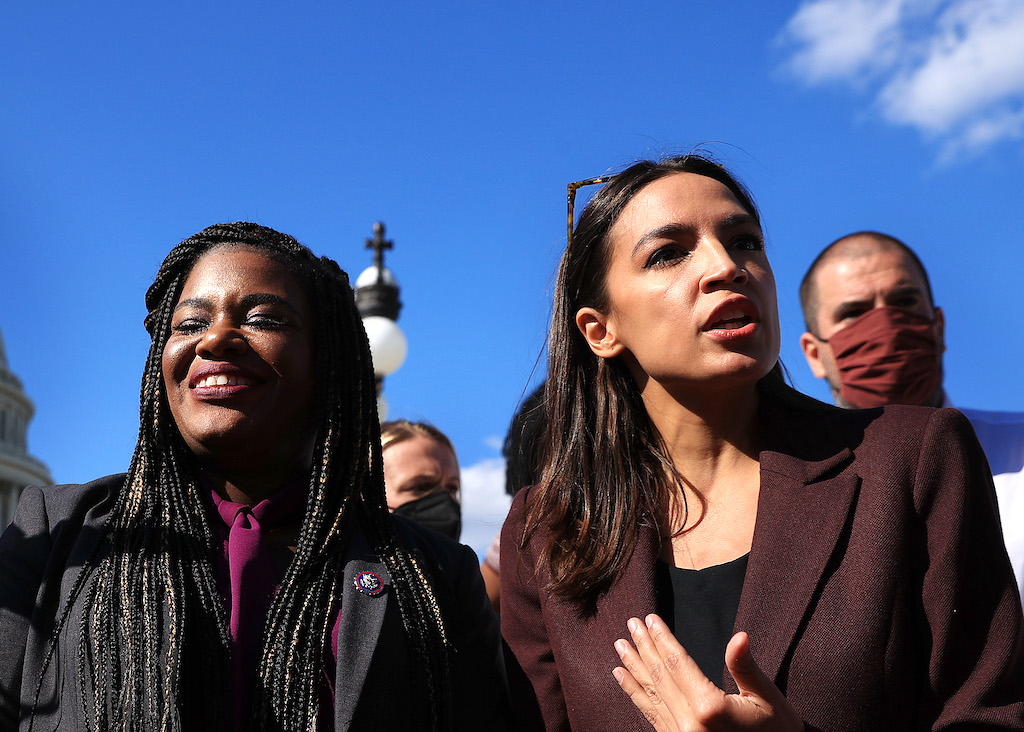
Representatives Cori Bush and Alexandria Ocasio-Cortez talk to reporters outside the US Capitol in Washington, DC. (Chip Somodevilla / Getty Images)
On paper at least, there’s been a months-long consensus shared among both progressive Democrats and senior figures in the party leadership that the two big pieces of legislation currently facing Congress — the Build Back Better (BBB) reconciliation package and the Bipartisan Infrastructure Framework (BIF) — should be passed in tandem. On this point, the likes of Nancy Pelosi (“There ain’t gonna be no bipartisan bill unless we’re going to have a reconciliation bill”) and Joe Biden himself (“If only one comes to me, this is the only one that comes to me, I’m not signing it. It’s in tandem”) had been unequivocal, as had Congressional Progressive Caucus chair Pramila Jayapal.
Though somewhat convoluted at the level of detail, what happened on Friday represented a marked and undeniable shift away from this position. While less surprising from the likes of Biden and Pelosi, who in the wake of last week’s elections are quite desperate for anything they can call a political win, Jayapal’s maneuver is altogether more puzzling. In brief: Friday saw the passage of BIF through the House by a margin of 228 to 206, with only six Democrats (Jamaal Bowman, Ilhan Omar, Rashida Tlaib, Ayanna Pressley, Cori Bush, and Alexandria Ocasio-Cortez) refusing to cave to leadership pressure and voting against the bill.
Officially, progressives have a commitment from centrists to vote for BBB pending the provision of a financial analysis from the Congressional Budget Office (CBO) sometime later this month. The risk, of course, is that the CBO’s analysis will be used as a pretext by Democratic centrists to withdraw what is currently their nominal support for the bill — a possibility that is distinctly difficult to ignore amid its endless watering down.