In Peru, the Knives Are Already Out for Pedro Castillo
Pedro Castillo passed his first hurdle as president of Peru recently when he won congressional approval for his left-wing cabinet. To keep his momentum and defeat the right-wing opposition, he now needs to build his popular support in the streets.
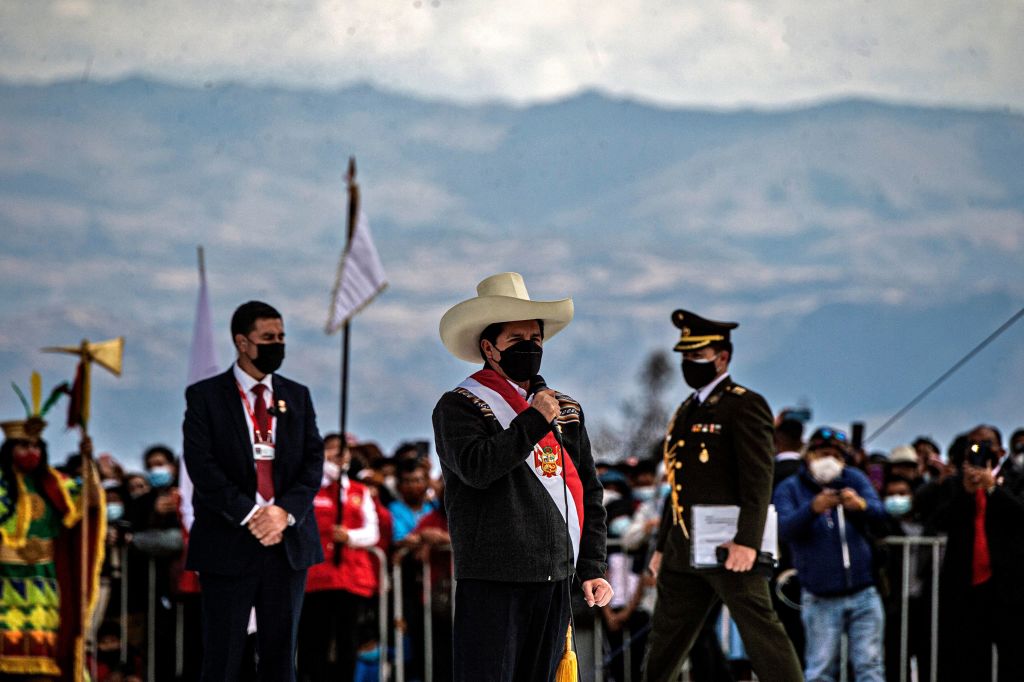
Peruvian president Pedro Castillo delivers a speech during a ceremony on July 29 at Pampa de la Quinua, Ayacucho, where the last battle against the Spanish royalists was won in 1824. (ERNESTO BENAVIDES/AFP via Getty Images)
The man with the longest name in the room, Felipe Juan Pablo Alfonso de Todos los Santos de Borbón y Grecia, could be forgiven if he did not care too much for Pedro Castillo’s maiden presidential speech. The inauguration of Peru’s new president took place on July 28, 2021, marking the two hundredth anniversary of the country’s proclamation of independence from Spain. King Philip VI of Spain — the man with the long name — looked on glumly as a peasant, rural schoolteacher, community patrol member, and union leader from one of Peru’s poorest provinces assumed the highest office in the country that had once been the crown jewel of the Spanish Empire.
Wearing his trademark straw hat and a liqui liqui — the traditional northern Andes outfit that has become a staple among Pink Tide heads of state — Castillo took an unconventional approach to the swearing-in speech. Rather than focusing on the drama surrounding his electoral triumph over far-right candidate and notoriously sore loser Keiko Fujimori, Castillo offered a history lesson.
After greeting his fellow heads of state and “His Majesty the King of Spain,” Castillo spoke on behalf his “brothers of Indigenous ancestry in pre-Hispanic Peru, my Quechua, Aymara, and Amazonian brothers, the Afro-Peruvians and the many communities of immigrant ancestry, as well as the dispossessed minorities in the countryside and in the cities. Today, we all say: kashkaniracmi. We still exist.” He spoke of lands inhabited by “cultures and civilizations” that “for four and a half millennia solved their problems and lived in harmony with what nature offered them,” only to be interrupted by “the men from Castile,” who “established the castes and differences that persist to this day.”