The True Story of Indonesia’s US-Backed Anti-Communist Bloodbath
The massacre of the Indonesian left in 1965–66, backed by Washington, was one of the great crimes of the twentieth century. A new generation of scholars has uncovered its long-suppressed history of slaughter of up to a million people in the name of anti-communism.
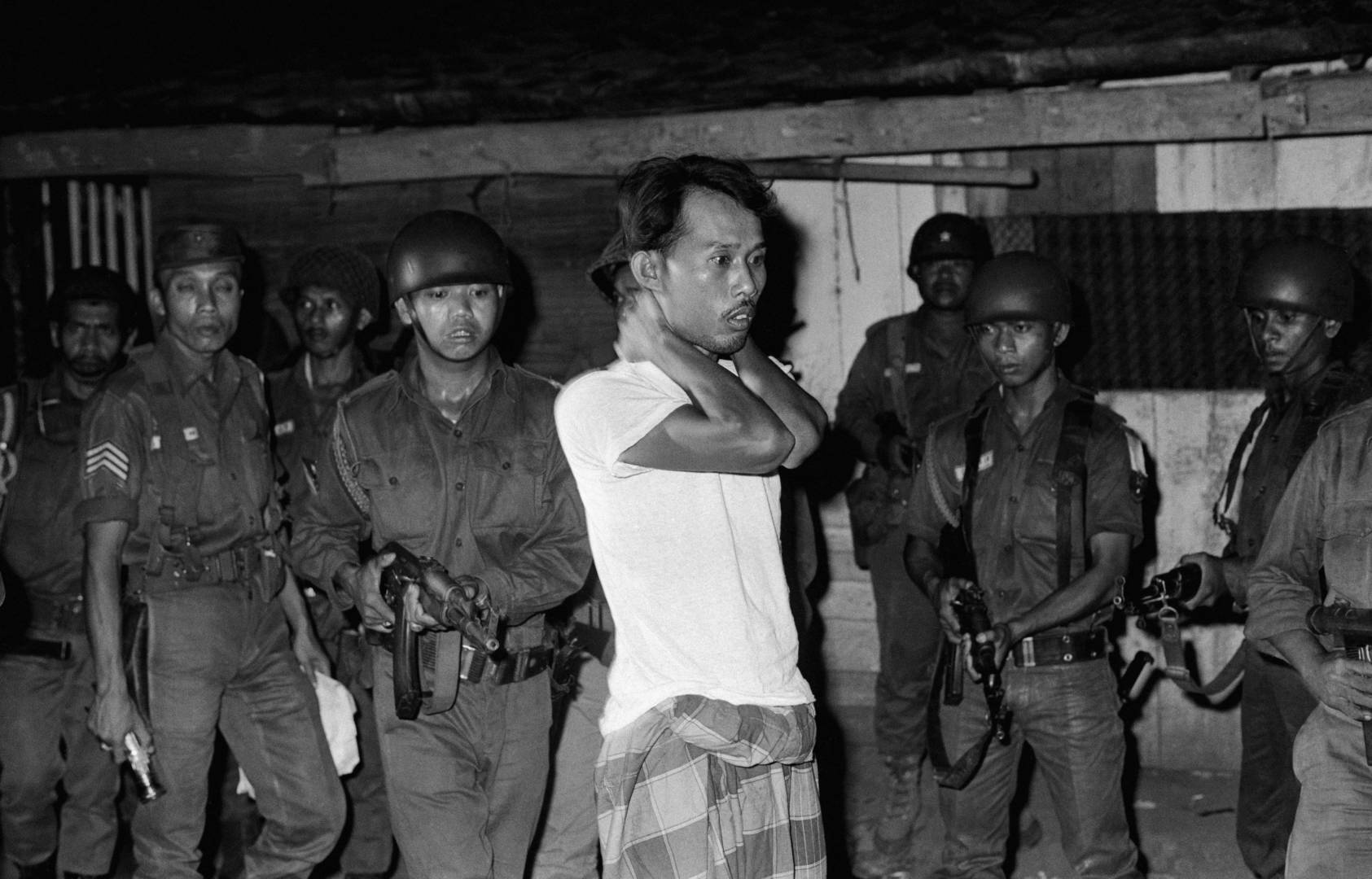
An alleged communist is questioned under gunpoint by Indonesian soldiers in 1965. (University of Melbourne)
On the night of September 30, 1965, a bungled coup d’état resulted in the deaths of a handful of Indonesian generals, a lieutenant, and the five-year-old daughter of one general who escaped the kidnapping. Within days, a relatively unknown military figure, Suharto, had jumped the chain of command. Suharto blamed the Indonesian Communist Party (PKI), the largest communist party outside of the Soviet Union and the People’s Republic of China, for the murders. And he promised revenge.
This set in motion a mysterious and often perplexing series of events that led to the downfall of Indonesia’s founding president, Sukarno — an anti-imperialist who had sought to forge national unity by combining the forces of nationalism, religion, and communism — and the rise of the authoritarian General Suharto’s New Order (1966–1998), a period of far-right military dictatorship, massive corruption, and unbridled foreign investment. Suharto both prefigured and outlasted his Chilean analog, Augusto Pinochet.
The circle of officers around Suharto immediately incited public opinion against the PKI. Claiming there was a massive conspiracy they called Gestapu or G30S/PKI (short for “September 30th Movement/PKI”), they warned of an imminent threat of a nationwide Communist uprising. On orders from Jakarta, regional commanders began campaigns of arrest, torture, and execution.