The Indonesian Left Is Stuck in an Anti-Communist Hangover
Little noticed in the West, the past two years have witnessed the largest protest wave in decades against Indonesia’s increasingly authoritarian crony-capitalist government. But activists are still mentally stuck in the 1990s, deploying depoliticized concepts like “civil society” and “moral force,” and resorting to ill-conceived methods of resistance that have left the movement in a rut and unable to realize its radical potential.
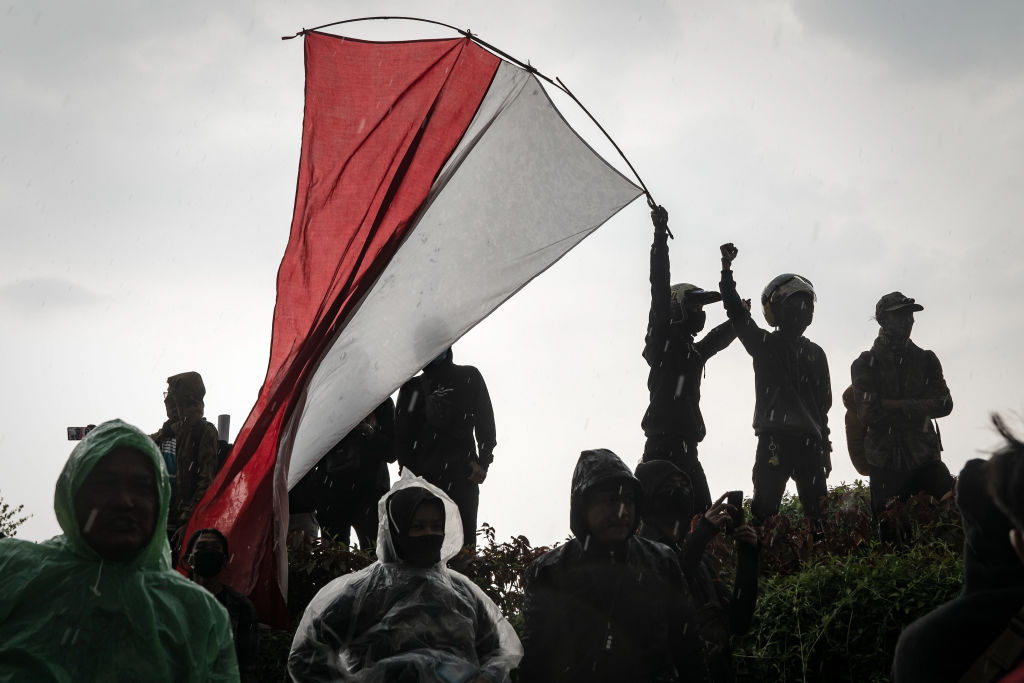
A protester holds an Indonesian flag while demonstrating against the Omnibus Law in West Java, Indonesia, 2020. (Photo by Ulet Ifansasti / Getty Images)
The main idea underlying Vincent Bevins’s 2020 book The Jakarta Method is that the Cold War was not, as people commonly understand it, a two-way conflict between America and the Soviet Union to achieve global hegemony. Instead, it is more accurately described as a period where the United States frantically attempted to smooth out the flow of global capital by eliminating left resistance in newly independent third-world countries such Indonesia, Brazil, and Iran. To do this, the numerous Washington-backed covert CIA operations would follow a common playbook: depose national leaders and governments that presented a hindrance to America’s interests, then ensure that the newly appointed ones do not turn out to be another problem.
It was in Indonesia, however, that the CIA’s anti-communist crusade finally arrived at its penultimate method. The issue with simply overthrowing progressive leaders is that there will always be a considerable portion of the populace that sees the coup as unjust, which eventually enables the Left to find their way back to power. What was designated the “Jakarta Method” was the complete annihilation of progressive forces in a targeted society through a reign of terror that involves mass murders, torture, and forced disappearances.
In 1965, the Communist Party of Indonesia (PKI) was the third-largest communist party in the world, boasting over three million card-carrying members with millions more affiliated through workers’, farmers’, women’s, and cultural organizations. By the end of 1966, over half a million of them are estimated to have been murdered, while the survivors were detained to work in prison camps. Those who were released from imprisonment — or were lucky enough to not get caught in the first place — kept their mouths shut in fear of persecution.