“A Monument to Disenchantment”
In his new book, historian Greg Grandin shows why an expanding American empire has required an increasingly militarized border. And why America's founding frontier myth is finally coming to an end.
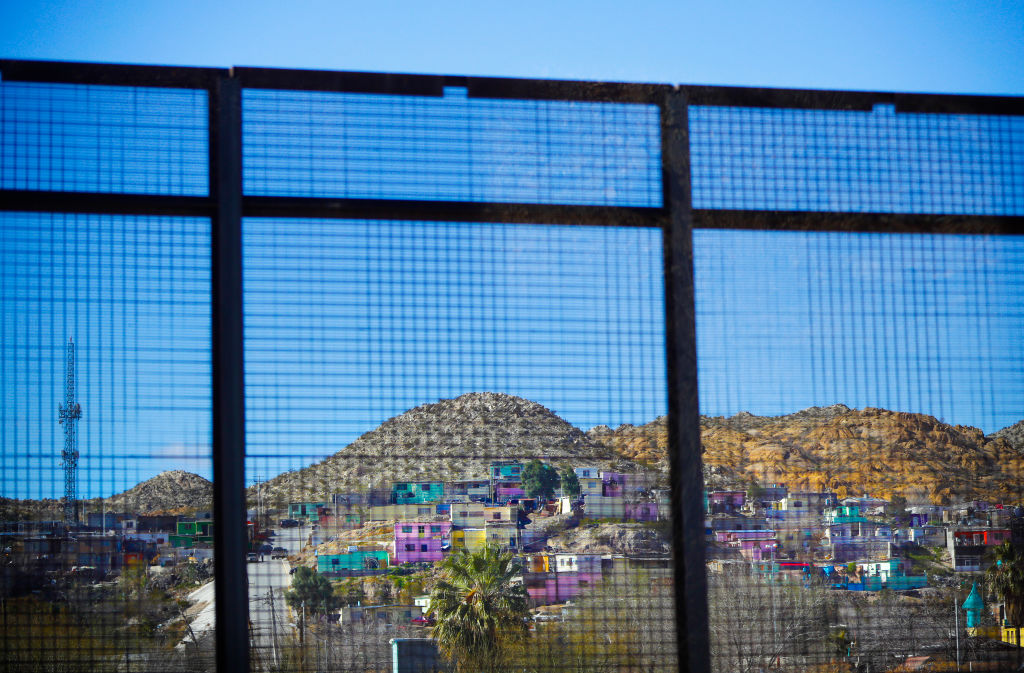
Residential homes in the Mexican city of Ciudad Juarez can been seen through border fencing during Acting Secretary of Defense Patrick Shanahan’s tour of the US-Mexico border February 23, 2019 in El Paso, Texas.Pablo Martinez Monsivais / Getty
In 1787, James Madison wrote that “an ever-enlarging republic would dilute the threat of political conflict and factionalism.” He was wrong on two counts: that expansion could continue indefinitely and that expansion could ease conflict. Settlers certainly pushed west, to the Alleghenies, to the Mississippi, then to the Missouri, and when they finally hit the Pacific coast they kept pushing out and onward — on to the Philippines, Guam, Puerto Rico, Hawaii, as well as the Dominican Republic, Haiti, Cuba, and Panama. And when traditional colonialism was no longer feasible or tolerated, they pushed into market expansion, war, and outer space. As Greg Grandin notes in his new book, The End of the Myth, “expansion became the answer to every question, the solution to all problems, especially those caused by expansion.”
But this ever outward, expansive push of the imperium has also been accompanied, in the last century, by a selective locking down of the border. Though Grandin isn’t the first to note the irony, his engaging analysis and illuminating exhumation of key, overlooked historical moments on and around the frontier provide a critical lens to understand both today’s border obsessions and the white-nationalist resurgence that has long accompanied the nation’s insatiable, hypocritical fervor for “more, more, more” (one of Grandin’s chapter titles).
Grandin unpacks Frederick Jackson Turner’s “frontier thesis,” which postulated, much like Madison’s starry-eyed hope a century earlier, that the West gave the republic room to expand, that the territorial breathing room could act as a safety-valve, “a magic fountain of youth in which American continually bathed and was rejuvenated.’” The individualism espoused in the myth of the frontier, however, drew a straight line to rapacity and exploitation — including indigenous genocide, the entrenchment of slavery, the near extinction of the Buffalo, massive deforestation — generating deep inequalities and a lasting and racist plutocracy. “The frontier,” Grandin writes, “was a state of mind, a cultural zone, a sociological term of comparison, a type of society, an adjective, a noun, a national myth, a disciplining mechanism, an abstraction, and an aspiration.” It was a cure-all and an alibi, and it fostered the delusion of exceptional greatness just as it spurs today’s calls to make America, for a select few, “great” again. “Empire was a safety valve for all the pent up passions and explosive or subversive tendencies of an advanced society,” Grandin quotes Massachusetts congressman Caleb Cushing, writing in 1850.