A Communist Designed Your Kitchen
- Julia Damphouse
Margarete Schütte-Lihotzky is renowned as creator of the first fitted kitchen, designed to cut the time devoted to household chores. But her “social architecture” was just part of her deep political convictions — a journey that led her to the Communist resistance against Nazism.
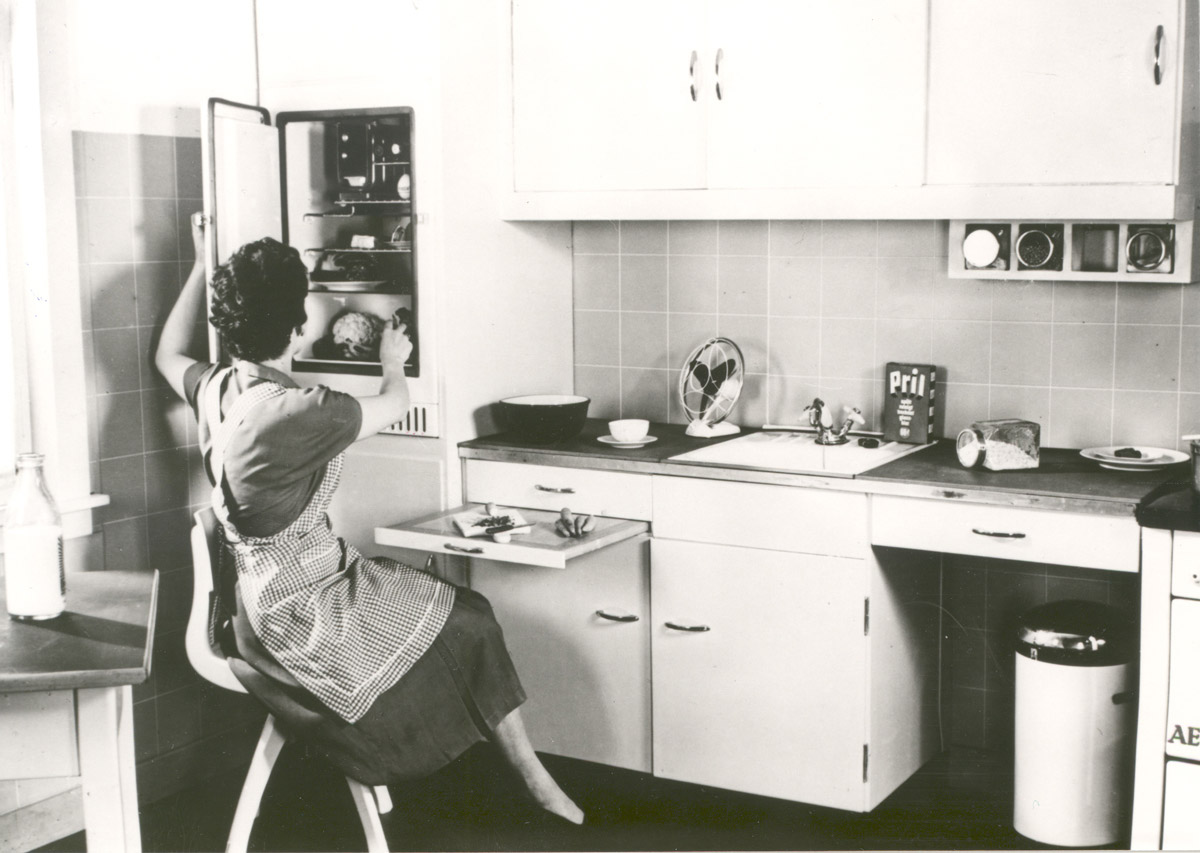
A woman sits down in her Frankfurt Kitchen.
Without doubt, the “Frankfurt Kitchen” was Margarete Schütte-Lihotzky’s most pioneering work — today you can even find an example in New York’s Museum of Modern Art. Measuring just 1.9 by 3.4 meters, it was the world’s first fitted kitchen, known for its blue-green cabinets, compact workspace, and affordable price. Designed to make the most of the limited room available in the workers’ apartments of the 1920s, it was so efficient in its layout that the time taken to move between tasks could be measured with a stopwatch.
Yet Schütte-Lihotzky had no desire to be known as an interior designer. In old age, when people only described her as the designer of the Frankfurt Kitchen, she would insist, “I am not a kitchen.” In truth, the Austrian architect gave the world much more over her 103 years — in particular, thanks to her socialist politics. Upon her birth in 1897, in the days of the Austro-Hungarian Empire, women’s role was often defined as kinder, küche, kirche — children, kitchen, church. Yet Margarete Schütte-Lihotzky’s life followed a quite different course — better defined in terms of career, kitchen, and communism.
Formative Experience
Margarete Lihotzky was born on January 23, 1897 and grew up in Vienna. She came from a bourgeois family: her father was a senior civil servant, and her mother, related to the famous art historian Wilhelm von Bode, was an acquaintance of Nobel Peace Prize laureate Bertha von Suttner. This background made it possible for her to study at Vienna’s University of Applied Arts during World War I — this being one of the handful of universities at the time that admitted women.