Putting Modernism All Over the Map
It’s been 100 years since the Bauhaus school of art and design opened in the German city of Weimar. Today it’s best remembered for its clean-line, modernist designs — but behind this banal reputation lies a political project that sought to reimagine art's role after the devastation of World War I.
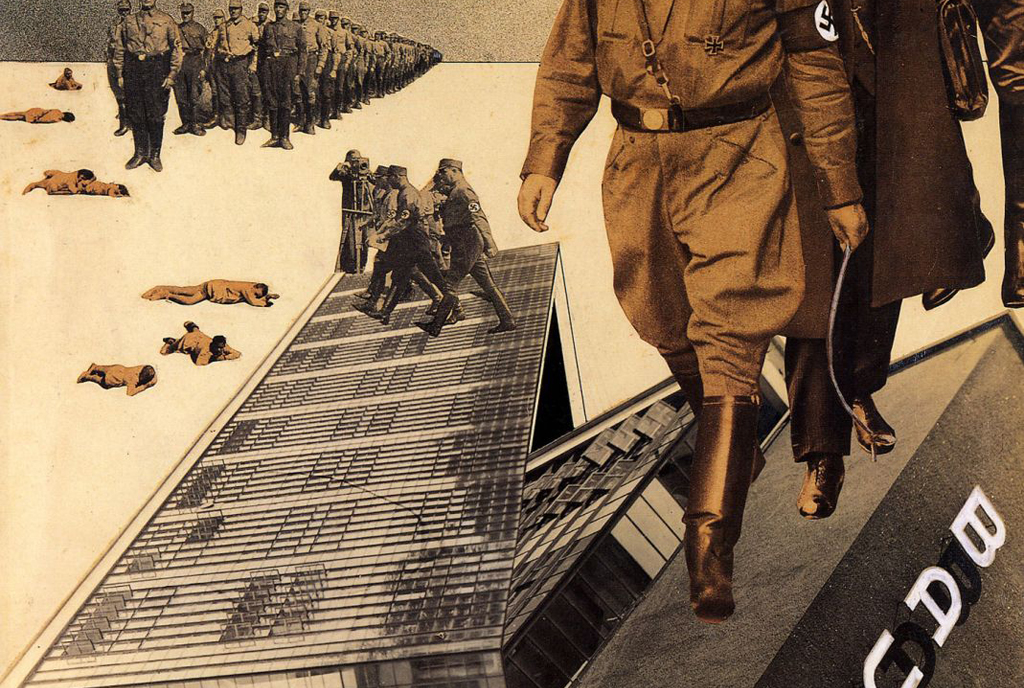
Iwao Yamawaki, “The Attack on the Bauhaus,” 1932
Today, the word Bauhaus evokes clearheaded, functional design with a vague whiff of revolutionary modernism. In countless ways, the relatively short-lived school gave form to the modern experience — from the shapes of the letters we read to the arrangement of the cities we inhabit.
A straight line of influence, as the architect and critic Mark Wigley has argued, connects the Bauhaus to the smartphones that now mediate and organize many of our lives. Wigley did not mean this as a compliment. While an iPhone’s minimalist, intuitive form gives an impression of deadpan honesty, that same form can help obscure social realities: mining, sweatshops, limitless surveillance. Such contradictions were just as characteristic of the Bauhaus as its clean lines and primary colors.
The Bauhaus had three periods: first, it was a multidisciplinary school of art and craft in Weimar (1919–25), then a production-oriented “Institute of Design” in Dessau (1925–32); finally it was a private architecture school in Berlin (1932–33). During the Bauhaus’s brief and turbulent lifespan, interpretations of the institution’s politics varied widely. The eclectically progressive directorship of Walter Gropius in Weimar gave way to a more politically neutral Dessau period.