How Digitalization Is Preparing a Fight for World Market Supremacy
With US hegemony in decline, China and the European Union are each vying to impose their own leadership over the next wave of digitalization. Donald Trump's talk of "America First" expressed this rivalry in especially crude terms — but even after his departure, the contest among the main world powers is only intensifying.
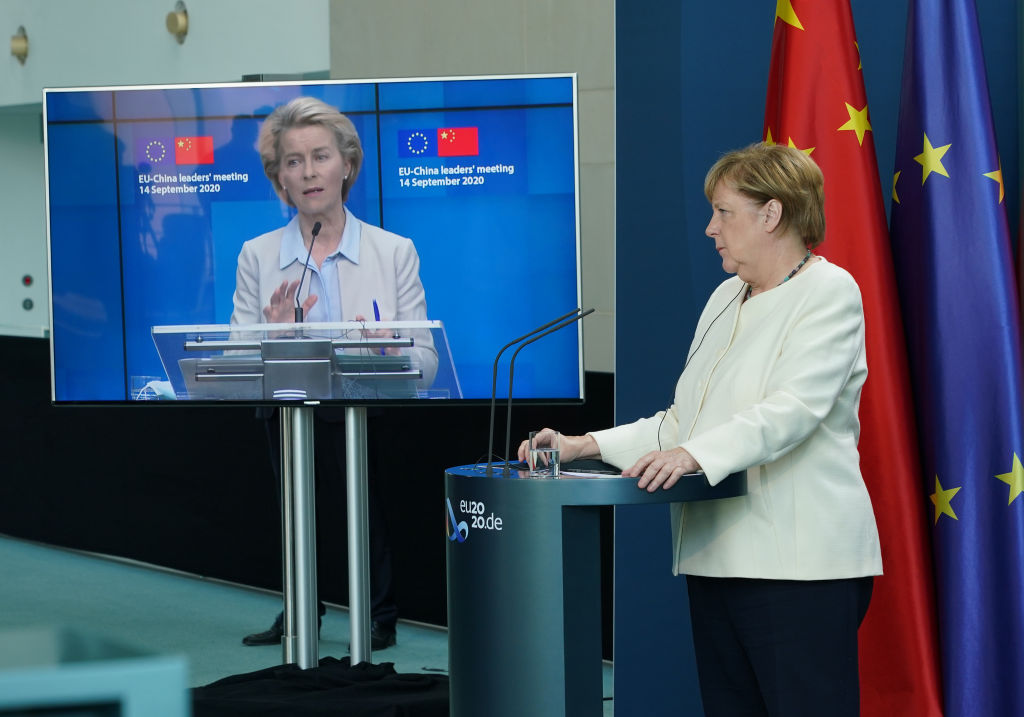
German chancellor Angela Merkel, along with European Commission president Ursula von der Leyen, who is tuning in via video link from Brussels, speaks to the media following a video meeting with Chinese president Xi Jinping, on September 14, 2020 in Berlin, Germany. (Sean Gallup / Getty Images)
The United States and China are engaging in a trade war that British think tank Chatham House calls rooted in “a race for global technological dominance.” And for German business daily Handelsblatt, “Europe is getting caught in the crossfire of [this] technology war.” Faced with this threat, the European Commission has reserved large parts of its coronavirus recovery fund to boosting or maintaining Europe’s “digital sovereignty.” Technology, it would seem, is a matter of power politics. But what does “technological dominance” mean in the digital age?
In her State of the European Union address in September, European Commission president Ursula von der Leyen announced that we have ahead of us nothing less than a “digital decade,” and demanded clear-cut goals for a digital Europe by 2030. As she put it, “Europe must now lead the way on digital — or it will have to follow the way of others, who are setting these standards for us. This is why we must move fast.”
The three remaining world powers — the EU, China, and the United States — are today struggling for world market supremacy. The battles will be fought in the field of digital technology. And as von der Leyen indicated, one of their most important weapons will be the bid to impose their own standards on the global market. Let’s have a look at their battle plans.