How Eastern Bloc Architects Shaped Cities Across the Third World
In the era of decolonization, even nonsocialist states in Africa and Asia drew heavily on architects and planners from Eastern Bloc countries. Experts from the “Second World” adapted their work to local cultures and expectations — and often brought “Third World” lessons back with them.
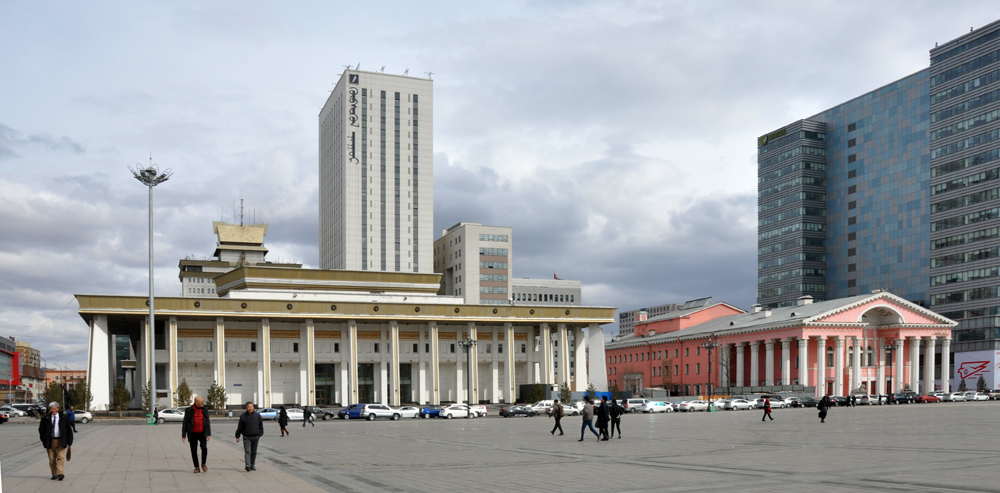
Sükhbaatar Square in Ulaanbaatar (Mongolia). On the left, the Palace of Culture (TsNIIEP Im. B. Mezentseva, Moscow); on the right, the Music and Drama Theatre (arch. Gerhard Kosel and M. S. Shirov, 1942). Photo by Łukasz Stanek, 2012.
When we talk about globalization, we often mean the extension of capitalist hegemony over the world since the end of the Cold War. But after World War II the socialist bloc practiced alternative models of worldwide collaboration — ones supposedly based on the principles of solidarity, international cooperation, anti-imperialism, and scientific-technological revolution. The Council for Mutual Economic Assistance (Comecon), the economic organization founded by the Soviet Union and its satellites in 1949, abandoned the Stalinist policy of autarkic national economies and aimed at inter-socialist economic collaboration. In the wake of decolonization in the Global South, these ambitions were extended toward the newly independent countries in Africa and Asia.
This is the story architectural and urban historian Łukasz Stanek tells in his new book Architecture in Global Socialism. He recounts this history from the perspective of the cooperation between architects, planners, and construction companies from Eastern Europe and the Global South. In particular, he focuses on five cities in Ghana, Nigeria, Iraq, Kuwait, and the United Arab Emirates, shaped by the collaboration between the “Second” and the “Third” worlds. Against the backdrop of the urbanization processes in Accra, Lagos, Baghdad, Abu Dhabi, and Kuwait City, he shows both sides’ interest in cooperation, the dynamics of their collaborative efforts, and their political and economic goals.
He also shows how personal contacts between architects, planners, managers, and engineers from Southern, Eastern, and Western countries impacted urbanization processes in Eastern Europe after the end of socialism. The recent explosion of the grain silo in the Beirut harbor — designed and built by a Czech company — has again brought this topic back into view. It shows how state-socialist architectural export permeated urbanization processes around the world and continues to do so today. We talked about these questions and many more in our interview with Łukasz Stanek.