The “Camden Model” Is Not a Model. It’s an Obstacle to Real Change.
In response to radical demands to defund and disband the police, liberal reformers are pushing the “Camden model.” Don’t fall for it. Camden relies on mass surveillance to pacify its population — all to benefit business interests.
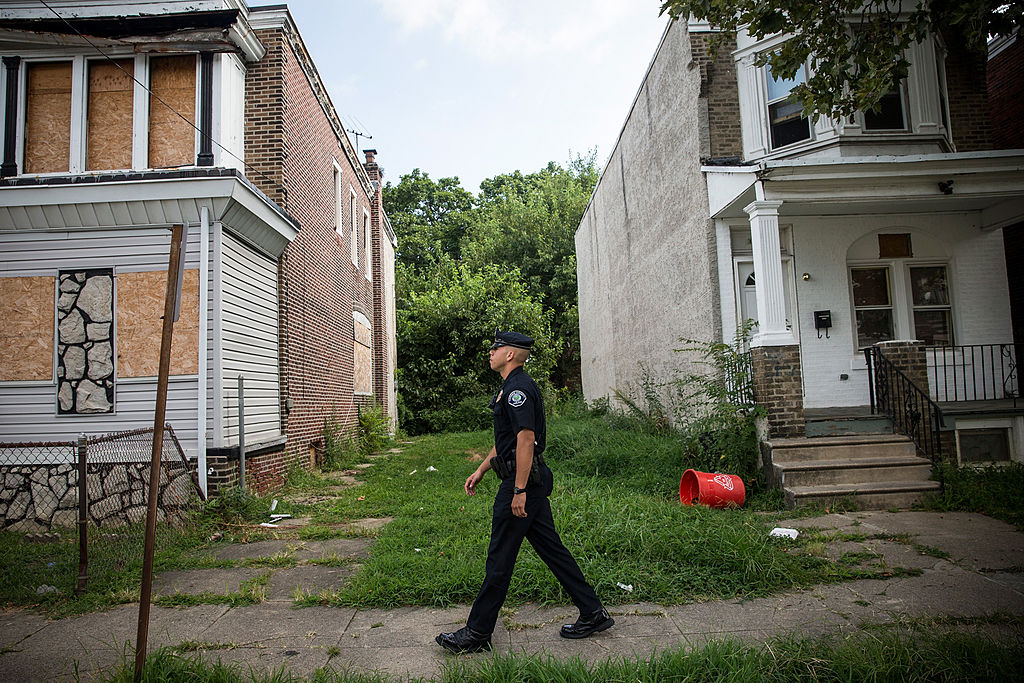
A Camden County Police Department officer goes on foot patrol on August 22, 2013 in the Parkside neighborhood of Camden, New Jersey. The Camden County Police Department was officially created in May 2013, after the Camden Police Department was disbanded. (Andrew Burton / Getty Images)
They’re doing it again.
In 2015, President Obama used Camden, New Jersey as a prop to announce the findings of the President’s Taskforce on 21 Century Policing, a package of procedural reforms to address the post-Ferguson crisis of police legitimacy. In 2012, Camden suffered the highest crime rate in the country and a murder rate 560 times higher than the national average. In 2013, the city disbanded its police force, launched the new Camden County Police Department, and embraced community policing. Violent crime dropped dramatically. As of 2018, it’s down 38 percent from 2013.
Scratch the surface of this feel-good story of crime reduction and community policing, and you’ll find a “surveillance city.” Camden is under constant monitoring: cameras, ShotSpotter gunshot detectors, automated license plate readers, a mobile observation tower. The much-praised police-citizen interactions that make up the work of “community policing” also double as moments of intelligence collection. It’s not just one-off interactions either. Police also develop relationships with neighborhood sentinels — “mothers with children, postal delivery workers, people who are engaged in local groups” — to gather intelligence. They organize residents to monitor their neighbors, report activity to police, and otherwise bolster police programs.