“Prisons Are Microcosms of the Broader Society”
As COVID-19 rips through American prisons, incarcerated people have braved violent repression to demand a humane response to their suffering. In an interview with Jacobin, Pulitzer Prize–winning historian Heather Ann Thompson explains the current wave of prisoner protest — and what it could signal about the future of American politics.
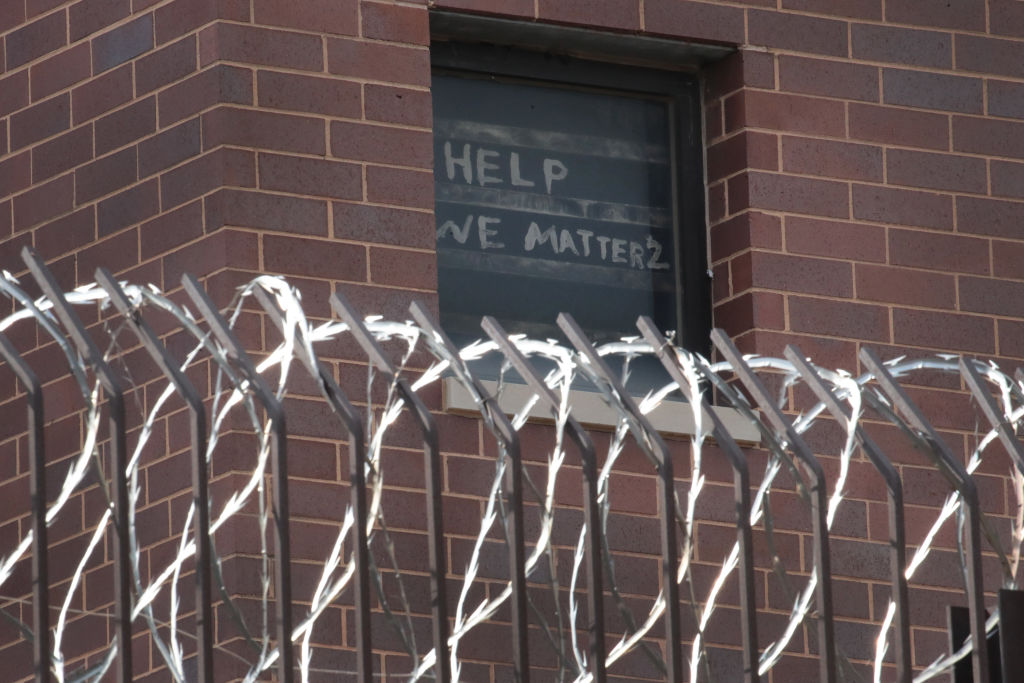
A sign pleading for help hangs in a window at the Cook County jail complex on April 9, 2020 in Chicago, Illinois.Scott Olson / Getty
As activists and prisoners warned, COVID-19 is currently spreading through American prisons and jails, posing grave risks to incarcerated populations and the country at large. A mapping project launched by journalist Adryan Corcione illustrates the scale of the outbreak — hundreds of county jails, state correctional institutions, and federal prisons, each marked by a pin indicating the confirmed or likely presence of COVID-19.
In many places, activists have won emergency releases to help slow the spread of the virus. But as the outbreak accelerates, prisoners are increasingly demanding care and consideration from their wardens — and, very often, facing violent repression for doing so.
In New York City’s Rikers Island jail complex, where hundreds of cases of COVID-19 have been confirmed by city officials, prisoners were recently pepper-sprayed while seeking medical attention. After six prisoners tested positive for the disease in a Washington prison, corrections officers fired rubber bullets into a crowd of a hundred protesting prisoners. Incarcerated people briefly took control of a cellblock in one Kansas prison. And at the Oakdale Federal Penitentiary in Louisiana, where eight prisoners have died as a result of COVID-19, a man was pepper-sprayed and restrained with handcuffs after objecting to being put in a cell with people exhibiting symptoms.