We’re Still Picking up the Pieces of the Last Crisis
After the bank bailouts in 2008, the next stage in the government’s response was to cut spending on public services and lump even greater responsibilities onto private households. The end result was a huge rise in informal and unpaid labor carried out by women — and faced with the current shutdown, the losers from the last crisis are being punished even further.
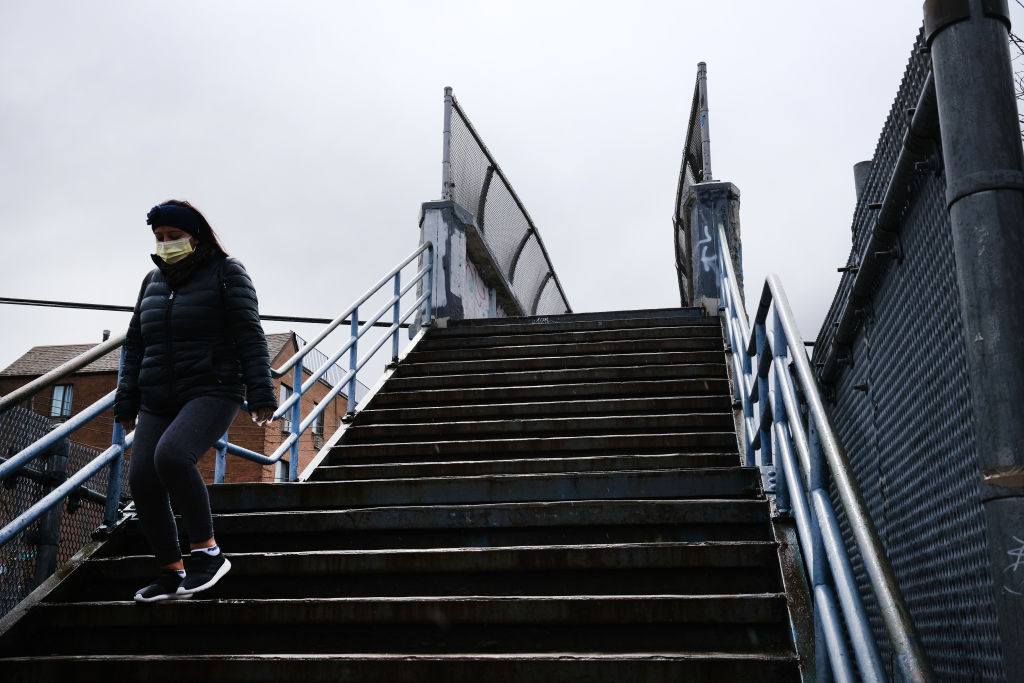
A woman walks through a neighborhood in the Queens borough, which has one of the highest infection rates of coronavirus in the nation, on April 3, 2020 in New York City. (Spencer Platt / Getty Images)
At this point there can be only one priority: to overcome the public health crisis caused by the COVID-19 pandemic. As economist James Meadway has described, in the short term we need the opposite of a war economy — not the public mobilization of resources against a common enemy, but a demobilization in order to avoid spreading the virus. This means multiple crises in the entire circuit of capital. Global production and logistics networks are breaking down, with workers staying at home and goods (except food and basic items) not finding buyers. Without doubt, the depth of the crisis depends on how long it takes to overcome the pandemic. But we need to remember that as the circuit of capital stops, payments and debts will not. There is no way to “pause” the economy in order to press “play” again later. Yet even as capital faces several simultaneous crises, and states come to the rescue with taboo-breaking measures, this does not automatically produce better conditions for the political left.
With financial markets panicking and historically unprecedented increases in unemployment (almost twenty-two million new jobless claims in the United States since mid-March), it is natural to look back to the last crisis in 2008 for a guide on how we can think about the present moment. We can, indeed, learn a lot from it — but we also have to identify the huge differences between then and now. The 2008 crisis started in a particular sector, the financial/real estate sector, and in one country, the United States. Today, we face a crisis that affects all sectors and geographical contexts simultaneously, exposing their interdependencies and the pace of the international economy. If the Left is to present a political alternative, we need to understand the depth and asymmetric impacts of the economic and social crises, to critically appreciate the myriad measures announced around the world, and to present a road map for the political tasks ahead of us.
Not the Same Everywhere
It is almost impossible to predict a decline in GDP in these circumstances, but this crisis has hit an already stagnant international economy, whose mediocre growth has been fueled by record levels of indebtedness among companies, households, and governments — debt exceeds 300 percent of world GDP, having increased by 50 percent over the past ten years. The sudden drop of cash flows in this financialized economy threatens a brutal spiral of bankruptcies, deflation, and unemployment. Just accounting for the immediate effects of containment measures, each month will cost up to 2 percent of GDP for most countries, according to the Organisation for Economic Co-operation and Development (OECD). Investment bank Morgan Stanley projected a 12 percent drop in Eurozone GDP, while Goldman Sachs predicts a 9.9 percent hit to US GDP during this quarter. The cumulative impacts of this contraction will, nonetheless, preclude any quick return to “normal” in the coming months.