This Eurozone Crisis Will Be Even Worse Than Last Time
European Commission president Ursula von der Leyen has apologized to Italy for the EU’s underwhelming response to coronavirus. But faced with economic meltdown, battle lines are hardening between the German-led bloc and the states of the Southern periphery — and the splits are about to become even more irreconcilable.
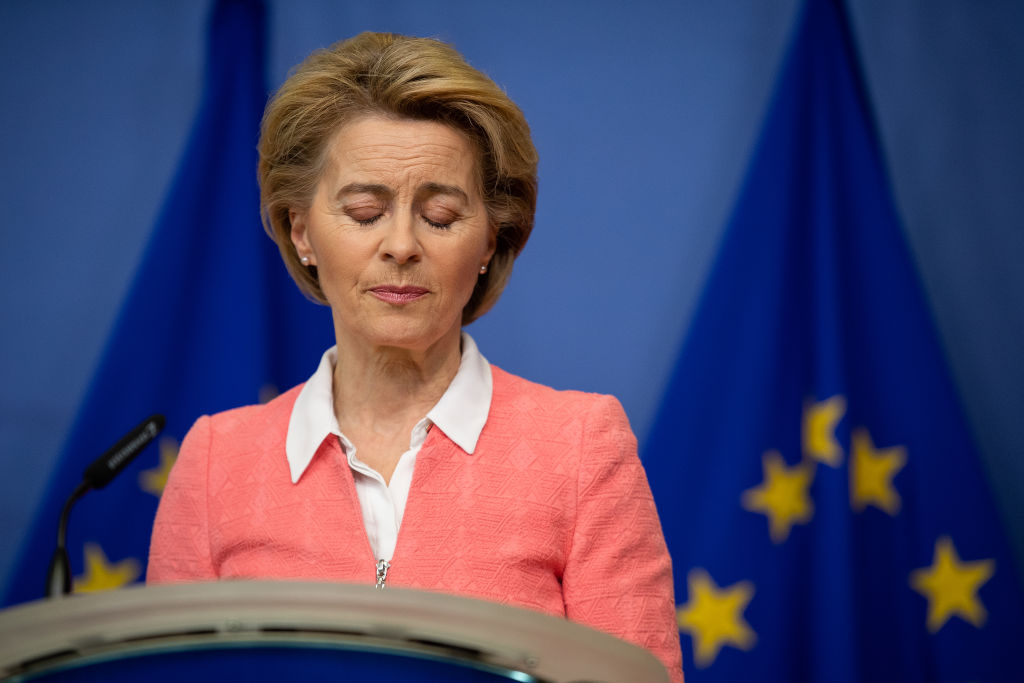
President of the European Commission Ursula von der Leyen holds a press conference at the European Commission on March 4, 2020 in Brussels, Belgium. Leon Neal / Getty
The coronavirus crisis is often compared to a natural disaster, or, as European Commission president Ursula von der Leyen called it, an “external shock” befalling our society from the outside. But pandemics don’t come from nowhere. They develop under social conditions and are associated with specific forms of metabolism between humans and nature. Indeed, this was true even of the first emergence of the current pandemic. Capitalist expansion and land grabbing have promoted the emergence of zoonoses, i.e., infectious diseases that, like SARS-CoV-2, are transmitted between animals and humans. The clearing of forests for industrial agriculture tears down natural barriers, as wild animals with previously unknown viruses are driven out of their habitats and come into contact with livestock and humans.
The comparison of the coronavirus with a natural disaster is even more misleading considering how it has spread globally. This is most obvious in the sense that China’s ever closer integration into the capitalist world market in recent decades facilitated the international transmission of the virus. But COVID-19 rapidly spread to — and through — Europe because austerity policy has severely damaged the health care systems in many countries, particularly in the aftermath of the Eurozone crisis, and because effective measures to contain the virus were taken far too late.
At the beginning of March — even as the EU backed Greece in suspending the Geneva Convention on Refugees in that country’s attempt to seal off its external borders — the European Commission vehemently opposed border closures within the Schengen area (covering most of the continental EU) such as could have contained COVID-19. Apparently, safeguarding the four freedoms (free movement of persons, goods, services, and capital) — the symbolic cornerstones of the neoliberal European single-market project — was seen as more important than a robust containment of the looming pandemic by reducing cross-border travel.