Economic Planning Meets Needs Which the Market Ignores
The COVID-19 pandemic has brought a change of priorities, as states buy up masks and ventilators regardless of the cost. Basing economic decisions on human need, not our ability to pay, imposes a principle of equality — allowing us collectively to decide what kinds of production we really need.
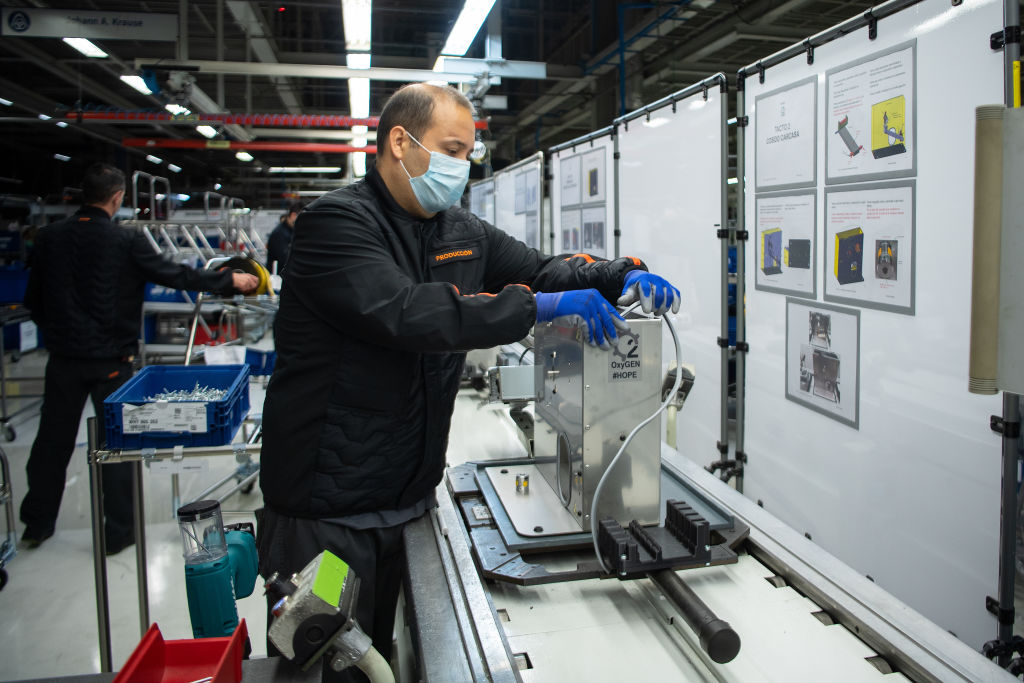
SEAT employees work on the production line making a new medical ventilator named ‘Oxygen’ at the Spanish car maker’s Martorell factory on April 7, 2020 in Martorell, Spain.David Ramos / Getty
During World War I, coal — like bread, meat, and wood — was running low. So when shortages really started being felt in Paris in September 1916, the city council turned to drastic measures. It took direct control of supplies, distributing coal to households based on the size of their apartment and the number of people living there. Families filled out a questionnaire specifying their needs, which were written on ration cards; when they needed coal, they would head to the mairie d’arrondissement (town hall), where distribution took place.
Price control is a common feature of war economies. But faced with the coal shortage in Paris during World War I, things went a step further. The “price signal” on which markets rely was suspended, in favor of accounting in kind — in terms of quantities of coal, not its price.
The amount of coal distributed to households was not based on their solvency, i.e., the money they had, but on what they needed. This form of distribution also made clear that the question of supply was political. With production subordinated to need, private economic agents were no longer free to produce and sell what they wanted. What instead took hold was a principle of equality.