“My SS Uniform Is Just My Heritage”
Each February, Europe’s neo-Nazis converge in Budapest for the “Day of Honor,” a celebration of the SS’s record in Hungary. For years, Prime Minister Viktor Orbán has been erasing all traces of antifascism from the official national history — and now the uniformed marchers enjoy government endorsement.
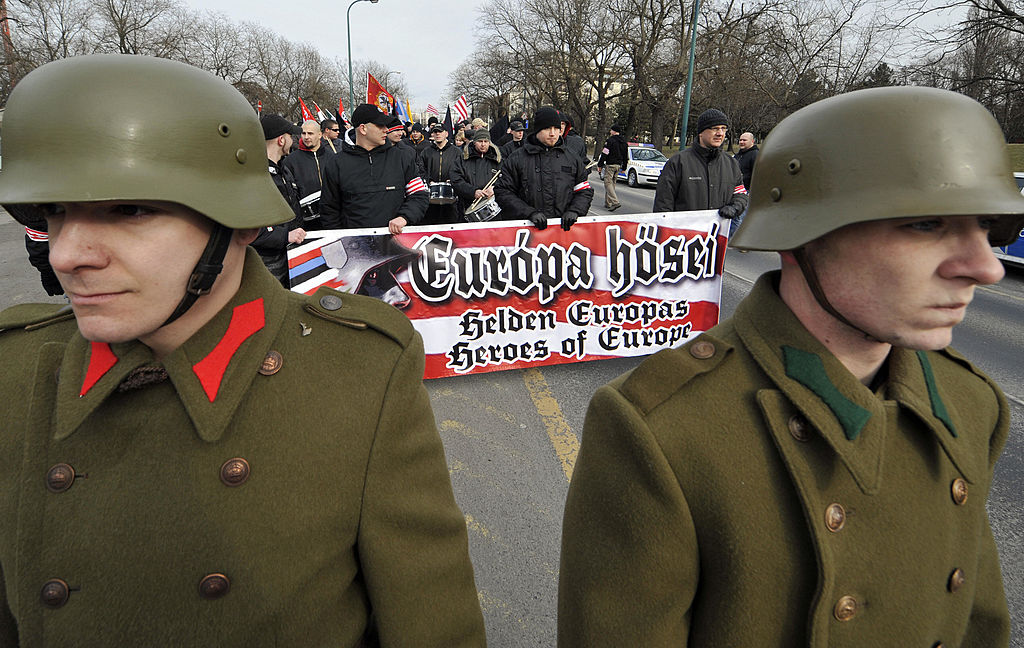
Neo-Nazis marching with their banner of “Heroes of Europe” in Budapest on February 14, 2009. (Attila Kisbenedek / AFP via Getty Images)
In February 1945, the Soviet Army finally defeated the Nazi German forces controlling Hungary, driving them out of Budapest. Hungary had been an Axis power since 1940 and ruled by protofascist dictator Miklós Horthy since the 1920s; in March 1944 German forces occupied the country, before replacing Horthy with Ferenc Szálasi, leader of the Nazi-inspired Arrow Cross Party, seven months later. Both the Axis and Allied powers had long considered Budapest a city of great political and geographical significance. But now, Hitler declared Budapest a “fortress” to be defended at all costs. The Soviets’ entrance into the city thus became an important symbol of Germany’s inevitable defeat — and led to one of the bloodiest battles of World War II.
February 11 was a key date in this battle, coming as it did after a weeks-long siege. Faced with the joint Soviet and Romanian forces’ capture of Buda, the hilly and affluent side of the capital, the SS and Wehrmacht and Hungarian soldiers had built a stronghold in and around Buda Castle, a fortress that sat atop a high hill. Surrounded on all sides, they faced a choice: surrender to Stalin’s army, or starve from lack of supplies. Defying Hitler’s orders, Waffen-SS General Karl Pfeffer-Wildenbruch led an attempted breakout to try to reach German lines. But only a few hundred troops made it — and the Soviet forces killed tens of thousands of German and Hungarian soldiers.
February 11 would have no particular significance over the subsequent decades of Soviet-imposed Communist rule. But after the last Soviet troops left Hungary in 1991, the anniversary acquired a new resonance. This particularly owed to the jockeying for power in the years after the Soviets left Hungary — and the new far-right movements that took form. A neo-Nazi named István Győrkös restarted the Arrow Cross Party and founded a neo-Nazi paramilitary group called Magyar Nemzeti Arcvonal (Hungarian National Front). Győrkös — today in prison — declared himself “Vezető” or “leader,” a title similar to “Führer” or “Il Duce.” In 1997, he plucked February 11 out of the history books as a day of Nazi mourning, naming it the “Day of Honor.”