The City Where British Working-Class History Is Still Alive
UK Labour MP and potential party leader Rebecca Long Bailey has spent her life immersed in Salford and its working-class life. The right-wing British press wants to undermine those politics by attacking the city. But Salford’s history reflects the best of British working-class culture.
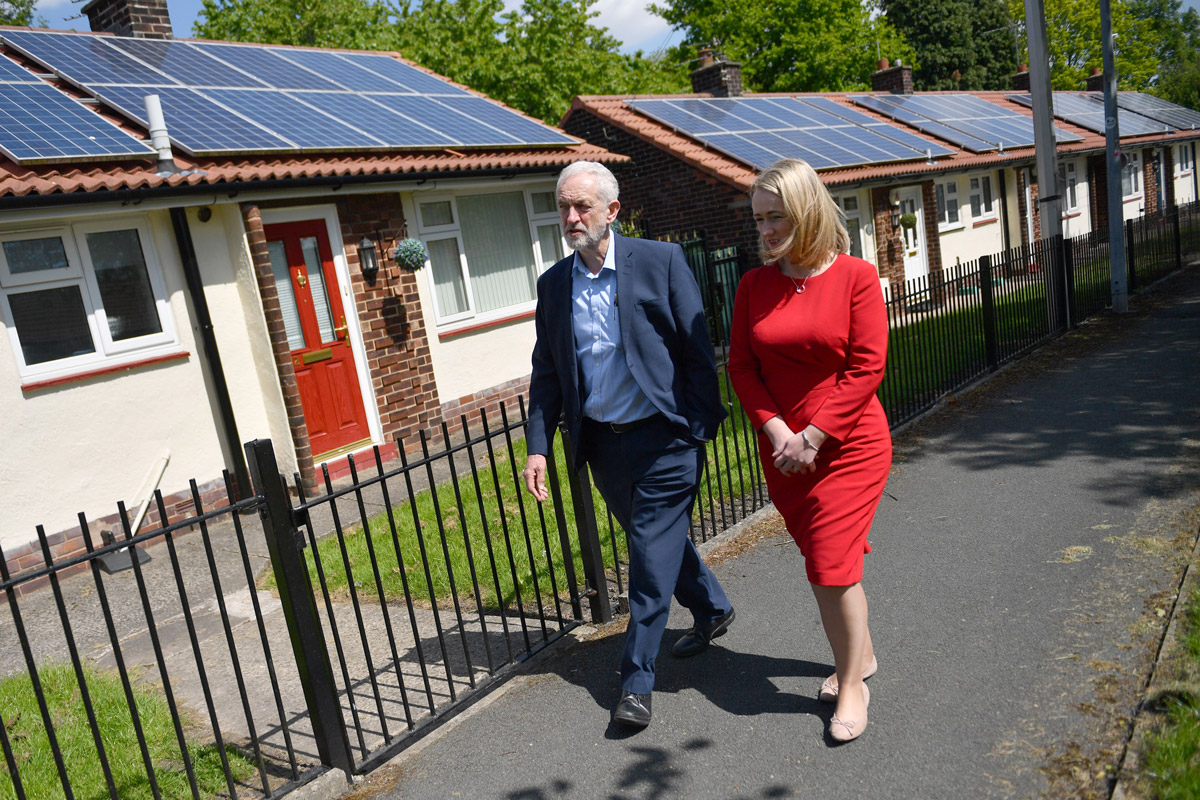
Labour Party leader Jeremy Corbyn and MP Rebecca Long-Bailey view houses with solar panels on Mereside Grove in Worsley on May 16, 2019 in Salford, England. (Anthony Devlin / Getty Images)
If you head down toward The Crescent in Salford, on your way toward Manchester on the A6, you’ll run into a peculiar building. Opposite the Salford Museum and Art Gallery on the dual carriageway stands a mock Elizabethan red brick with gabled ends. Jubilee House was built to mark the Queen’s Diamond Jubilee at the end of the nineteenth century and began life as a nurses’ home, but now it goes by quite a different name: the Working Class Movement Library (WCML).
It is one of Salford’s charming ironies that this building — along with other working-class landmarks such as the Salford Lads Club and the Coronation Street red bricks — was designed by a staunch Tory, Henry Lord. You suspect the vice-chairman of the South Salford Conservative Association might have thought twice about this particular commission had he been aware of its afterlife.
Engineering worker Eddie Frow and his wife, the teacher Ruth Haines, began the WCML in their home in the 1950s. For decades, “Eddie and Ruth” traveled Britain salvaging archive materials from the labor movement, many of which would otherwise have been lost or discarded. By the 1980s, the collection had outgrown their semidetached house, and Salford City Council took on the task of finding a home for it, offering Jubilee House as the location.