A Captive Market
As if locking up mass numbers of people in cages weren’t depraved enough, jails and prisons around the country are now charging prisoners exorbitant fees to read, listen to music, and speak to their family and friends. It’s a gross violation and exploitation of prisoners’ basic rights to enjoy culture and connect with other humans.
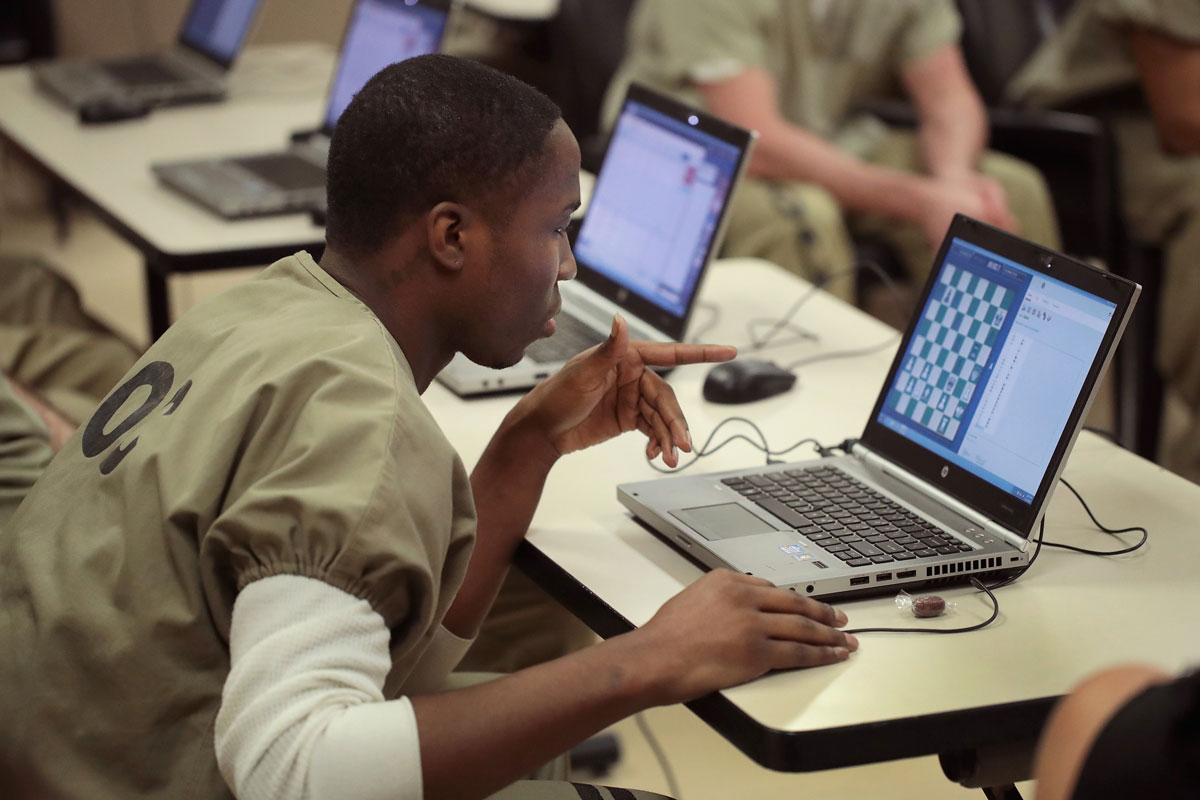
An inmate at the Cook County Jail competes in a chess tournament online on May 17, 2017 in Chicago, Illinois. (Scott Olson / Getty Images)
How much does a copy of your favorite book cost to read by the minute? Maybe you bought it for $10 at the local used bookstore and read a page every three minutes. It seems odd to calculate, but your cost comes out to a small fraction of a penny per minute.
It’s not odd for inmates across the United States, however. Jails and public prisons have teamed up with prison-services firms to charge prisoners to read and learn.
In West Virginia, for example, the company GTL (formerly Global Telcoin, Inc.) recently began providing iPad-like devices to ten prisons in the state. The devices themselves are free and so are the books, which are from Project Gutenberg, an online provider of more than sixty thousand public domain texts. But inmates are charged $0.05 per minute (currently discounted to $0.03) to read the “free” books. At three minutes per page for a three-hundred-page book, that’s $45, as long as they don’t stop to admire an elegant turn of phrase or ponder a passage.