France’s Strikes Show the Unions Are Alive
On the eve of the financial crisis, Nicolas Sarkozy boasted that “when there is a strike, nobody even notices anymore.” But as France mounts its longest strike in decades, organized labor is once again showing its power — and its limits.
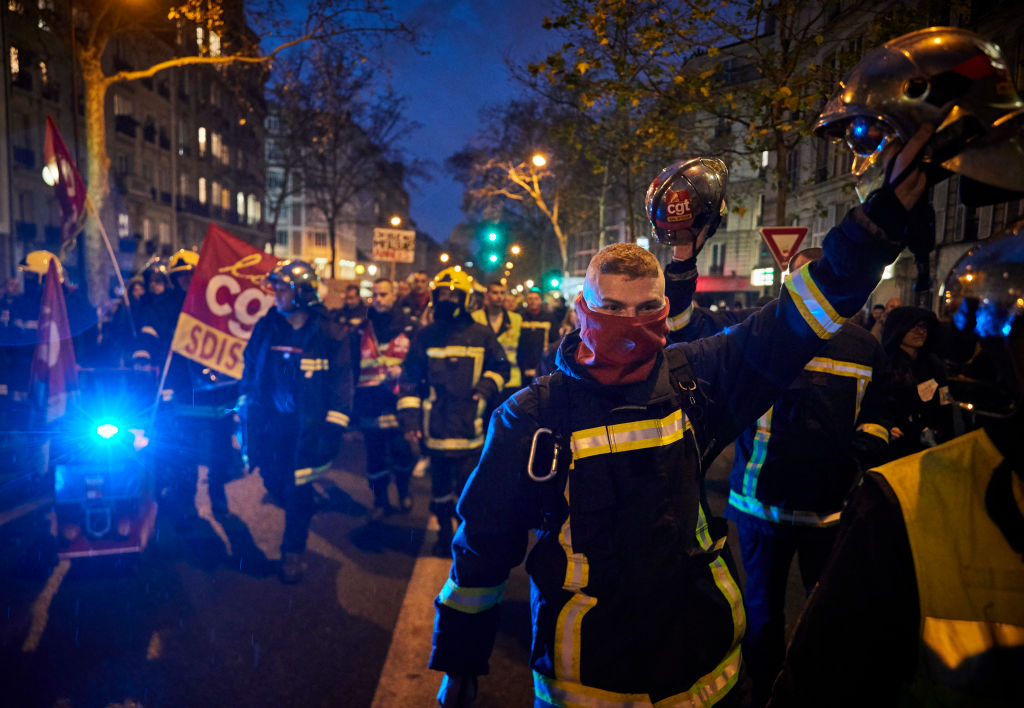
French fireman and members of the CGT union march through the streets of Paris chanting against President Macron as thousands take to the streets in support of the national strike on a crucial day between the government and the unions over pension reforms on December 17, 2019 in Paris, France.Kiran Ridley / Getty
On November 17, 2018, France saw the birth of a movement unprecedented since May 1968, as hundreds of thousands of people mobilized against the fuel-tax hike announced by Emmanuel Macron’s government. While France has historically been a country of protest, this mobilization appeared as something novel, unusual in both its sociological composition and its means of action. The protestors donning their yellow vests — the famous gilets jaunes, which all motorists have to keep in their cars — came from sections of the population rarely mobilized in social movements. They ranged from poor workers to women from working-class households and rural youngsters.
There was a paradox, here. Although the gilets jaunes centrally focused on material concerns — at first glance similar to those raised by trade unions — they were distrustful of traditional labor movement organizations, or even repudiated them outright. Despite lukewarm efforts to establish closer ties, a month after the first protests, and the personal involvement of many individual union activists, the hoped-for convergence never really took place. Today, the gilets jaunes continue to stage fresh “actes” (days of action). But their roundabout occupations have been cleared and their protests each Saturday now rally only a few hundreds of demonstrators here and there across France.
For some, the gilets jaunes movement provided further cause to highlight the weakening and isolation of France’s trade unions. In winning almost €10 billion in indirect wage rises as concessions from Macron’s government, the gilets jaunes made gains that the union confederations have not been capable of for some thirty years. These latter’s sense of humiliation was all the more palpable because it came at the end of a decade of defeats for their own mobilizations. Indeed, the unions’ strategies have invariably seemed ineffective, faced with the neoliberal agenda enforced by a series of different governments, of both Left and Right. In 2008, right-wing president Nicolas Sarkozy could gleefully claim that “when there is a strike in France, nobody even notices anymore.”