“This Strike Is Uniting the Resistance Against Macron”
A government bid to cut back pensions has pitched France into its longest strike in decades. But as one railworker organizer tells Jacobin, the dispute is about more than retirement insurance — it’s about stopping Emmanuel Macron’s whole agenda.
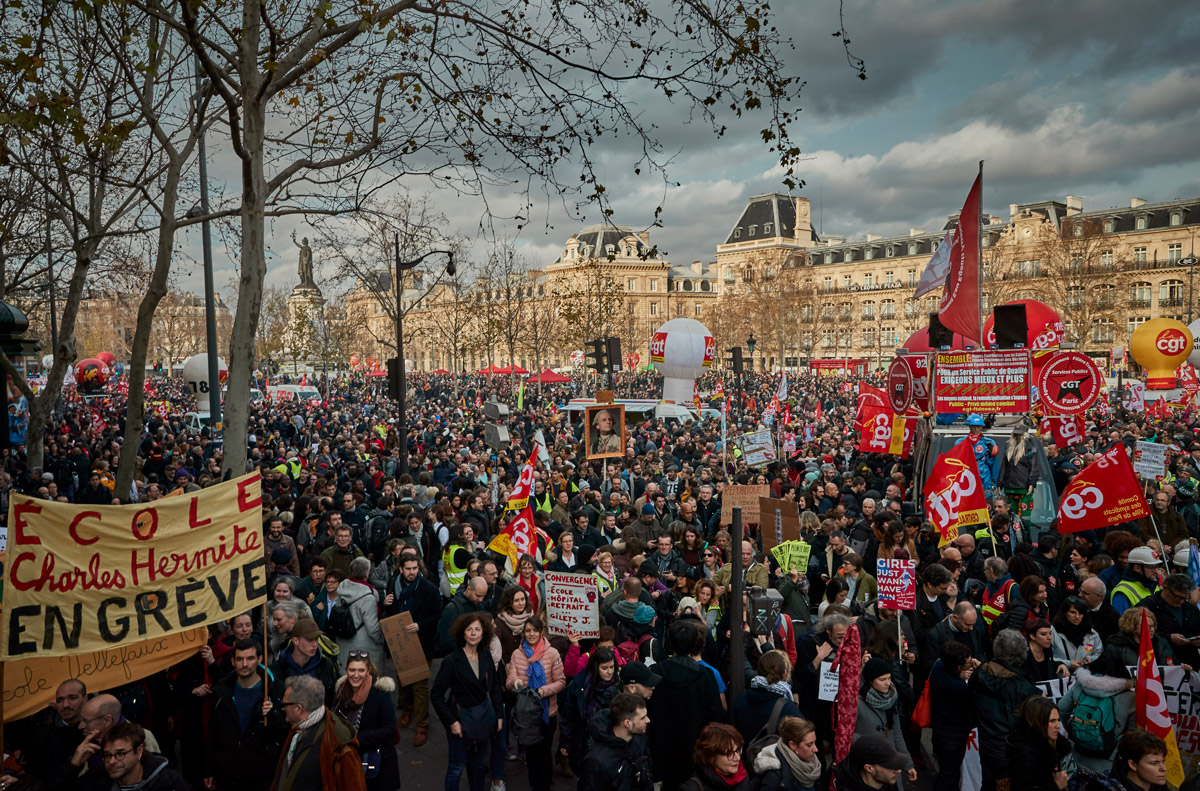
Protesters march at Place de la République as thousands take to the streets over pension reforms on December 17, 2019 in Paris, France. (Kiran Ridley / Getty Images)
It’s over a month since French workers began their strike against planned pension reforms, in what is already the longest such action for several decades. Indeed, the agenda pushed by Emmanuel Macron’s government threatens a severe blow to the welfare state, promising a sharp drop in the value of workers’ pensions, an increase in the full-pension age from sixty-two to sixty-four, and a shift toward private pension funds rather as opposed to public social insurance. Even though striking workers refused a call for a “Christmas truce” — and continued their action through the festive period — they enjoy the consistent support of the general population. Polls show that 75 percent of French people want the plan abandoned in whole or in part and 63 percent back the strike itself. An online crowdfund to support the strike has already raised over €2.3 million.
Beginning on December 5, the strike immediately assumed mass proportions among workers on the RATP (Paris public transport company) and the SNCF (the French national railway company), bringing the almost complete paralysis of the capital’s transport system, as well as cancellations and limited services on high-speed trains across the country. There have also been mass demonstrations, with around one million protesters taking to the streets of towns and cities across France on each of four days of action (continuing on Saturday, January 11). Showing the broad opposition to Macron’s plans, the protesters have come from both the public and private sectors, including teachers, medical staff, lawyers, and even the dancers at the Paris Opera.
Social and political tensions in France have been running high after more than a year of gilets jaunes demonstrations. The ongoing strike relies on more traditional modes of actions and organization, with an industrial action backed up by large-scale demonstrations and local general assemblies. But it has put significant pressure on Macron and his government, whose political credibility has been in free-fall over the past months. While the authorities have promised concessions to some groups of workers, including police, overall Macron’s approach has focused on stigmatizing the strikers — and, as with the gilets jaunes, to deploy brute force to repress their demonstrations.