To Crush Chile’s Popular Uprising, Its Government Is Taking a Page from the Fascist Playbook
In the wake of Chile’s popular uprising, the country’s right-wing government is carrying out a ruthless legal crackdown against all forms of protest. Some call it “law-and-order populism” but there’s nothing populist about it — it’s inspired by the penal practices of twentieth-century fascism.
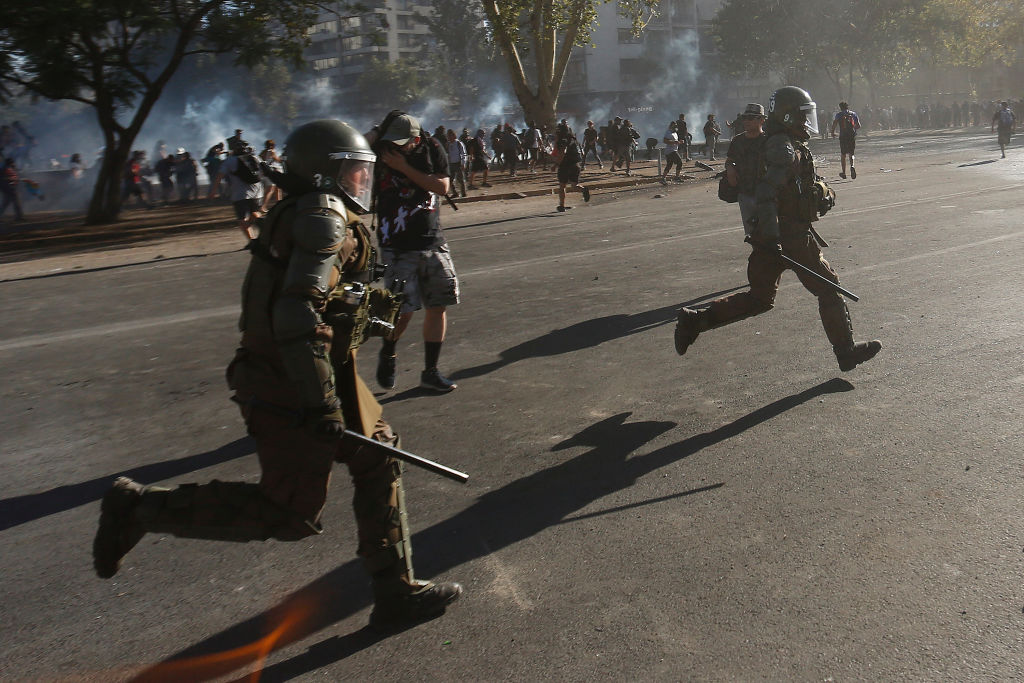
Chilean riot police officers chase protesters on December 27, 2019 in Santiago, Chile.Marcelo Hernandez / Getty
The temptation of representative governments to repress social protest instead of yielding to the demands of a mobilized citizenry is strong. Why would a president satisfy grievances voiced in the street instead of fulfilling his own government program? Why cave to popular pressures instead of allowing ordinary channels of political negotiation and consensus to deliver change? The answer is necessarily contextual: it depends on the degree of legitimacy enjoyed by political leaders and representative institutions. After almost two months of massive mobilizations and brutal repression, polls show 82 percent of Chileans disapprove of President Piñera’s administration, with a whopping 94 percent condemning the government’s actions in dealing with disturbances of public order. Nevertheless, Piñera’s repressive “security agenda” is making steady progress in Congress — which currently enjoys a dismal approval rating of only 4.7 percent — seeking to establish new crimes, increase penalties, and give judges more discretionary power to punish.
The government’s objective in prioritizing security over social demands seems clear: to subdue the popular uprising and prevent future outbreaks of social discontent. New laws would impose mandatory minimums for blocking streets (where mass mobilizations take place), occupying land (which has been central to indigenous territorial struggles), and any type of face covering while engaging in protests. These provisions are not sui generis but build on a legal tradition that finds its roots in fascism and its legal doctrine centered on the internal defense of the state.
Penal Fascism vs. Penal Populism
The government’s security agenda has stirred strong controversy. Some in the opposition have criticized it as “penal populism.” This is of course not the first time that the populist label has been used in a derogatory manner, but in this particular instance the mislabeling obscures the otherwise obvious fascist overtones of the government’s strategy to “pacify” the mobilized citizenry in an attempt to impose an already lost status quo ante.