Chile Can Be a Laboratory of Popular Democracy
The social upheaval in Chile has made it clear that the country’s Pinochet-era, neoliberal constitution must go. But the process of replacing it cannot be a top-down affair. Like the popular assemblies that have carried the rebellion forward, it must be based on democratic mass participation.
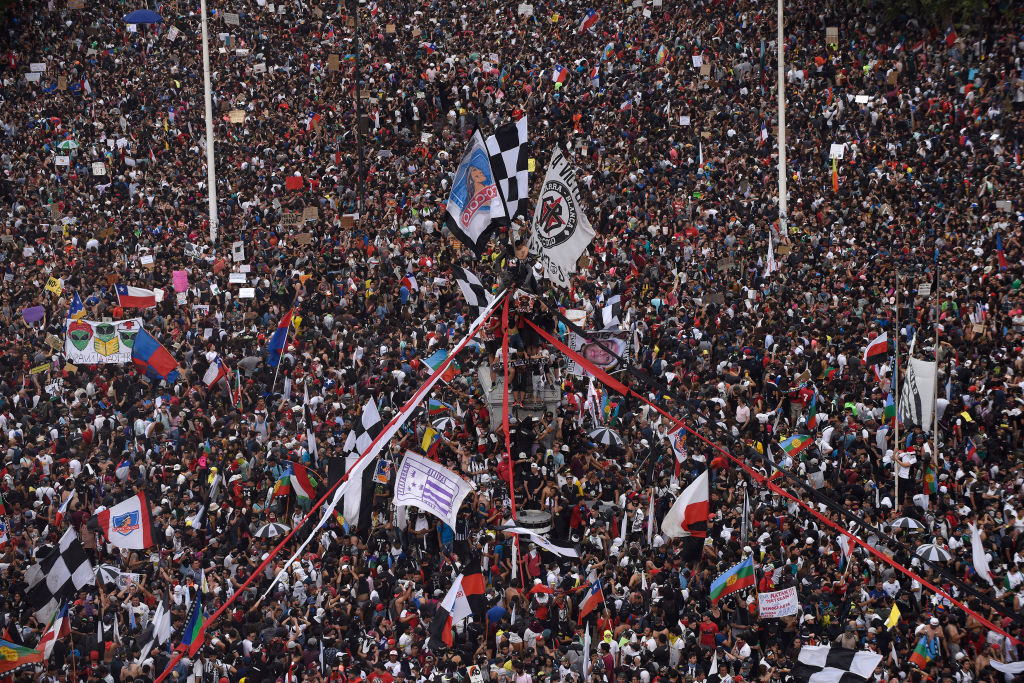
Demonstrators gather in a massive protest at Plaza Baquedano during the eighth day of protests against President Sebastian Piñera’s government on October 25, 2019 in Santiago, Chile. (Claudio Santana / Getty Images)
Chile needs a structural change, a new social pact to erase the mark of the neoliberal dictatorship on Chilean democracy once and for all. Millions have taken to the streets to protest against the neoliberal model, the precariousness of daily life for the non-rich in the richest country in Latin America, the negligence and corruption of the political class, left and right, and also to demand a new constitution.
Although President Sebastian Piñera begrudgingly accepted this reality recently, claiming that “nobody predicted” this popular uprising, the truth is that neither the massive mobilizations nor the demand for a new constitution are surprising. What is surprising is that smart people deluded themselves into thinking that Chile could have been governed by the Pinochet constitution forever, despite its illegitimate, undemocratic origin, its imposition of neoliberal economics and social conservatism alien to the Chilean masses, or its social impact in terms of what the Chilean “miracle” model has produced: great aggregate wealth that has been appropriated mostly by the richest 1 percent, who own more than one-third of the country’s GDP, an indebted and precarious middle class, and a working class living in conditions of poverty.
Although indicators show a steady drop in poverty since 1987, measurements do not cover all aspects of the precarity of life at the edge of poverty, such as dying waiting for surgery due to an underfunded and poorly run public healthcare system. Chileans have been living in a material socio-economic apartheid in which the wealthy and some in the middle classes have access to first-world, even luxurious care at a hefty price, while the rest are stuck with long lines and lack of basic health security in the public system. In Santiago, the epicenter of the popular uprising, inequality hits people in the face on a daily basis. While those who can afford to use private highways can buy themselves shorter commutes, the working classes rely on public transportation or are unable to afford the tolls, and therefore spend long hours stuck in traffic.