Why Naomi Klein Has Been Right
By following the development of global capitalism and international left movements for the past three decades, Naomi Klein has analyzed the world much more clearly than mainstream political observers — and stayed ahead of the curve in proposing bold solutions to fix our most burning problems like climate change.
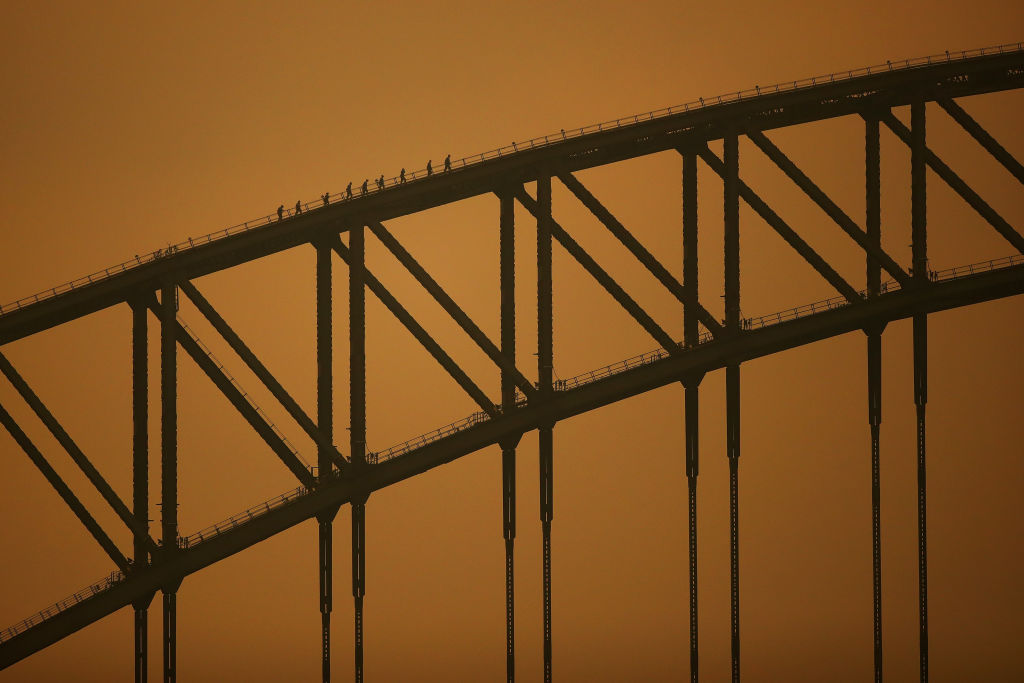
People climb the Sydney Harbour Bridge on December 6 in Sydney, Australia as smoke from raging wildfires blankets the city. (Cameron Spencer / Getty Images)
On Fire: The (Burning) Case for the Green New Deal opens with the image of schoolchildren going on strike for the climate, following the Swedish teenager Greta Thunberg, whose blunt challenges to political leaders around the world have rocketed her to global fame. It’s an opening that reflects the monumental shift in the conversation around climate change over the course of the past year, advanced by young people in particular — from Thunberg’s School Strikes for Climate to the Sunrise Movement’s sit-ins on Capitol Hill to the election of Congresswoman Alexandria Ocasio-Cortez — and the emergence of the Green New Deal (GND) as a central demand.
Yet rather than digging into the events of the past year or arguing for a particular set of policies or programs, On Fire makes the case for the Green New Deal by tracing the evolution of climate politics over the past decade. Setting the recent surge of GND momentum against ten years of Klein’s reporting — on the BP oil spill, the Keystone XL and Dakota Access pipeline protests, and wildfires in British Columbia — serves as a reminder of how much it has taken to get to this point.
In 2011, Klein was protesting the Keystone XL pipeline at the White House. In October 2013, she wrote about the need for “political revolution” in response to increasingly dire climate science, and chronicled its opening flares — people taking action to stop fracking in England, disrupt oil drilling in Russian waters, and sue tar sands companies for violating indigenous sovereignty. Disruptive action, that is, didn’t start with Sunrise or the United Kingdom’s Extinction Rebellion. Even the pieces that narrate her own alarming encounters with a warming world, like her unsettling account of two weeks spent anxiously vacationing on the British Columbia coast in 2017 while forests to the north burned, always turn in the end to politics — a refreshing change from the proliferating genre of anguished meditations on climate doom.