Getting Away with Murder in Northern Ireland
Pandering to ultranationalism, Boris Johnson is seeking to make it harder for the families of those murdered by British soldiers in Northern Ireland to pursue justice in the courts. It’s the latest escalation of the Tories’ hard-right turn on the question of how Britain should confront the legacy of the Troubles.
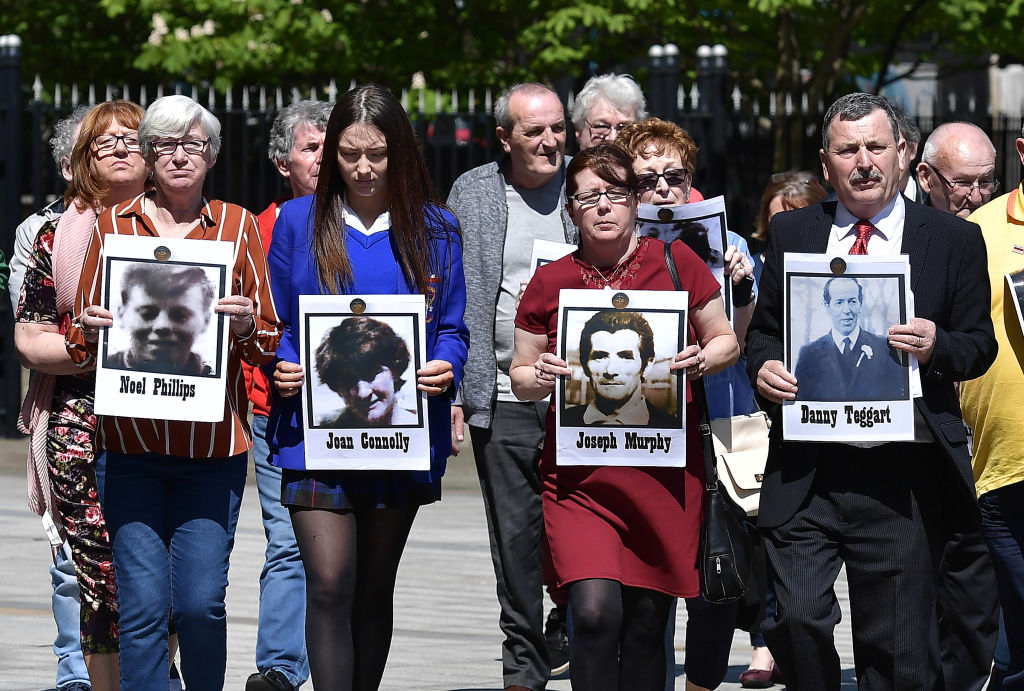
The Ballymurphy family members make their way from court this afternoon holding pictures of their loved ones at Laganside Courts on May 13, 2019 in Belfast, Northern Ireland. Charles McQuillan / Getty
New British parliament sessions always begin with antiquated pomp and circumstance. The doors to the House of Commons are slammed in the face of a figure called “Black Rod,” who raps on the door three times with a staff. Then it opens, and the Queen is ushered in to read a speech prepared by the prime minister and his aides, setting out the new government’s priorities.
Attempting to keep his newly won Tory seats onside, and aware of the fact the National Health Service (NHS) is deemed as important as Brexit to voters, Johnson promised an investment boost to the health service, albeit one that constitutes a mere 40 per cent of what is actually needed. Johnson naturally included a ritual insistence that the United Kingdom will leave the European Union on time.
But other throwaway mentions are far more troubling. The Queen’s speech included a commitment to end “vexatious claims” against the armed forces. This was a clear attack on the multiple court cases currently underway regarding extrajudicial killings in the North of Ireland. It has taken decades for the families of those murdered by British soldiers to bring their cases to court, blocked at every turn in their pursuit of justice.