“If You Have Border Installations, People Will Shoot at Them”
Fifty years since British troops were deployed on the streets of Northern Ireland, the peace process is again in danger. The turmoil surrounding Brexit has raised hopes of Irish unity — but also risks a fresh descent into violence.
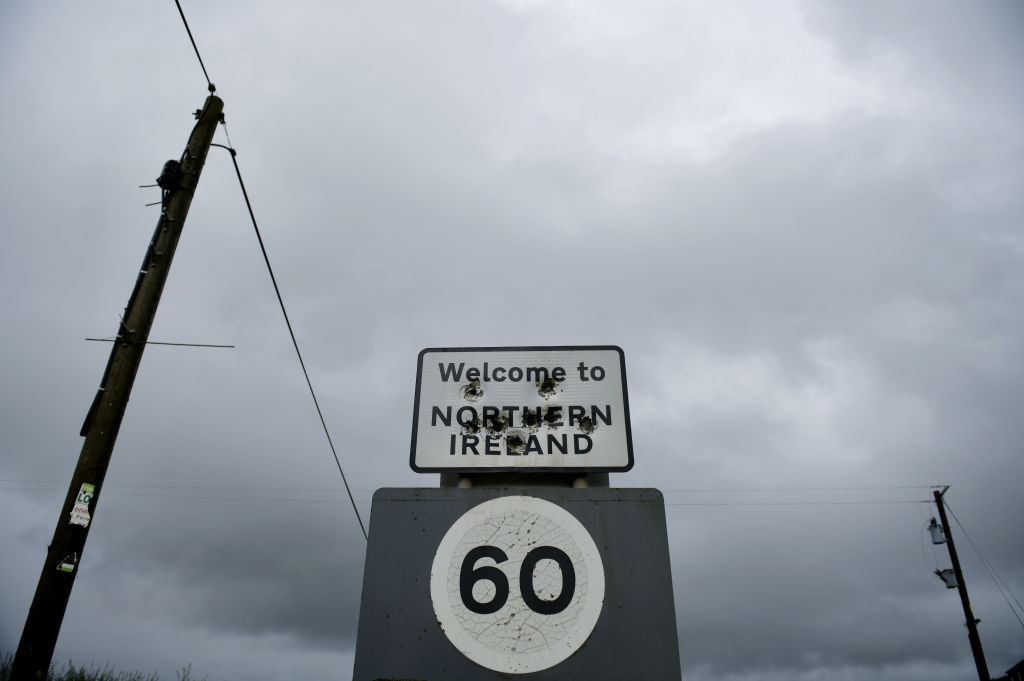
Bullet holes mark a “Welcome to Northern Ireland” sign post that denotes the Irish border on July 22, 2018 in Derrylin, Northern Ireland.Charles McQuillan / Getty
The crisis over Brexit has catapulted Northern Ireland into the headlines once more. Home of the United Kingdom’s only land border with the European Union, the need to avoid customs checks on goods entering the rest of Ireland has been a key plank of the EU’s Brexit negotiating agenda — and the biggest single obstacle in the United Kingdom’s efforts to exit the bloc.
This difficulty has also increased the sway of Northern Ireland’s ultraconservative Democratic Unionist Party (DUP) in Westminster. Key to propping up Tory governments since 2017, the DUP stands sharply opposed to customs checks on boats crossing the Irish Sea — the obvious alternative to a “hard” inner-Irish border. While recent weeks have seen talk of the DUP moderating its position, it continues to bind the government’s hands.
Yet even as the DUP takes center stage in London, Northern Ireland’s own devolved institutions — and the peace process that began with 1998’s Good Friday Agreement — remain in crisis. Just months after the Brexit vote, the cross-community power-sharing agreement broke down, as the DUP and Sinn Féin proved unable to form a new government. This has sparked a nearly 1,000-day standoff, in which Northern Ireland has been left without an executive.