Northern Ireland’s Nurses Are Striking for Their Patients, Too
The UK’s Royal College of Nursing hasn’t organized a single strike in its 103-year history. Now that’s changing as nurses across Northern Ireland take industrial action in response to years of neglect of the National Health Service.
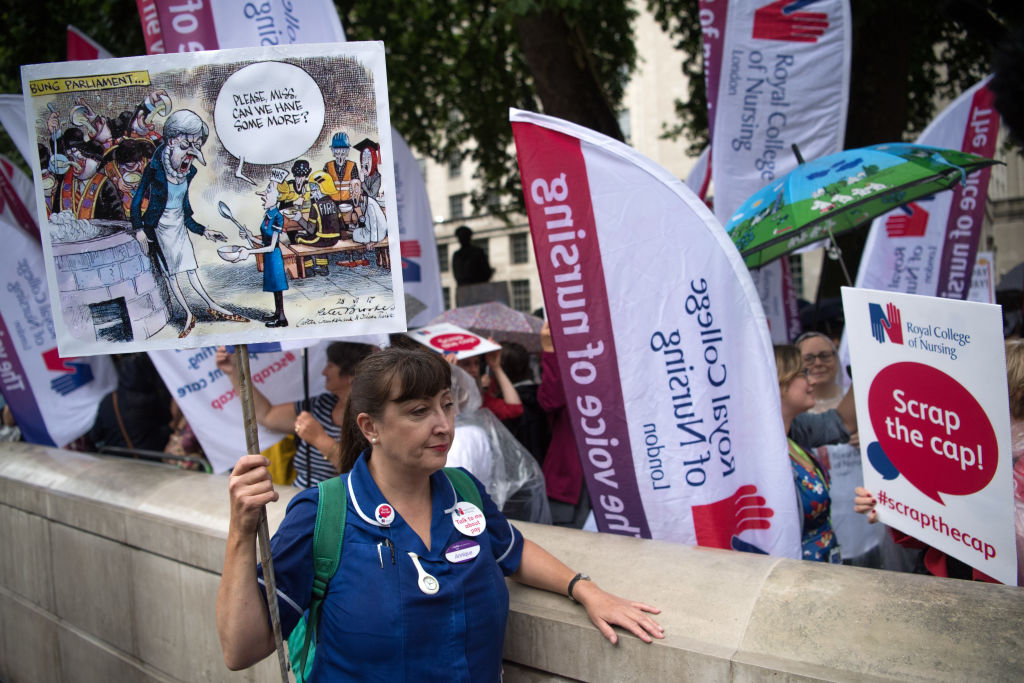
A nurse from the Royal College of Nursing holds a placard during a protest outside Downing Street on July 27, 2017 in London, England. Carl Court / Getty Images
Founded in 1916, the Royal College of Nursing (RCN) can lay claim to be the world’s largest trade union centered on nurses. With 435,000 members in the United Kingdom — from registered nurses and midwives to health-care assistants and nursing students — today it’s wielding its strike prerogative for the first time in its 103-year history. It’s made this choice in far from ideal circumstances — and yet with the National Health Service (NHS) under pressure, the decision for defensive action comes not a moment too soon.
On November 7, after a ballot lasting four weeks, nurses in Northern Ireland voted in favor of industrial action set to commence on December 3. After four months of abortive negotiations with Northern Ireland’s devolved Department of Health, the consensus was nigh on unanimous. Some 96 percent of those who took part voted in favor of industrial action; 92 percent voted for a strike.
But why take action now, right on the cusp of a period when the health service faces its busiest time of the year? It’s a textbook case of critical mass in action. Indeed, for the Department of Health, the writing isn’t so much on the wall as it is scrawled across every bedless ward and overstretched waiting room throughout Northern Ireland.