Chileans Have Launched a General Strike Against Austerity
Chile is the original home of neoliberalism, first begun after the overthrow of President Salvador Allende in 1973. If you listen closely to mass protests on the streets today, you can hear Allende's last words: “The people must defend themselves.”
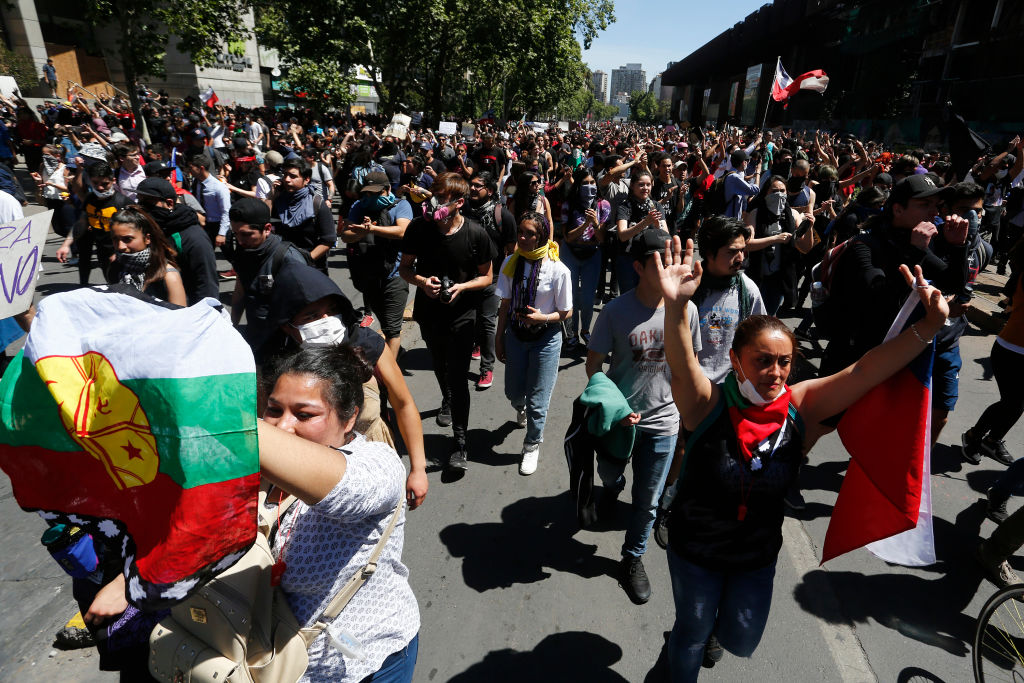
Demonstrators wave flags during a protest against President Sebastian Piñera on Monday in Santiago. (Marcelo Hernandez / Getty Images)
In Chile’s main cities, armed forces and tanks are filling the streets. But civilians are holding their ground, refusing to abandon public space. Official reports indicate eleven fatalities so far, though there are indications that the number is higher. The president has taken to national television to announce that the country is “at war with a powerful enemy who is willing to use violence without any limits.” There are blackouts all across the country. This is October 2019, but it could just as easily be 1973, when socialist president Salvador Allende was overthrown in a coup, replaced with dictator Augusto Pinochet.
Last Saturday, the right-wing president, Sebastían Piñera, decreed a curfew in Santiago that would soon extend to other regions and cities across the country. He has since granted expanded powers to the chief of the national armed forces, Javier Iturriaga, who he has charged with reestablishing order. In this state of emergency, Piñera has effectively banned the right to assembly — a measure not seen since the days of Pinochet.
Despite these strongman measures, a pluri-national (in recognition of Chile’s indigenous communities) general strike is now in full swing across the country. A new day of mass protests is expected tomorrow.