It’s Still Netanyahu’s Israel
Over the past decade, Benjamin Netanyahu has remade Israeli politics in his own image. Though his career now hangs by a thread, his legacy of far-right pandering and cold-blooded “management” of Palestinian oppression will live on.
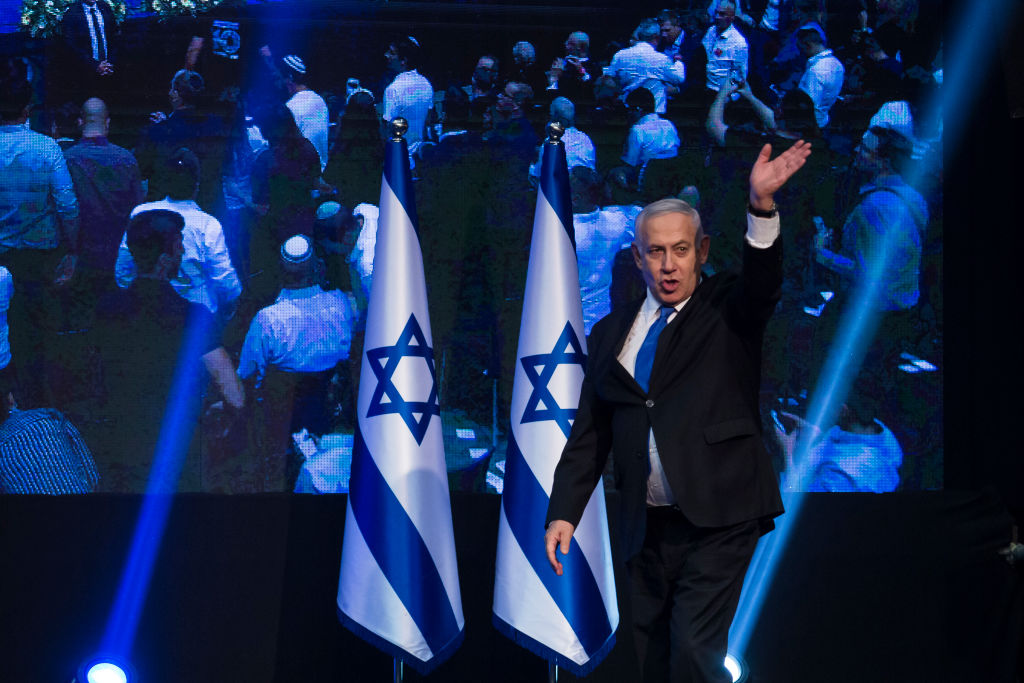
Israeli prime minister Benjamin Netanyahu greets supporters as he enters the Likud Party after-vote event on September 18, 2019 in Tel Aviv, Israel. (Amir Levy / Getty Images)
Last week, for the second time in six months, Israeli president Reuven Rivlin asked Benjamin Netanyahu to form a government. This time, however, the task facing the man they call “King Bibi” is even more difficult, having lost his Knesset majority to his rival Benny Gantz. Gantz, a hawkish ex-IDF general, heads the center-right Blue and White party, which equaled Likud’s vote share in April’s election before narrowly beating them last week. With the parliamentary math failing to support any simple majority, both parties signaled their willingness to form a unity government. However, Netanyahu refused to relinquish power altogether, and Gantz rebuffed his offer to rotate the premiership, citing Netanyahu’s looming corruption indictments. In the absence of a viable Likud–Blue and White coalition, it was the minute numerical advantage of Netanyahu’s electoral bloc (56 to Gantz’s 55, with 61 needed for a majority) that convinced Rivlin to approach him first.
At first glance, the situation looks intractable. Netanyahu’s most natural path to government goes through Avigdor Lieberman, the loudmouthed leader of the right-wing Yisrael Beiteinu party. Lieberman is a distinctively Israeli creation, a settler-politician as virulent in his hatred toward Israel’s ultra-Orthodox as he is toward the Palestinians. His nine seats would put Likud comfortably into a majority; Netanyahu’s problem is that it was Lieberman who prevented him from forming a government in April, by refusing to sit in coalition with the ultra-Orthodox party Shas. Barring a stunning abdication of principle, Yisrael Beiteinu is a dead end.
Alternatively, Netanyahu may appeal to one of the centrist parties currently affiliated with Gantz, or he may try to pry a sufficient number of defectors from within Blue and White. These schemes will be amply supported by lurid talk of the Iranian menace and promises of annexation of the West Bank, though if they fail — and it’s likely they will — the future will once again be up to Rivlin’s discretion. Whether or not he subsequently recommends Gantz depends on the latter’s ability to command a unity government, as Blue and White otherwise has no path to a majority that doesn’t include both Lieberman and the Arab parties. If Rivlin refuses to recommend Gantz, or if Gantz is unable to persuade a sufficient number of Bibi loyalists to anoint him leader, Israel will head to a third election after the New Year. (In a bleakly comic way, this may be the best outcome for Palestinians, as it would deprive Israel of a functioning government until at least April.)