When Politics Becomes Professional
All successful movements need leaders, elected officials, and, yes, even bureaucrats. The key is to remember the radical roots of those bureaucracies and leaderships — so they can sustain instead of squelch socialist politics.
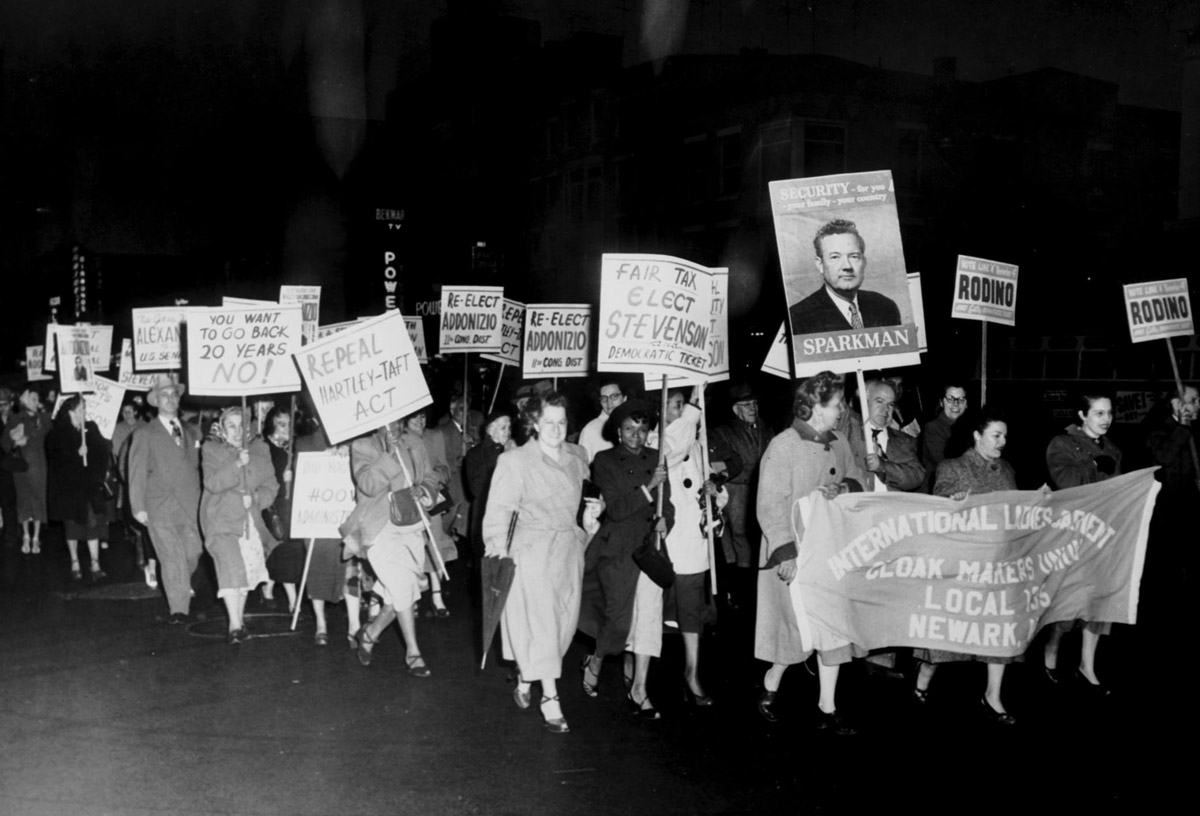
Protesters march as they carry signs reading “Repeal Taft-Hartley Act.”
The historian Josh Freeman has an excellent review of Michael Walzer’s Political Action, which came out in 1971 but has been reissued by NYRB Books. Freeman compares Walzer’s short pamphlet to the Manual of Practical Political Action, another how-to political guide, prepared in 1946 by the labor movement’s National Citizens Political Action Committee (NCPAC), one of the first modern PACs. Both texts were written at moments of political deceleration, when the velocities of change were about to alter dramatically or already had.
But here’s what Josh says about that earlier moment that’s relevant for today:
For NCPAC . . . organizing requires strategies that are not inherently progressive. Somewhat apologetically, the Manual suggests borrowing techniques from commercial advertising, presenting detailed guidance, much of it derived from standard business practices, about newspaper advertising, radio spots, and direct mail. The Popular Front from which it had emerged well understood the mechanics of persuasion, with one foot in working-class movements and another in the creative professions, from theater to cinema to advertising and the graphic arts. The idea of organizing as a politically neutral enterprise requiring specialized knowledge has had a long afterlife. Perhaps its most influential reincarnation was through Saul Alinsky and his many followers. Glimpses of it can be seen in Barack Obama’s account of his community organizing days in Dreams from My Father.
But, of course, technique goes only so far. For all its meticulous cataloging of knowledge needed for effective organizing, from billboard advertising rates in thirty different cities to how to use skits to enliven meetings (include ones written by Arthur Miller about inflation and civil rights), NCPAC got creamed in the 1946 congressional elections. The Republicans, campaigning against the New Deal, organized labor, prices increases, and the ineptitude of the Truman administration, won control of both houses of Congress for the first time since 1930. Among other things, the Democratic defeat opened the door to the passage of the Taft-Hartley Act, the beginning of a rollback of labor power that has continued ever since.