The Red Scare Deformed the New Deal by Purging Its Radical Civil Servants
The New Deal brought a generation of leftists into the federal government. But Red Scare anti-communists purged these radical bureaucrats or forced their politics rightward — blocking more far-reaching reform and distorting our understanding of the New Deal.
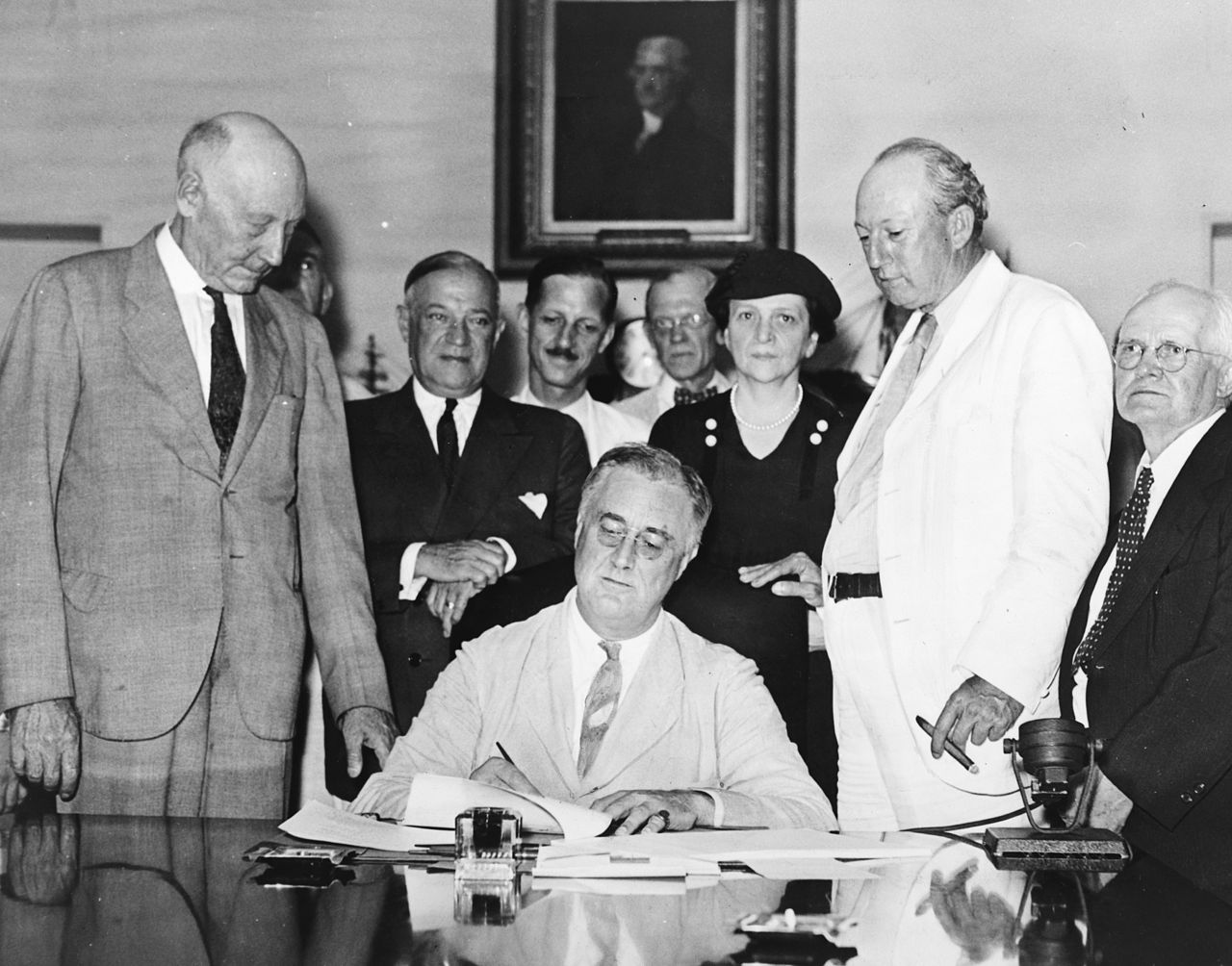
President Franklin Delano Roosevelt signs Social Security Act, August 14, 1935. (Social Security Online via Wikimedia Commons)
Many accounts of the New Deal, whether told from a liberal or a radical perspective, paint it as fundamentally pro-capitalist. The project’s architects sought to save capitalism from its excesses and reform the system so that more extreme alternatives — fascism on the Right, communism on the Left — did not take root. Once economic prosperity and political stability were restored post–World War II, New Dealers’ incentive for further reform disappeared.
But this story is partially accurate at best. In fact, many people who joined the Roosevelt administration at high levels in the 1930s were radicals who viewed the New Deal as a chance to empower labor, reorient the economy around democratic priorities rather than the profit motive, and advance the interconnected causes of racial, gender, and economic equality.
As early as the late ’30s, conservatives attacked many of these radicals as communists and subversives and undercut the most ambitious New Deal efforts, as historian Landon R. Y. Storrs details in her 2012 book The Second Red Scare and the Unmaking of the New Deal Left. Eventually, much of the New Deal left was either forced out of government or, likely bowing to anti-communist hysteria, moderated their politics to remain eligible for government service.