Forget Your Middle-Class Dreams
When it comes to workplace organizing, there's no such thing as a “privileged” worker. You’re either with your coworkers or you’re against them.
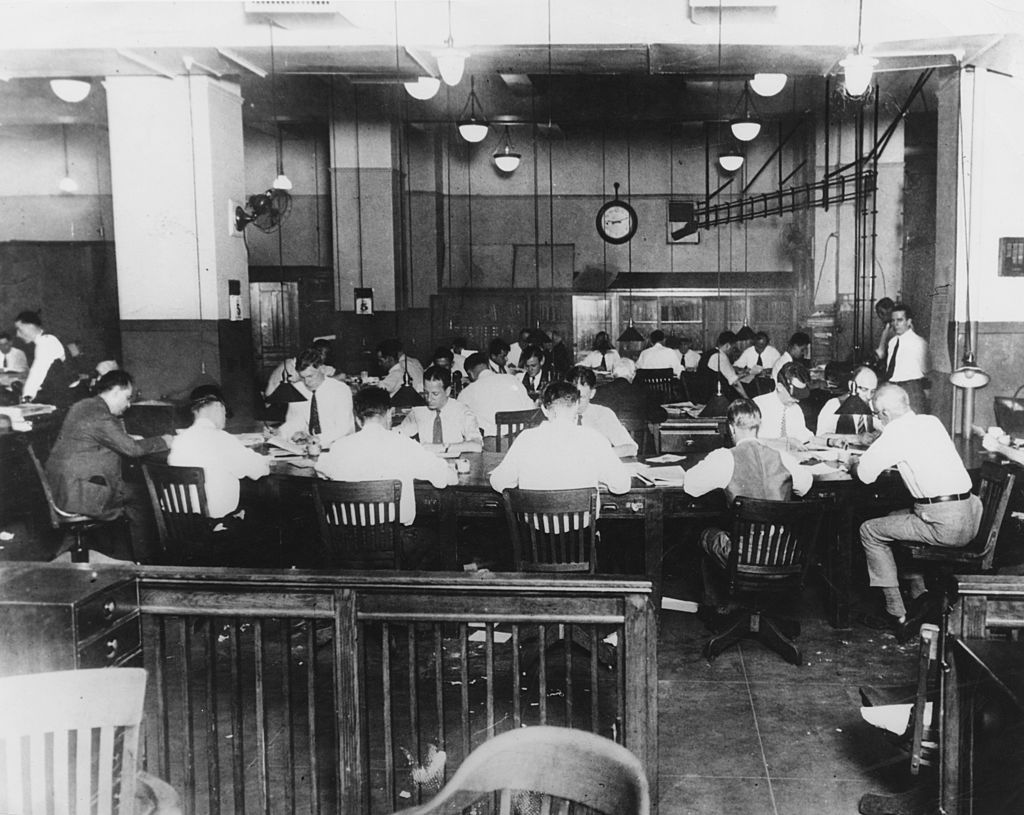
Journalists at work in a news office, circa 1930. James W. Welgos / Archive Photos / Getty
In 1932, a group of left-wing intellectuals formed the League of Professional Groups for Foster and Ford, a campaign to back the Communist Party’s William Z. Foster and James W. Ford for president and vice president, respectively. Toward this end, the League produced a pamphlet, titled Culture and the Crisis: An Appeal to the Writers, Artists, Teachers, Physicians, Engineers, Scientists, and Other Professional Workers of America. In it, they appealed to these “brain workers” to join “muscle workers” in the fight for a new world. Noting white-collar workers’ immiseration — “There are teachers in the bread lines, engineers patching the sheet-iron sheds in the ‘Hoovervilles’” — the pamphlet articulated a dividing line for this group. Their choice was “between serving either as the cultural lieutenants of the capitalist class or as allies and fellow travelers of the working class.” There are two sides, it argued. Pick one.
Although Foster and Ford did not go on to win the election — they received 102,785 votes — the pamphlet marked an early theorization of white-collar workers’ class position in the United States. Michael Denning, in his book on the era, designates the pamphlet as ground zero of US Western Marxism. Considering their own place within a stratified capitalist society, the authors behind the pamphlet pointed the way forward: white-collar workers — as evocative an image as “brain workers” is, it’s a fib to pretend manual labor doesn’t require a brain, so the phrase will have to remain lost to history — should be allies and fellow travelers of the working, industrial class.
But if selling one’s labor for a living, being compelled to do so by the threat of starvation and to keep a roof over one’s head, makes one a worker (at least, so long as one does not have disciplinary power over other workers, which complicates the matter) then why, exactly, don’t the teachers and engineers count as actual workers, rather than merely their allies? As it turns out, it didn’t take long for one of the pamphlet’s signatories to argue exactly that. Rejecting the earlier formulation, Lewis Corey, in his 1935 The Crisis of the Middle Class, argued “the mass of lower salaried employees and professionals are not ‘allies’ of the working class, they are part of the working class and its struggle for socialism” because of their “economically proletarian condition” and “the necessity of their labor under socialism,” among other things. While these workers may not have it as bad as blue-collar workers, that’s irrelevant. At the will of capital, they labor, they hunger, they sweat. Thus, they’re workers.