Vetoing Podemos
Spanish MPs voted down Pedro Sánchez’s investiture last Thursday, as Podemos refused his threadbare coalition deal. Yet it’s the radical left party whose strategy now hangs in the balance — and it may be forced into a humiliating climbdown.
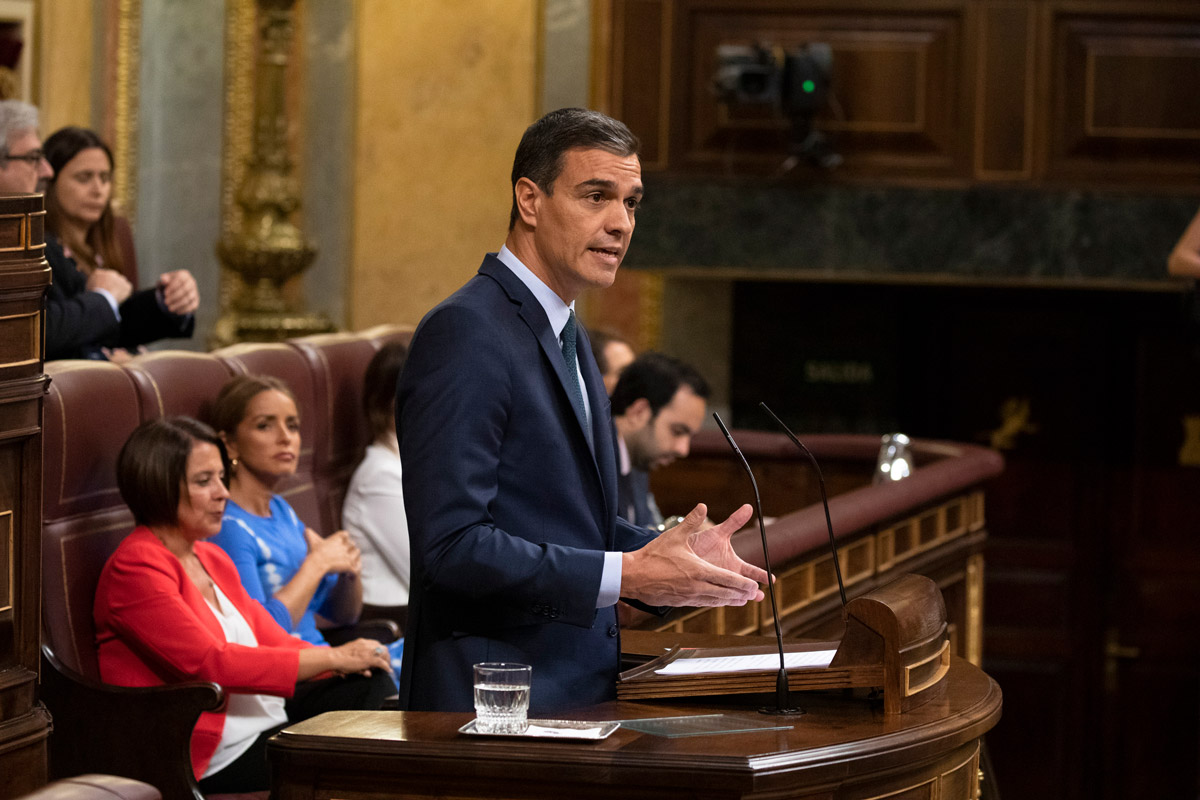
Acting Spanish prime minister Pedro Sanchez speaks during the third day of the investiture debate at the Spanish Parliament on July 25, 2019 in Madrid, Spain. (Pablo Blazquez Dominguez / Getty Images)
Nearly three months after the Spanish general election, the country remains without a permanent government. Interim premier Pedro Sánchez’s center-left Socialist Party (PSOE) had been the big winner in April’s poll, securing a six-point victory over its nearest rivals and increasing its representation in the 350-member Congress from 85 seats to 123. For the New York Times, the result had converted the 47-year-old economist Sánchez into “the unlikely standard-bearer for a Socialist movement that has crumbled in countries like France, Italy, and most recently Germany.” Yet having failed to form a majority in parliament, last Thursday Sánchez lost the vote for investiture as prime minister.
The momentum generated by the PSOE’s election win has largely been squandered over the last three months, a period of institutional deadlock in which Sánchez has engaged in a war of attrition with his political rivals. Unwilling to govern against the country’s economic elites or ruffle feathers among the European powers, the PSOE man’s maneuvering has had the clear aim of neutralizing the radical left party Unidas Podemos’s influence in any new governing arrangement.
Last week, it looked like the situation might be shifting. The PSOE finally abandoned its veto on cabinet representation for Podemos, thus raising hopes of Spain’s first left-wing coalition since the Second Republic in the 1930s. Interviewed for Spanish television, Sánchez, however, insisted this concession would depend on Podemos leader Pablo Iglesias renouncing his own demand for a ministerial role. Launching an extraordinary attack against the leader of his potential coalition partner, Sánchez justified this exclusion in terms of Iglesias’s stance on the Catalan independence crisis. With a verdict on the Catalan leaders’ trial for sedition due in September, Sánchez declared he needed “a deputy prime minister who defended Spanish democracy — who said the rule of law existed . . . and that there were no political prisoners [i.e. in Catalonia] jailed for their ideas.”