A Musician for the Class Struggle
Italian composer Luigi Nono’s career told the story of European communism writ large: brash and revolutionary at the height of the 1960s and ‘70s, reflective and uncertain as the Italian Communist Party collapsed and the possibility of radical change receded. His life is a reminder that no artist is free from the politics of our time.
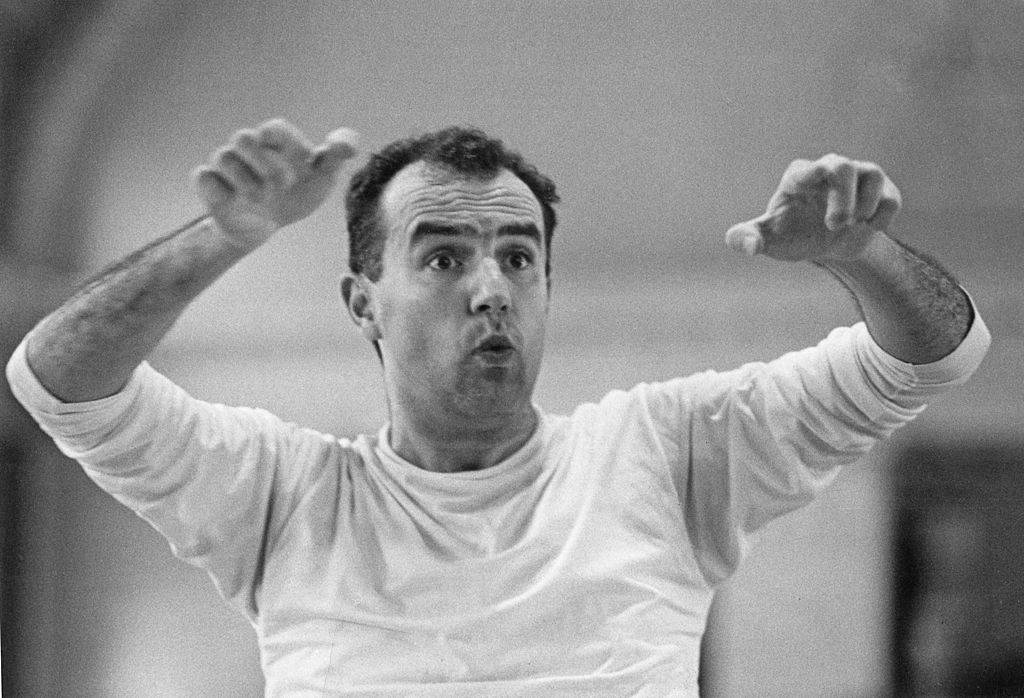
Italian composer Luigi Nono conducting his piece “Canti di vita e d’amore: sul ponte di Hiroshima” in rehearsal at the Royal College of Music, London, September 7, 1963.Erich Auerbach / Hulton Archive / Getty
In late 1961, the German composer Hans Werner Henze was conducting the third staging of his brand new opera, Elegy for Young Lovers, in Munich, West Germany. An old friend of Henze’s was sitting in the audience. However, halfway through the first act, the friend suddenly rose and loudly forced an entire row to stand so that he might leave. This man was Luigi Nono, world-famous composer and member of the Italian Communist Party (PCI).
In his autobiography, Henze recounts an after-party where Nono, when questioned on his behavior at the concert, violently overturned a table, smashing expensive china in the process. Henze ponders Nono’s angry response to his opera and eventually expresses total ignorance of the reason. But as an old friend, Henze must have been aware of Nono’s issue: Elegy lacked explicit and contemporary political content.
Given Nono’s life and work, his reaction, melodramatic as it was, makes sense. He was a committed antifascist and communist who had spent years developing a theory and practice of revolutionary art-making. Watching Henze, a fellow communist and PCI member, stage an apparently politically neutral opera was galling to Nono, especially given the historical context.