The Worrying Rise of Spain’s Far Right
In today's general election, Spain’s far right Vox party is set to enter Congress for the first time. And it’s already building alliances with the mainstream center-right.
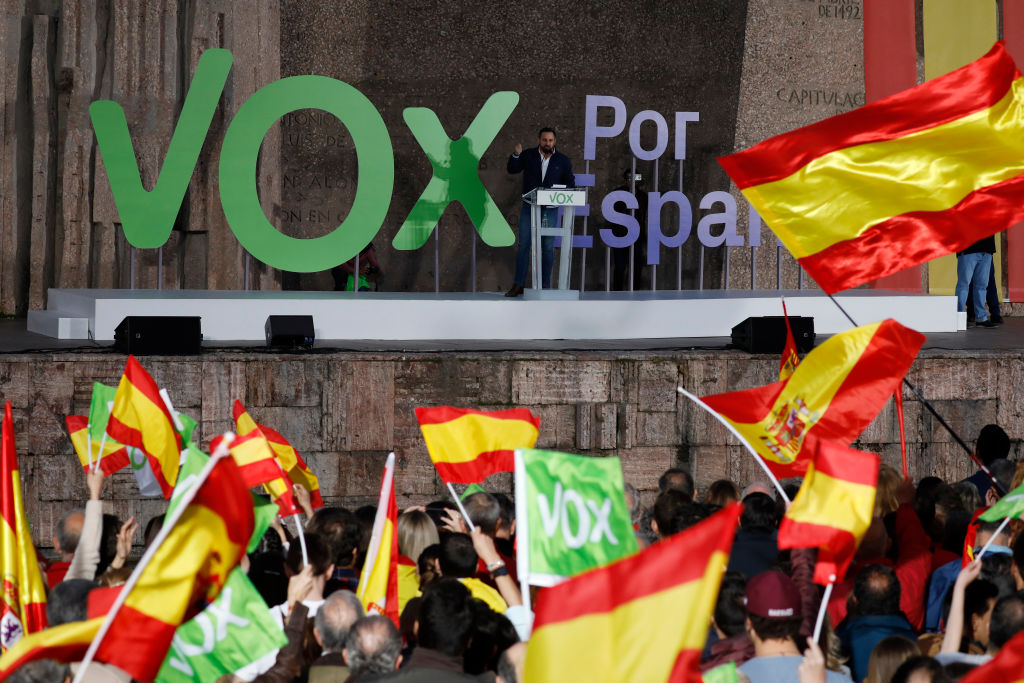
Leader of far-right party Vox, Santiago Abascal, takes part in the Vox closing rally on April 26, 2019 in Madrid, Spain.Pablo Blazquez Dominguez / Getty
Discussions of Europe’s rising national-populism in recent years often took Spain as something of an exception. It was asked how come this was the only major country in continental Europe where no far-right force had managed to enter parliament. In other liberal democracies, notwithstanding the deep antifascism inherited from 1945, so-called “post-fascist” forces had managed to elect MPs and conceal or prettify the ideology that once bled the old continent dry. Yet Spain seemed different.
Up until 2018, this country had no equivalent to hard- or far-right forces like France’s Front National, Germany’s Alternative für Deutschland, the Dutch Partij voor de Vrijheid, Italy’s Lega, or UKIP in the United Kingdom. Yet this apparent anomaly also masked something going on under the surface, which finally became apparent with the Andalusian election last December. In the vote in Spain’s biggest region, the far-right Vox party achieved institutional representation for the first time, helping lift to power a coalition of the mainstream center-right.
With a snap general election to be held today, Vox looks bound to go one step further and elect MPs to the national parliament. More than that, after April 28 it hopes to influence the government itself. Its backing could be decisive in the formation of a right-wing coalition at the national level, uniting the conservative Partido Popular (PP) with the liberal right as embodied by Ciudadanos. Four decades since the end of the Franco regime, Vox’s breakthrough spells dark days for Spanish democracy.