Franco Never Left
- David Broder
Spain’s far right is enjoying its biggest breakthrough since the 1970s. But it grows from a reactionary swamp that has festered ever since Franco’s dictatorship.
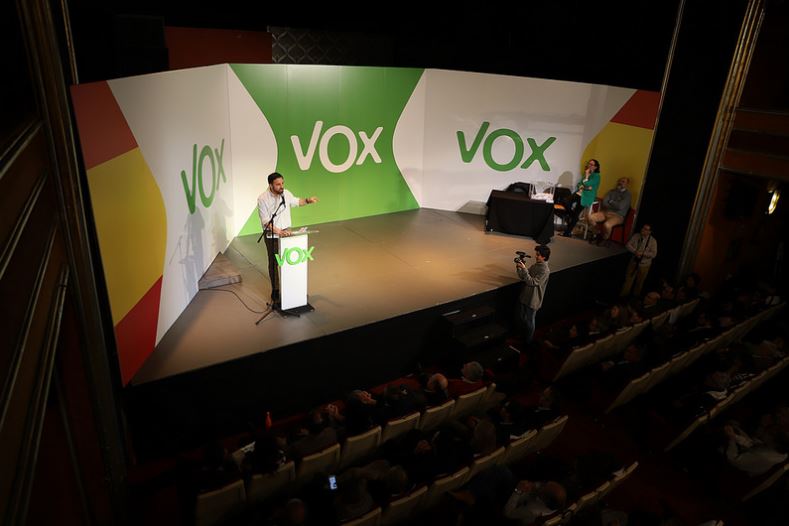
A Vox event in Madrid, Spain on October 3, 2018. Vox España / Flickr
At the start of the 1970s most Europeans thought that any rebirth of fascist organization would be built around the remains of the Mediterranean dictatorships, in Greece, Portugal, and Spain. Yet if Golden Dawn remains a powerful expression of neofascism in Greece, in these latter two countries this expectation has been all but disproven. Parties linked to the far right have in recent decades tended to achieve worse results in the Iberian peninsula than anywhere else on the European continent.
At least, this was true before the elections in Andalusia at the start of December, where the far-right Vox made a surprise breakthrough with 10 percent of the vote, electing twelve MPs. This was an electoral earthquake not only because the far right made it to Parliament in Spain’s most populous region, but also because the Left lost its parliamentary majority. The situation looks set to allow the Right to govern Andalusia for the first time since the return of democracy — and their government will rely on Vox’s support.
But we should not fool ourselves into thinking that the previous electoral failures of the Spanish far right meant that its values were nowhere to be found in the country’s institutions. Rather, its “absent presence” masked the persistence of a neo-conservative and xenophobic Francoism. This had, without doubt, hitherto lacked distinct political expression, instead being diluted within a “big-tent” Partido Popular (PP), Spain’s dominant conservative party. But now it is being given a new lease of life in Vox, a party with deep roots in the history of far-right organizing.