Dress Rehearsals for Utopia
Liberals like to paint mass performance as totalitarian and repressive. But the festivals of revolutionary France gave the people a sense of its own power.
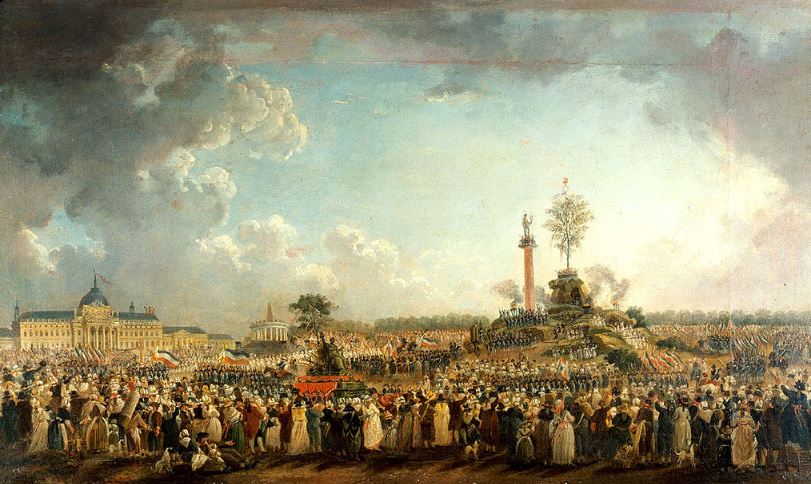
Festival of the Cult of the Supreme Being, 1794. Pierre-Antoine Demachy / Wikimedia Commons
During the upheavals bracketed by the Storming of the Bastille in 1789 and the Thermidorian reaction in 1794, France played host to hundreds of revolutionary festivals. Ranging from small village celebrations to mass urban mobilizations, these events constituted arguably the most significant collective expressions of the revolutionary era.
Historically unprecedented in size and scope, the largest of these festivals — the Festival of the Federation in 1790, the Festival of Indivisibility and Unity in 1793, and the Festival of the Supreme Being in 1794 — rallied as many as half a million ordinary men, women, and children in spectacular collective performances. Incorporating processions, mass oath-taking, and human tableaus, they provided a means to bind the decentered agents of revolutionary change into a new body politic.
The importance of these mobilizations to the leaders of the period is evident both in the addresses they gave in the National Convention and revolutionary committees, and in the mass of plans and directives for their organization. In the face of a life-or-death struggle against internal subversion and foreign armies, the revolutionary state marshalled staggering amounts of resources and manpower for these celebrations of the volonté générale (general will). This included the service of leading dramatists, composers and artists, most notably the neoclassical painter and revolutionary statesman par excellence Jacques-Louis David, who served as the primary creative director of the largest and most daring festivals of the Jacobin period.