An Indigenous Reconstruction in Brazil
An interview with Sônia Guajajara, an indigenous woman running for Brazil’s presidency.
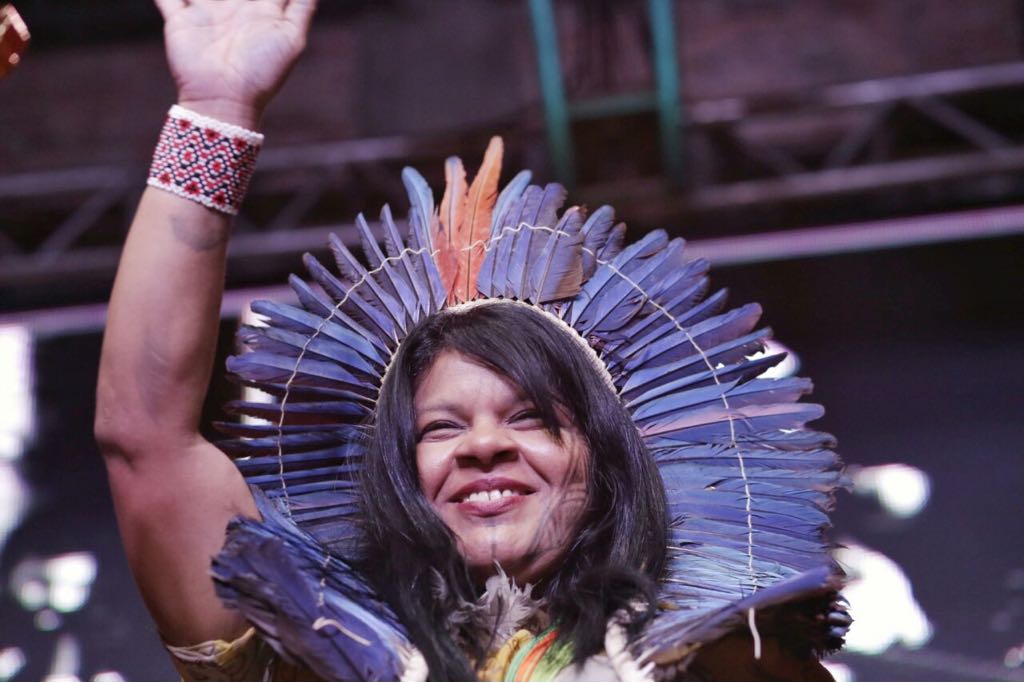
Sônia Guajajara at an event. Annelize Tozetto / Revista Vírus
518 years ago, the territory now known as Brazil was invaded by a Portuguese fleet and colonized. Many of the indigenous peoples who inhabited the land died from diseases, were killed, or enslaved. The indigenous population was reduced to less than a million, and their land was taken away and exploited. These land seizures didn’t just effect insurmountable damage to the native ecosystem; they also, by concentrating property in the hands of a very few, wrote inequality into the foundations of modern Brazil.
This is why, more than five centuries later, Sônia Guajajara, a Guajajara indigenous woman from northeast Brazil’s Arariboia region, says her pre-candidacy for the presidency in this year’s elections represents a paradigm shift. Brazil’s indigenous population may number less than a million in a population of over two hundred million, but their political struggle has reached a strength and visibility in recent years that makes it hard to deny their importance in struggles over class, imperialism, and financial capital. Their struggle is an urgent one; in 2016 alone, 118 indigenous people were murdered. These assassinations tend to be connected to the continued attempts by agribusiness to push onto indigenous land, though they are also rooted in racism.
Guajajara, who has been a member of the Socialism and Freedom Party (PSOL) since 2011, will formally run as PSOL’s vice-presidential candidate alongside Guilherme Boulos of the Homeless Workers’ Movement (MTST). However, the party and the campaign have pushed for a “co-candidacy” arrangement in place of the traditional presidential/vice-presidential ticket. In this way, they’re hoping to dispute the hierarchy of the traditional ticket and promote an equal, three-way alliance between the PSOL, indigenous peoples, and the MTST.
A specialist in linguistics, a mother of three, and the best-known indigenous leader at home and abroad, she forms part of the coordination of Brazil’s most notable indigenous organization, the National Articulation of the Indigenous Peoples of Brazil (APIB).