Siding With the Bosses
The Supreme Court has made the fight against workplace sexual harassment even more difficult.
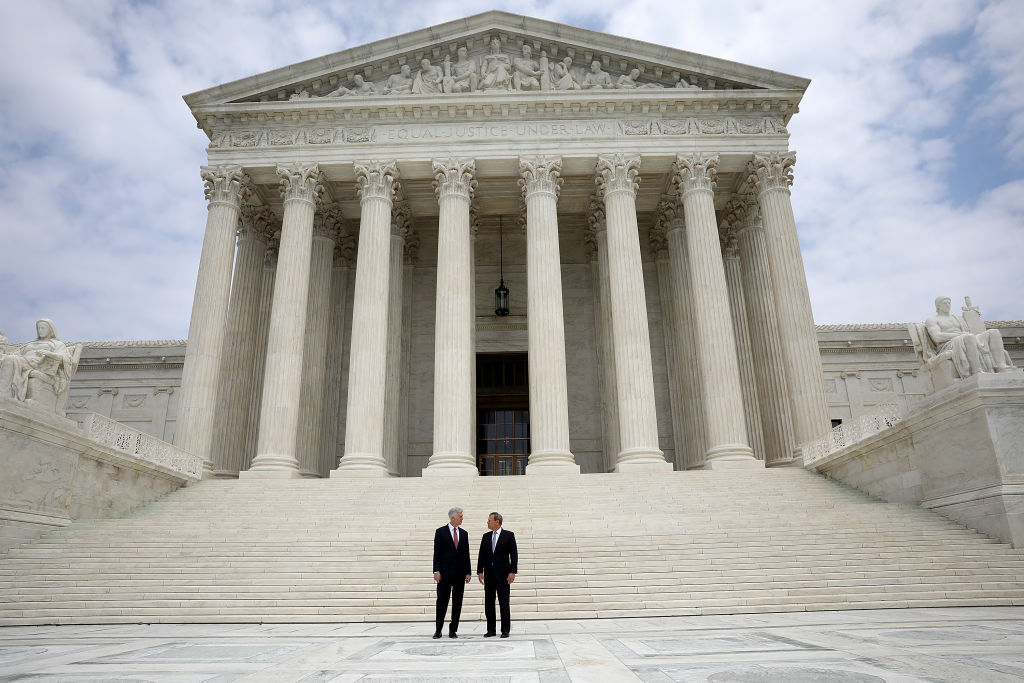
Supreme Court Justice Neil Gorsuch stands with Chief Justice John Roberts following his official investiture at the Supreme Court June 15, 2017 in Washington, D.C.Win McNamee / Getty
After months of sustained public pressure targeting sexual harassment in workplaces across the United States, in May the Supreme Court significantly undermined the power of workers to collectively challenge discrimination and abuse at the hands of their employers. In a 5–4 decision on the Epic Systems Corp. v. Lewis case, the Court ruled that private-sector employees do not have the right to enter into class-action lawsuits to challenge violations of federal labor laws.
“[T]he Supreme Court has taken away a powerful tool for women to fight discrimination at work,” said Fatima Goss Graves, president and CEO of the National Women’s Law Center, in a press statement. “Instead of banding together with coworkers to push back against sexual harassment, pay discrimination, pregnancy discrimination, racial discrimination, wage theft and more, employees may now be forced behind closed doors into an individual, costly — and often secret — arbitration process. This will stack the deck in favor of the employer.”
The case concerns tens of thousands of employees at three companies — Epic Systems Corp., Ernst & Young LLP, and Murphy Oil USA Inc. — who were forced to sign away their right to join class-action lawsuits against their employers as a precondition to being hired.