Wild Horse Nine Skewers the Dangerous Fools Behind US Empire
Wild Horse Nine is an irreverent portrait of the dopes who traffic in violence against democracy around the world, all in the service of US empire. But the connection between human callousness and evil has flown over the heads of some critics.
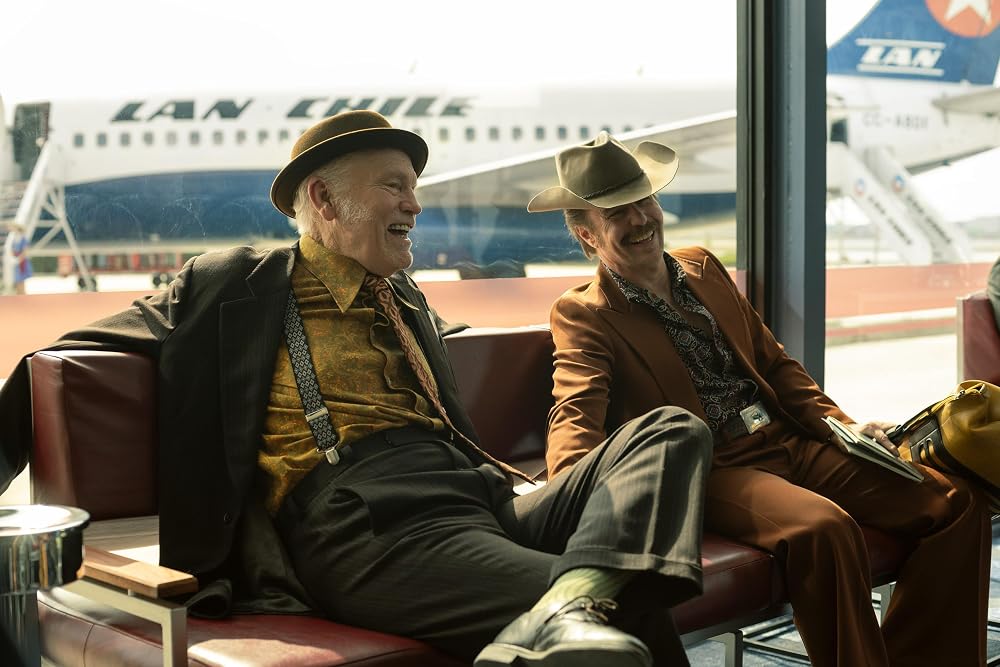
Martin McDonagh’s Wild Horse Nine depicts a CIA that is mostly run by blundering idiots. But it doesn’t shy away from the consequences that arise from the way they flourish here and around the world. (Blueprint Pictures / Film4 / TSG)
The climactic speech of Martin McDonagh’s dark comedy Wild Horse Nine is the “Kill ’em” monologue, delivered by an old Central Intelligence Agency (CIA) operative named Chris Carlisle (John Malkovich), who’s dying of cancer and whose mind is also starting to go. But after decades of habitual lying for professional reasons, he’s pledged to tell the truth to a Chilean college student and leftist organizer named Monica (Mariana di Girolamo) in what becomes an unlikely end-of-life friendship.
When Chris finally does tell her the truth as he knows it, after a life spent doing the worst, sickeningly violent, and incalculably harmful dirty work for US empire, it’s so terrible that it brings tears to her eyes. It’s about what you’d have to do to really achieve widespread democracy and human flourishing: eradicate those forces that are always going to support fascism, that will always be dedicated to upholding the power of dictatorial, money-grubbing, and colonizing monsters for all the typical reasons.
Chris includes himself in the roster of people who should be killed, or should’ve been, long before he could make this cold assessment of his own life’s work: “I’m a big shot at the CIA. A veteran of Guatemala 1954 — success. The Congo 1960 — success. The Bay of Pigs 1961 — less successful. Dallas 1963 . . . ”
It seems Chris played a key role in the John F. Kennedy assassination and is talking more and more freely about it, even including it in the memoir he’s dictating into a tape recorder. You may recall another CIA agent being evoked in Wild Horse Nine, also wonderfully played by Malkovich, who’s writing a memoir — or as Osborne Cox calls it in the Coen brothers’ comedy Burn After Reading (2008), a “mem-wah.” Malkovich has had a whole history of playing CIA agents experiencing various degrees of career turmoil and mental instability. He was the rogue assassin Booth, seeking to kill the current president in In the Line of Fire (1993) and tormenting Clint Eastwood’s aging Secret Service agent for failing to prevent the assassination of JFK.
In Wild Horse Nine, Chris has become such a loose cannon that his superior, MJ (Steve Buscemi), a CIA bureau chief overseeing South American operations, decides they can’t wait for Chris’s death by natural causes, no matter how imminent it might be.
The “kill ’em” speech alone is so powerful, though it’s delivered with such perfectly shocking casualness that it would probably get John Malkovich another Best Actor Oscar, except that his costar, Sam Rockwell, is equally fantastic as Chris’s only friend, the irascible longtime CIA protégé Lee Chesterfield. In all likelihood they’ll both be nominated and then split the Academy Award vote and lose.
They play old cronies in 1973 Santiago, Chile, who’ve just finished destabilizing the government of democratically elected President Salvador Allende, to the point that Chris can predict the exact time the coup d’etat by Augusto Pinochet’s military forces will occur, after which the roundup, torture, and murder of leftists will begin. Lee has agreed to a trip to the Chilean territory of Easter Island so that Chris can see the “big heads,” his last goal before he dies.
There’s no sugarcoating the fact that Chris is a hopelessly corrupt old spook, but the process of dying, plus his Catholic fear of going to hell for his innumerable mortal sins, has given him a certain melancholy sweetness and has also made him want to reckon, very loudly and publicly, with his god-awful past. Lee has been assigned by MJ to keep Chris in line and, if he can’t do that, to kill him on the island. Chris, who in his lucid moments knows this, carries a scrap of paper around reminding himself, “Don’t trust Lee!”
Chris also periodically forgets that he’s arranged to have Lee ease him out of life in a mercy killing on the island. The code word is “Arkansas.” As Chris reasons, he’d never casually say “Arkansas” because “no one wants to go to Arkansas.”
If you know Martin McDonagh’s film work at all, most famously In Bruges (2008) and The Banshees of Inisherin (2022), you recognize the elements of McDonagh’s favorite designs. They include, most prominently, two male friends bickering and bonding and betraying in shades of light humor and dark antipathy. Then there’s the heartbreakingly beautiful setting that creates the ironic backdrop to human viciousness, making the viewer wonder once again what the hell is wrong with us as a species. It’s always in an earthly paradise where people turn on each other and the shooting starts.
The title Wild Horse Nine is one that McDonagh shrugs off as far as any deep meaning, saying “I like numbers and I like horses.” But there’s no question that wild horses roaming free on gorgeously shot Rapa Nui are a key element of the film, especially the one particular horse with the distinctive white stripe on his forehead that keeps approaching Chris. “Are you a cancer-sniffing horse?” Chris asks.
The haunting attentions of the horse, like the odd, poignant friendship with Monica, takes on outsize importance as Chris tries to reckon with his own grim legacy. “I should’ve shot fewer people and spent more time with horses,” is one awkward, emotionally stunted conclusion drawn.
Wild Horse Nine doesn’t fail to include the almost nonexistent personal lives of Chris and Lee. McDonagh favorite Tom Waits gives a one-scene performance as Chris’s reclusive and estranged brother, a crusty old wreck who lives in a hut near Monument Valley — John Ford’s Monument Valley in Utah, where he shot all those celebrated Westerns — which serves to demonstrate how few and tenuous Chris’s links to life are anyway. And Lee is frequently on the phone with his wife Marge, played by Parker Posey. She’s an emotionally erratic alcoholic who has a very active sex life during Lee’s long absences from home. When Lee asks after the kids, Marge squawks, “The kids? Who cares!”
The message is pretty clear — what Chris and Lee have, personally, is each other, and that relationship, built on professional barbarism, is coming to a necessary end.
In an interview with Seth Myers, Malkovich called the two main characters “American jackasses,” just much more lethal than most.
The point is they’re still typical, on a continuum between ordinary chuckleheads and the dangerous chuckleheads in positions of power. If we find some of these jackasses dangerously likable, well, of course we do — we were raised with them, they’re our relatives, our neighbors, our old college pals we gave a pass to for a while before their malevolence became clear. And obviously McDonagh wants to connect these ordinary people with a harsh look at the United States and the simpleminded attitude of hero worship that’s been inculcated in the Western world since World War II:
The film explores a time when, seemingly, America’s place in the world was as the good guy, which is what most kids in the West — not just in the U.S. but in the U.K. and Ireland, Western Europe — are brought up to feel. The C.I.A. are the good guys and the K.G.B. are the bad guys; America is the good guy and Russia is the bad. But the more I read about what the C.I.A. were up to throughout the end of the last century, and particularly in Chile — to destabilize and help overthrow a democratically elected government, which ended up in fascist horrors for 15 years — it makes you think that you’re not being told the truth about the West and its moral outlook.
To those on the Left, this probably seems like a far too mild agenda. But we’ve got to keep in mind the extraordinary level of delusion that still prevails in the United States. For every leftist that knows all about what the CIA did in Chile in 1973, there are a hundred Americans who either don’t know about it or refuse to acknowledge the fact of it or what the fact means. There’s a reason McDonagh includes documentary footage of Chile ’73 in Wild Horse Nine, as well as actual footage of the capture of Patrice Lumumba, prime minister of the First Congolese Republic after having played a significant role in overthrowing the region’s Belgian colonizers. He was also taken out through a CIA-engineered coup — tortured, executed, body dissolved in acid.
In Wild Horse Nine, Chris claims blandly that “I liked Patrice.” When Lumumba told him the CIA would be responsible for the end of democracy in the Congo for at least a generation, Chris replied in tones of sympathetic reasonableness that of course it would. That was the whole point.
It’s interesting to note that among the many excellent reviews the film is getting, it’s also racking up a few prominent bad reviews from sites like NPR and the New Yorker. But what’s not mentioned in these reviews are such gutting interludes as the Lumumba footage. Instead the critics carp about the “tiresome bickering-and-bantering routine” of the two lead characters and McDonagh’s irreverent attitude, not making any attempt to consider the relationship between the two, the blandly callous rhetoric about horrors, the crude joking around, the hideous incongruence that we encounter every single day in the United States in the forms of blithering government edicts and banally evil pronouncements of the tech lords and brainwashed media commentary and sociopathic online f-ckery of all sorts.
We live among American jackasses, and there are big consequences that arise from the way they flourish here and around the world.