Capitalism Is More Than a Legal Regime
Katharina Pistor argues that capitalism is a legal regime we can transform by rewiring private law. But a reform program that ignores the wage relation and the exploitation of labor will leave the core of capitalism untouched.
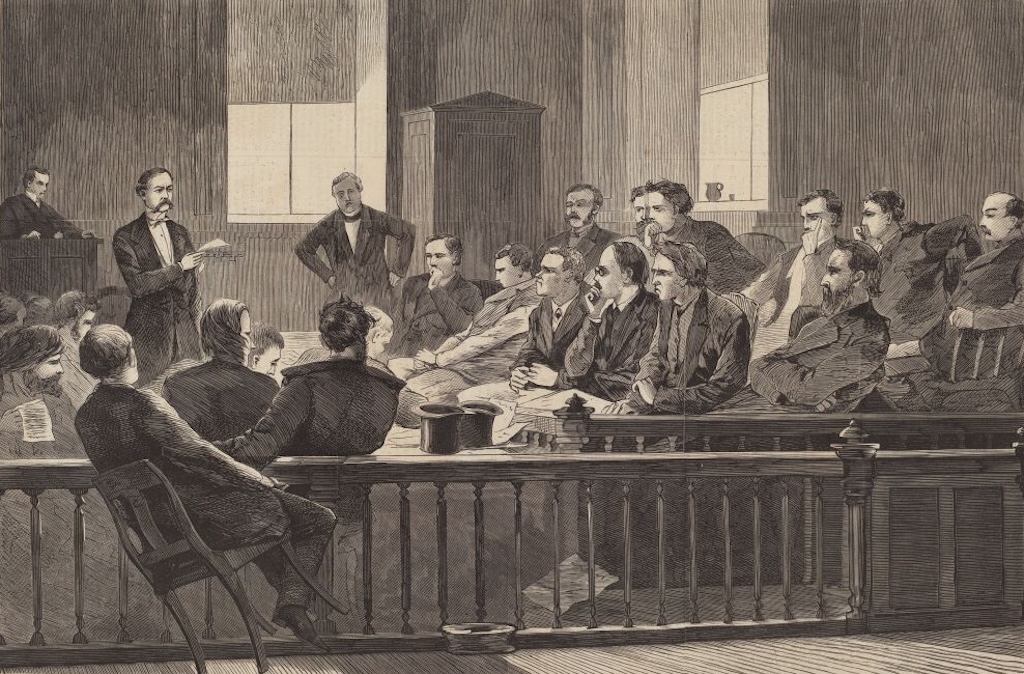
Winslow Homer, “Jurors Listening to Counsel, Supreme Court, New City Hall, New York,” 1869. (Heritage Art / Heritage Images via Getty Images)
“Capitalism is a legal regime, not just an economic system as conventional wisdom has it.” With this opening sentence, Katharina Pistor takes the argument of her previous book, The Code of Capital, a step further. There she showed how lawyers turn assets into capital through property, contract, collateral, trust, corporate, and bankruptcy law. Her new book extends the argument to capitalism as a whole.
If law so thoroughly constitutes capitalism, she asks, why is it “so resistant to legal governance”? And how might we transform it?
Pistor has much to say about the legal powers of capital, and her account deserves serious attention. Yet I find two fundamental problems with her argument. Although she insists that capitalism is legal to the core, she has remarkably little to say about the wage relation and the extraction of surplus labor in the production process. Without these, we can understand neither capitalist production nor its capacity to reproduce itself.
This omission carries over into her proposals for transforming capitalism. Her project of democratizing private law leaves the basic relations of production intact. The result is a reform program that may constrain some of capital’s powers but offers little prospect of overcoming capitalist exploitation.
The second, related problem concerns the economic foundations of her argument. Pistor describes her approach as “imbued with a strong dose of political economy.” Yet she makes claims about the redistributive achievements of the welfare state and the sources of capitalist profit without engaging with a substantial body of Marxian theoretical and empirical research that bears directly on both questions.
At the heart of Pistor’s account is a definition of capital by its tradability. For her, capital is any asset that law has coded so that it can be “mortgaged or sold for profit.” Without such coding, she writes, ordinary assets “will not produce wealth on the scale that legally coded capital assets can.” Three things follow.
Capital becomes an asset that law codes for trade at a profit. Capitalists become “traders in any asset that promises financial returns,” and capitalist ownership becomes a matter of “maximizing pecuniary gain from an asset.” Capitalism thus becomes the legal regime that creates such assets and gives their holders privileged access to the coercive power of the state through private law. Conspicuously absent from this triad is the capitalist as employer of wage labor, a point to which I return below.
Drawing on Evgeny Pashukanis, Pistor locates a defining feature of capitalist law in the separation of private and public law. Each rest on a different normative foundation. Public law concerns constitutions, democratic self-government, and limits on state power; private law, by contrast, revolves around individual autonomy and freedom of contract. Yet private rights, no less than public ones, depend on the coercive power of the state for their enforcement.
This arrangement enables capital to exercise considerable power through private law while escaping many of the constraints that public law imposes.
Pistor develops this argument through three mechanisms. The first is legal empowerment: property, contract, and the corporate form confer powers on private actors while limiting their accountability. The second is access to legal coercion, through which private parties can call on the state to enforce their claims. The third is legal arbitrage: capital can move between jurisdictions and choose favorable legal arrangements, whereas workers and other individuals face the restrictions that immigration and nationality laws impose.
In Pistor’s account, these mechanisms also help explain why earlier reforms proved so vulnerable. The New Deal introduced substantial changes in finance, housing, labor relations, and social security, but “did not alter private law and its normative foundations.” Capital subsequently found ways around these reforms, including the outsourcing of labor and the creation of new financial instruments. Pistor therefore argues that regulation alone cannot do the job; we must rewire private law itself and place it on a different normative foundation.
Production and Exploitation
My principal difficulty with the book concerns its treatment of production, or rather its failure to examine it. In the opening paragraph, Pistor lists several phenomena that Karl Marx and Joseph Schumpeter regarded as economic: trade, labor relations, private ownership of the means of production, corporations, banking, and money. She then declares that “these matters are legal to the core.”
Given this claim, one might reasonably expect an examination of the legal relations that govern capitalist production, particularly the employment contract. Surprisingly, there is almost none of it.
The terms “surplus value,” “surplus labor,” and “labor power” do not appear in the book, and the index contains no entry for “exploitation.” Production enters the discussion mainly through the ownership of the means of production, with little attention to what happens when workers put those means to use in the production process.
Pistor does refer to labor exploitation on three occasions, but none of them leads to a sustained discussion. She notes that recently some Marxist scholars have questioned “the exploitation of labor as the source of surplus that capital extracts.” But she reports this disagreement without a reference, without saying who these scholars are, and without stating her own position.
In a related passage, she appears to endorse the view that, “as Marx and [Friedrich] Engels argued, owning the means of production allows capitalists to extract surplus from labor.” That idea, she adds, “economic models have more recently confirmed.” These “economic models,” however, turn out to be a single model, that of Oliver Hart and John Moore, which is a far cry from confirming Marx’s theory of exploitation. For these authors, “surplus” refers to the gains from trade that relationship-specific investment generates, which the parties then divide through bargaining; it has nothing to do with Marx’s surplus value.
Pistor also observes that one-sided contracts have long characterized labor relations, and that this “inspired Marx’s analysis of the exploitation of labor through capital.” She recognizes, moreover, that ownership of the means of production gives capital “the power to set the terms for the contractual relation with labor.” This could have been the starting point for an analysis of capitalist exploitation, but she does not pursue the subject further. The discussion turns instead to unionization, the National Labor Relations Act, and gig workers, largely in terms of bargaining power, before moving on to social media contracts.
Finally, she remarks that “labor exploitation has never been recognized as grounds for asylum.” Here “exploitation” refers to abusive working conditions rather than to the specific social relation that Marx analyzed.
This neglect of exploitation matters for Pistor’s own argument, because the wage contract is surely among the most consequential legal relations in capitalist society. Workers and capitalists enter into it as formally free and equal parties, yet the contract gives the capitalist command over the use of labor power for a specified period. The worker’s separation from the means of production is what makes this arrangement possible and, for most wage earners, necessary.
Marx’s analysis of the sale and purchase of labor power is particularly relevant here. In the sphere of circulation, the exchange happens between equals. Exploitation takes place in production, where the use of a unique commodity, labor power, creates more value than its own reproduction requires. The wage contract provides the legal form of this exploitative relation.
Pistor’s engagement with Marx follows a consistent pattern. She either sets aside central elements of his materialist analysis or reworks his categories into new ones. The first move shows in the weight she gives to power, intangible property, and data ownership. These largely take the place of the material constraints that, for Marx, the economic structure imposes on social and legal relations.
The second move is clearest in her claim that law is “a productive force in its own right, because it is the means that allows holders of assets to extract their pecuniary value.” Pistor knows that she is departing from historical materialism here, and she says so against G. A. Cohen and Jeremy Kessler. The difficulty is her criterion. In Marx’s framework, the capacity to extract value does not make something a productive force.
That capacity belongs to the relations of production, the social relations that organize production and determine who appropriates its results. She calls law a productive force, but extracting and appropriating value is precisely what relations of production do. Law adds nothing to a society’s capacity to produce; it organizes who controls production and who claims its results. By her own criterion, then, law belongs among the relations of production, not the forces.
Profit on Alienation and the Legal Appropriation of Wealth
One Marxian concept could help clarify much of what Pistor describes: profit on alienation, or profit upon alienation, a term Marx took over from James Steuart. It refers to profit that arises from transfers and unequal exchange rather than from the production of surplus value.
Anwar Shaikh discussed profit on alienation as a secondary but significant source of profit. Shaikh and I subsequently used the category in our book Measuring the Wealth of Nations, and Shaikh reiterated its significance in his treatment of the transformation problem. Costas Lapavitsas drew on a related conception in Profiting Without Producing to analyze the profits banks extract from workers’ income.
In a recent study, Alper Duman and I examined profit on alienation in Turkey between 2010 and 2019, focusing on real estate and finance. The first case involved the privatization of public land. When the state transfers land to a private developer at less than its market value, the developer gains the difference as profit, although the transaction creates no new wealth; public wealth simply passes into private hands.
The second case concerned bank lending to working-class households, which pay the interest out of wages rather than out of surplus value from production. We estimated profit on alienation over the decade at $9.31 billion in real estate and $57.23 billion in finance.
These examples are closely related to the processes Pistor investigates. The enclosure of land, data, and knowledge; the privatization of public assets; and the socialization of financial losses all involve legal arrangements that enable private actors to appropriate existing wealth. The law is an indispensable participant in these processes, and Pistor is right to insist on its importance.
An account of how assets acquire legal protection and become sources of private profit does not, however, by itself tell us where that profit comes from. It may come from the production of new value or from the reappropriation of existing wealth through unequal exchange. We can understand much of what Pistor calls the legal coding of capital as the legal organization and enforcement of profit on alienation. This is especially apparent in privatization and in financial claims on household income.
The distinction between surplus value and profit on alienation would allow Pistor to address a question that remains unresolved in her account. So would the related distinction between productive and unproductive activities, which Shaikh and I developed, and which I have extended to the digital sector. Under what circumstances does the legal coding of assets facilitate the production of new wealth, and when does it merely enable the transfer or reappropriation of wealth that already exists?
This question is especially relevant to The Code of Capital, whose subtitle promises to explain “how the law creates wealth and inequality.” Pistor provides a compelling account of the legal construction of claims to wealth. But the distinction between the production and the redistribution of value is essential if we are to understand the economic significance of those claims.
This also brings us back to the absence of the labor process. If the law helps constitute capitalist social relations, the employment contract and the property relations underlying it ought to occupy a central place in the analysis. Without them, we learn a great deal about how capital acquires, exercises, and protects its legal powers, but very little about the legal conditions under which workers produce surplus value.
The Welfare State and the Net Social Wage
Pistor’s case for rewiring private law also rests on a particular understanding of the welfare state. Countries have “experimented with social welfarism,” she writes, but the success of this reform agenda “has often been only temporary.” The New Deal, she argues, “aimed to restore the balance between the working class and the upper class.” Her explanation for the eventual erosion of the welfare state’s achievements emphasizes capital’s capacity to circumvent public regulation through private law.
This account takes for granted something that deserves closer examination: How much did the welfare state actually redistribute from capital to labor?
For several decades, Marxian researchers have investigated this question using the concept of the net tax and, later, that of the net social wage. They define the latter as the government expenditures on social services that workers receive minus the taxes they pay. The results are much more nuanced than the conventional picture of the welfare state as a sustained transfer of income from capital to labor.
Shaikh and I studied the United States and found that, between 1952 and 1997, the net social wage seldom moved outside a range of ±4 percent of employee compensation. It averaged only 0.6 percent, effectively zero. During the postwar expansion of 1952–1969, it was negative: workers paid more in taxes than they received in social expenditures.
The Ronald Reagan–George H. W. Bush period, which we described as a “counterattack by capital and the state,” pushed it down again. Our conclusion was that, by and large, “it is the taxes of the working population that essentially pay for the corresponding state expenditures.”
Shaikh’s subsequent multicountry study reached a similar conclusion for countries in the Organisation for Economic Co-operation and Development (OECD): “In effect, workers paid for their own social benefits.”
Katherine Moos extended the US estimates through 2012 using two methods. On the narrower measure, the net social wage averaged 1.3 percent of GDP; on the more comprehensive measure, which attributes a larger share of taxation to labor, it averaged -3.8 percent. She also identified a shift after 2001, when the net social wage turned positive for more than a decade.
Moos did not, however, interpret this development as evidence of renewed redistribution from capital to labor. She linked it instead to mass unemployment and underemployment, rising health care costs, and the expansion of wage subsidies such as the Earned Income Tax Credit. As she argues, “subsidies to labor are also subsidies to capital.”
Public expenditures, which governments often finance through deficits, increasingly make up for wages and benefits that employers no longer provide. In this context, a positive net social wage can be “evidence of the decline in conditions for the working class, not improvement.” Yakup Karabacak and I found a different pattern in Turkey from 1980 to 2019: the net social wage was negative in all but five years and averaged -1.13 percent of GDP. Turkish workers, in other words, paid more in taxes than they received in social benefits.
These results bear directly on Pistor’s explanation of the welfare state’s limitations. Her argument implies that public law reforms initially restrained capital, but that capital later undermined them because the foundations of private law remained unchanged.
Taxation and social security are themselves legal institutions, and public law largely constitutes them. The net social wage studies suggest that these institutions have often redistributed income within the working population rather than producing a substantial net transfer from capital to labor. More recently, some forms of social expenditure have effectively subsidized employers by compensating for inadequate wages and benefits.
This does not mean that welfare state programs were unimportant to workers or that they brought no improvement in living standards. Public health care, education, pensions, and unemployment protection can have enormous social value; however, governments finance them. But we should not confuse their existence with a net redistribution from capital to labor.
Pistor’s account of the welfare state would be considerably stronger if it engaged with this evidence. Public law was not necessarily the counterweight to capital that her argument seems to assume; it has also helped reproduce capitalist relations, including through the taxation of wages and the public subsidization of labor costs. Capital’s ability to escape into private law therefore cannot by itself explain the failure of welfare state reform.
For a book whose central concern is the difficulty of governing capitalism through law, engagement with this literature would have provided a direct test of its central claim.
Reform and the Question of Political Agency
The problem with Pistor’s program is not simply that her proposals are modest. Reforms can matter, and there is no reason to dismiss them because they fall short of abolishing capitalism. What is difficult to understand is why Pistor expects reforms of this kind to transform a system whose underlying relations of production would remain unchanged.
Consider the place of workers in her program. They appear as possible beneficiaries of greater participatory rights and as weaker parties who might gain access to public courts if restrictive arbitration clauses no longer stood in the way. Both changes could be worthwhile, but they leave the employment relation itself largely untouched.
Nor does Pistor propose changing the ownership of the means of production, which, as she herself acknowledges, gives capital the power to set the terms of labor contracts. Martha Nussbaum’s “capability of being able to work as a human,” which Pistor draws on, comes closest to addressing the conditions of work, but it does not confront the social relation through which capital appropriates surplus labor.
There is a further difficulty. Pistor says remarkably little about the social and political forces that might bring about the changes she advocates.
Pistor recognizes the rise of “populist” discontent, but she treats it primarily as a danger to channel before it becomes “difficult to control.” She does not seriously consider whether the conflicts that give rise to such discontent might also provide a basis for collective political action.
One might object that a book about law need not offer a comprehensive theory of political organization. But once Pistor moves from explaining capitalism’s legal structure to proposing its transformation, the question of agency becomes unavoidable. Through what organizations and struggles could anyone achieve and defend the proposed changes?
Treating law as constitutive of capitalist relations is not the problem (what is objectionable, as I argued above, is treating it as a productive force); indeed, Marx’s analysis of the wage contract provides ample grounds for doing so. But accepting the material significance of law does not settle the question of which social relations to transform. Pistor’s stated aim is to “chart a path beyond capitalism,” yet the economy she envisages is a “genuine market economy” without capital’s legal privileges. If the objective is to move beyond capitalism, a serious program cannot leave out the legal relations governing wage labor and the ownership of the means of production.
Transformation Without Transformation
The neglect of production and of collective agency also shapes Pistor’s strategy for transforming capitalism. She explicitly rejects revolution: “Traditionally, Marxists have called for revolution, a violent overthrowing of the ruling class. This has never happened in advanced capitalist countries, seems unlikely, and is also undesirable.”
Her preferred approach draws on Nicos Poulantzas’s image of “walking on a tightrope,” a gradual process of change within existing institutions. She mentions Andre Gunder Frank’s call for a “revolutionary Marxist strategy” only in passing, observing that “Obviously, this has not happened.”
For Pistor, the existing legal system “cannot simply be undone”; instead, “law needs to be rewired from within.” She returns to this position in the epilogue: “The transformation of the existing system will not happen in a single leap. Rather, transformation happens as the cumulative effect of a myriad of smaller steps.”
This preference for incremental “rewiring” rests partly on the claim that revolution has never occurred in advanced capitalist countries. Pistor does not analyze revolutions elsewhere — in Russia, China, Cuba, and Vietnam, and in the anti-colonial struggles — as revolutions; they appear only as “disappointing” outcomes or as instances of convergence on capitalism. Moreover, her own examples of law’s capacity for transformation, from feudalism to republicanism and from colonialism to a new international order, include several revolutionary ruptures. This sits uneasily with her claim that history has never moved “in a single leap.”
Pistor’s proposal to “democratize private law” rests on a theory of the state that is more sophisticated than the strategy she builds on it. She rejects both the liberal picture of the state as a neutral arbiter and the classical Marxist picture of it as an instrument of the ruling class. Following Poulantzas, she treats the state as a “condensation of the relations of forces,” a terrain of struggle that private law has caught “in its own trap.” She concludes that “calling for the state to free society from the excesses of capitalism is therefore misguided.”
However, her proposed transition still runs almost entirely through the state’s institutions. A binding “Just Private Law” code would require action by legislatures or a revision of the EU treaties. The precautionary principle, an expanded duty of care, and a broader doctrine of veil-piercing would depend on judges willing to apply them. Ending the banks’ money franchise, she admits, “rests in public hands”: legislatures, central banks, and finance ministries, the very bodies her own analysis shows to be most exposed to the influence of finance.
Capital has shaped each of these tools, and it has long influenced the processes that staff them. Her own evidence shows these institutions reworking or reversing reforms, from the New Deal to the civil procedure reforms of 1938. It is therefore unclear why a democratized private law would escape the same fate.
Pistor’s selective use of Poulantzas makes the problem worse. She takes over his relational conception of the state and, as we have seen, his tightrope image of gradual transformation. But she leaves aside what, in Poulantzas’s own framework, made any change from within the state conceivable at all: an organized social force outside it, capable of shifting the balance of forces that the state condenses.
One need not accept Poulantzas’s strategic conclusions to see the inconsistency. If the state is a condensation of class forces, then a reform program that names no force able to change that condensation has no road to realization, even on its own terms. Pistor offers no such force. No class, party, trade union, or movement appears as the agent that would push a reformed private law through captured legislatures and courts and defend it afterward.
Instead, she relies on deliberation, on crises as moments of decision, on judges, legislatures, and citizen tribunals, and on the hope that small steps will accumulate. When she anticipates the charge of naïveté, she answers that law is itself part of the raw material of capital, so normative change can act as a material lever. This shows that law can be a lever, but not one that anyone could pull in a state whose topography capital has shaped.
Without a theory of collective agency, her proposal risks being less realistic than the socialist alternatives she sets aside, not more. If we go beyond the limits Poulantzas imposed on his own approach, the main way out lies in a struggle by that collective agent to abolish the capitalist (or bourgeois) form of the state. That form of the state allows the private law system to function as a source of profit when capitalism finds itself in great crises. In its place, the struggle would establish a public law order that takes care of the collective interest of the whole society: socialism.
An Analysis Without a Strategy
Pistor has written an important book about the legal organization of capitalist power. Her insistence that law is constitutive of capitalism challenges the tendency of mainstream economics to treat legal institutions as an external framework within which economic activity takes place. Her account of the dismantling of New Deal reforms persuasively shows how private law arrangements enabled capital to circumvent public regulation. The net social wage evidence suggests, however, that we need to assess the redistributive achievements of those reforms more critically.
Her discussion of central banks and the socialization of financial costs since 2008 is also valuable. Her observation that contracts are “only rarely expressions of bargains” and more often “instruments of control” is especially striking. This insight could provide the basis for a much richer examination of the employment relation.
My disagreements concern the economic foundations of Pistor’s analysis (production, profit on alienation, and the net social wage) and the political conclusions she draws from them.
These gaps matter for her proposed reforms. The democratization of private law may restrain corporate power and strengthen the hand of weaker parties, and these are worthwhile objectives. But wage labor and capitalist ownership of the means of production would remain in place, and Pistor barely discusses the political forces capable of bringing about even the reforms she proposes.
I therefore find The Law of Capitalism more convincing as an analysis of the legal powers of capital than as an account of how we might transform capitalism. Pistor has considerably enriched our understanding of the former. A theory of the latter would need to address the production and appropriation of surplus value, the role of the state in reproducing class relations, and the social struggles through which working people might change those relations.