US Government Bureaucracy Is Designed to Punish the Poor
In The Time Tax, journalist Annie Lowrey ably documents the myriad ways US public services harm poor and working-class people and alienate them from the government. Yet she downplays the class interests that benefit from these Kafkaesque arrangements.
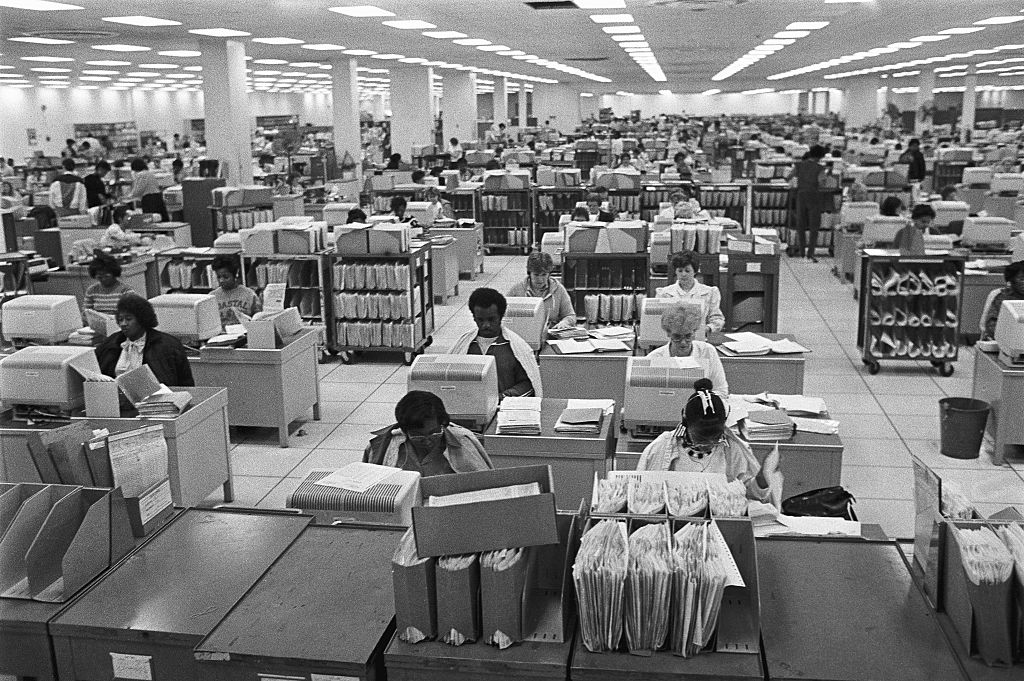
The United States’ long, sordid history of racial oppression and especially stark class exploitation helped give rise to a government bureaucracy that punishes and demeans the poor. Fixing it will require class struggle. (Bettmann Archive via Getty Images)
For several years, I lived in Norway and enjoyed the privileges associated with membership in Folketrygden, or the National Insurance Scheme. One privilege that I still think about often is the relative frictionlessness of interacting with the Norwegian government.
Seeing a doctor, for example, was effortless, and once my low annual deductible (as of 2026, ~$300) was paid, all testing and treatment for the year was covered without my involvement or input. My taxes were — without my prompting — prepared for me and sent for my amendment and approval. There was never anything to amend, of course. And because of the country’s leveringsfritak, or “silent acceptance” law, I did not even have to sign or submit a return.
The great difference between how things are typically done in Norway and how they are done in my home country, the United States, was never clearer to me than it was one day when I had to visit the US embassy in Oslo to handle some paperwork. At that time, the embassy was housed in an angular, charcoal-colored Eero Saarinen building across the street from the Royal Palace. It was not only conveniently located but, despite its popular reputation as a “fortress,” simple and straightforward to access — entering the compound required flashing my passport and was about as easy as doing anything else in Norway.
Imagine my surprise, then, when I arrived at the office where I was to complete my task: from the uncomfortable seating and oppressive lighting to the interminable wait and general feeling of disaffection, it was such an uncanny recreation of an underfunded Department of Motor Vehicles or post office that it could have been a movie set. There was even a small, cheaply framed photo of the president. The juxtaposition of this experience — which seemed designed to frustrate — and my happy dealings with Norway’s bureaucracies was, in its own way, radicalizing.
I sense that Annie Lowrey, author of The Time Tax, has been similarly radicalized, albeit through extensive personal and journalistic exposure to the myriad forms in which people in the United States have their time wasted and disrespected — or “taxed,” as she puts it — in almost every conceivable interaction with the government. She is clearly and justifiably pissed, and her book endeavors to show that the problem is, though widespread and deeply rooted in a particular national history of racial exclusion and class oppression, fixable. There is a world, she argues, beyond our current patchwork of fool’s errands and wild-goose chases.
The Time Tax and Its Origins
But it is to this patchwork — and its associated “time taxes” — that most of the book is devoted. Through a mix of reporting, social scientific research, and reflecting on her own experience with an autoimmune condition, Lowrey has collected a cabinet of maddening curiosities: impenetrable forms, inexplicable rejections, multiyear wait times, and more. Page after page finds ordinary Americans trying to navigate a twisted institutional terrain seemingly designed by Franz Kafka or M. C. Escher. In the United States, you can buy, bid, and bet with the click of a button. Yet paying your taxes, voting, and getting benefits for which you qualify requires you to do American Ninja Warrior — with the proper forms of ID in hand.
Having cataloged the challenges people face when using public services in the United States, the first section of The Time Tax concludes with a tantalizing glimpse at the Estonian case, which, in many ways, resembles the Norwegian one with which I am more familiar (sans generous welfare state and strong labor rights). The story, as told by Lowrey, is that the small Baltic country, battered and bereft after exiting the Soviet Union, lacked the time, experience, infrastructure, and resources to recreate the comprehensive service architectures of other countries. So it didn’t. Instead, a generation of young and enterprising leaders leaned into speed, convenience, and digital integration to build an innovative e-government. In Estonia, Lowrey has seen the almost frictionless future of navigating government — and it works!
The Time Tax is at its most interesting and convincing when Lowrey is detailing the diabolical busy boxes that occupy millions of Americans. After the brief field trip to Estonia, the book could — and probably should — have ended with her proposals. It doesn’t.
Perhaps drawing inspiration from her subject, Lowrey decides that she requires more of her reader’s time to make her point. After a section break, we leave Estonia and arrive at . . . Fort Pillow in 1864? With Confederate general and future Ku Klux Klan Grand Wizard Nathan Bedford Forrest? It was disappointing to discover that The Time Tax was not in fact beginning its descent to a satisfying landing — it had been diverted to another destination: the past.
The middle third of the book draws on the extensive historical and social scientific scholarship devoted to the United States’ welfare system to recapitulate a story that will be familiar to anyone who knows the tortuous history of social provision in the United States. All the beats are there: Civil War pensions, Jim Crow, Franklin Delano Roosevelt and the Great Depression, Lyndon Baines Johnson and the Great Society, Ronald Reagan’s “welfare queens,” Bill Clinton and the “end of welfare as we know it.” Lowrey provides some useful context for twenty-first-century annoyances but breaks no new ground here, and the long historical detour saps the momentum of her opening chapters.
I worry that it also leads her to draw the wrong conclusions about her time taxes. She laments, for instance, that “diversity creates time taxes” and suggests that we are not Estonia due to “racial makeup.” Could it not be instead that time taxes transform diversity into inequality and hierarchy?
Cutting the Time Tax?
In any case, the final part of the book picks up the threads of the first to make a final appeal and offer Lowrey’s solutions. This appeal takes for granted that the reader has not been entirely swayed by their own experiences or by the book’s emphasis on aggravation, injustice, racism, and inequality. Instead, Lowrey makes a persuasive closing argument that time taxes also hurt our health, teach us the wrong lessons about citizenship and government, and undermine social trust.
She concludes with her blueprint for change. Her proposed fixes include measuring time taxes via “sludge audits,” federalizing what are today state-run programs, reducing the use of means-testing in favor of universalism, and abolishing work requirements and pro forma interviews. These changes would, in the aggregate, make using public services faster, easier, more convenient, more empowering, and ultimately more fulfilling.
But I hesitate to call these proposals “solutions,” because I do not think that they actually address the problem at the heart of The Time Tax. This problem is not time taxes per se but the success of actors who weaponize bureaucracy to undermine our access to the goods and services of the social citizenship for which previous generations have fought and even died. The status quo in the United States is a nightmare not because elites are unaware of the fact that universalism promotes greater public investment and trust in government — it is a nightmare because they are aware. The history of many hitherto existing time taxes is also the history of class struggles.
Lowrey knows this — I think. She condemns TurboTax for helping to kill Direct File, Florida Republicans for fighting the reenfranchisement of convicted felons, and Donald Trump for the disaster of the Department of Government Efficiency (DOGE)–related cuts. She tells us that “time taxes are not just policy failures, but deliberate tools of social control.” And yet The Time Tax’s antagonist is without question “Uncle Sam” (her chosen shorthand for the government) and his “bureaucratic excesses.”
The issue is that while she lambasts “Uncle Sam” again and again, she is hesitant to center the private interests for whom that control is useful and profitable. In her long historical excursus, she can acknowledge that poll taxes and other discriminatory laws were used by racist white elites to exclude black people, make their lives precarious, and destroy governmental alternatives to foster dependency on actors who rarely had their best interests in mind. But while the past has opponents, for Lowrey, the present only has design flaws.
A smaller rhetorical point: Lowrey undermines her cause with the book’s core metaphor. Calling the problem the “time tax” might sell books to tax-wary Americans, but it could reinforce the pernicious idea that taxes do not benefit ordinary people. This is odd, as Lowrey herself acknowledges that a sustainable remedy to “the headaches, snafus, and frustration imposed by Uncle Sam” requires the expansion and improvement of administrative capacity — a development that would almost certainly require, well, greater taxes.
Finally, there is a problem of conceptual imprecision, which becomes apparent in the book’s first pages. Lowrey opens The Time Tax with a montage, juxtaposing disconnected scenarios for the purpose of creating a connective thread — the time tax — between radically different people, places, and challenges. But as she moves from losing the right to vote, to trying to get insurance to cover therapies for an autistic child, to attempting to open a soft-serve ice cream shop, to practicing cosmetology without a license, to handing out burritos to the homeless without a permit, I began to question whether each of these is in fact an example of the same problem. After a while, she more or less abandons any attempt to persuade you that a given obstacle is or is not a time tax. Instead, she just asserts it, identifying one or more annoyances and then adding something like “ — a time tax,” as if it were obvious.
All in all, The Time Tax is laudable as a collection of curios. It is less useful as a blueprint. Though Lowrey knows — and sometimes says explicitly — that this maddening status quo reflects the desires of certain powerful and well-resourced actors, she offers no proposals for organizing to muzzle, defang, or otherwise diminish their influence. She writes that “change does not happen without awareness, and awareness is not possible without numbers and stories.”
But it also does not happen without an awareness of who or what benefits from keeping you trapped in a thousand purgatories and a strategy for organizing against them. The path to a Norwegian-style welfare state is not just a matter of design — it is one of politics, and class politics in particular.