Charles Koch Has a Dystopian Plan for How to Control Workers
Ultraconservative billionaire Charles Koch likes to style himself as a champion of individual liberty. But his phony science of workplace management created an atmosphere that Koch’s workers compared to living in a totalitarian state.
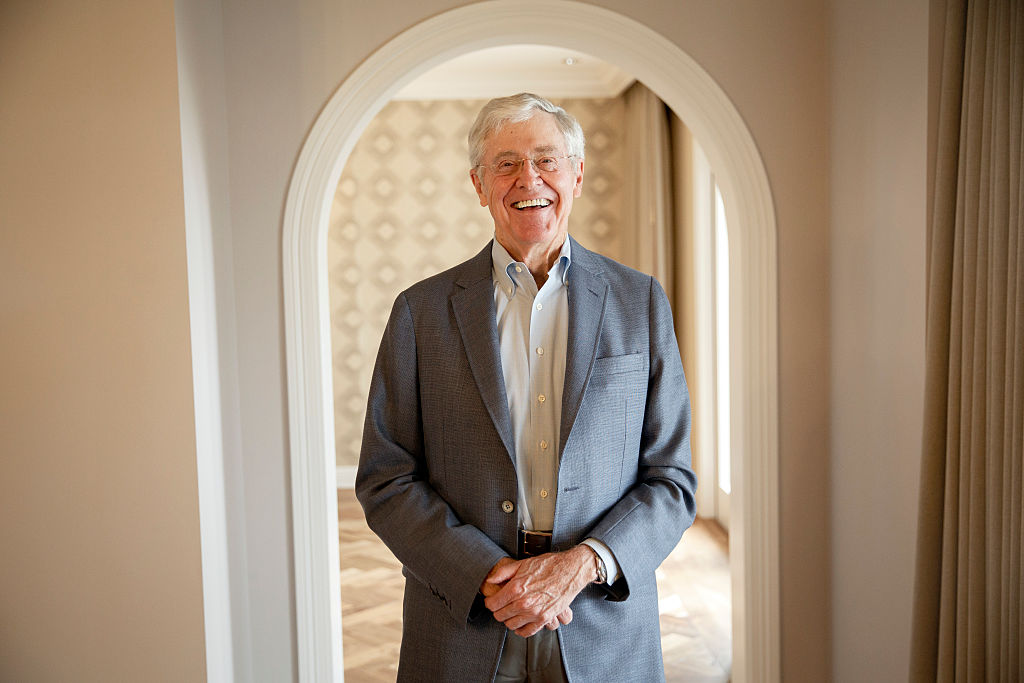
Billionaire Charles Koch created a system for controlling his workers that he called Market-Based Management (MBM). Koch’s employees compared the experience of MBM to life in George Orwell’s 1984. (Patrick T. Fallon for The Washington Post / Getty Images)
At a conference in Orlando, Florida, in 2005, the American billionaire Charles Koch gave a speech explaining how he and his audience could protect “freedom and prosperity in the world.” While accepting an award named after potato chip magnate Herman Lay, Koch explained that he had conceived a “science of liberty,” which he described as “the study and practice of sustainably advancing liberty to create prosperity and social progress.”
The solution lay, Koch said, in economic analysis — treating every interaction between people as a market exchange. He claimed this “Market Process Analysis” helped him build not only his fortune but also his family life and interpersonal interactions.
Out of it, he created what he called Market-Based Management (MBM), a theory for managing workers and his business. The science of liberty he outlined in Orlando applied those same principles to government — in America and around the world.
Playing God
Workers at Charles Koch’s web of companies felt differently. One anonymous Koch employee in Wichita wrote that their colleagues were “walking around like they are in the George Orwell book, ‘1984,’” terrified of the Koch family, the “only major employer in the area,” who used their power “to control the employees and their movement within the other Koch entities.”
Another, in Atlanta, called Koch’s extensive training in MBM “brainwashing.” The atmosphere, others reported, was “cult-like,” and employees were “noticeably unhappy,” with fifty-hour workweeks as well as mandatory overtime and weekend work. A software engineer in Bangalore wrote that at Koch’s companies “managers are GOD. . . . They can play with anyone’s life.”
Some of these disgruntled employees, hoping to convince management to change their ways, insisted they were not “practicing what they preached” — that MBM’s values were good and simply being misapplied. But Charles Koch had worked on the system for decades.
He personally cultivated its materials, and his company forced employees to study them for upward of five hours a week, according to one review. Some of the values in Koch’s system of MBM were simply anodyne — “respect” is its ninth “guiding principle.” But the underlying purpose of the philosophy was to extract maximum profit from employees.
Science of Control
The science of liberty seemed more like a science of control. Koch’s “science” relied on four connected claims about human behavior that structure economic and political life across the globe today.
First, that we should analyze society as merely a collection of individuals, an idea known as methodological individualism. Second, the claim that individuals are motivated only by self-interest, generally though not exclusively in the form of material incentives — or psychological egoism.
Third, an insistence that deliberate planning cannot be trusted: humans are too selfish, and too limited, to make or execute grand plans for society. We should trust the competitive evolution of markets over the cooperative intention of democracy.
And fourth, the belief that everything is — and should be — a market. The world consists of competing individuals, and social science exists to figure out how to structure that competition so prosperity arises out of it. This paradigm is known as market fundamentalism.
Proponents of these ideas present them as inescapable truths about the world, like gravity. If we know how human beings will act, there is no need to speak of how they should act. Thus, “there is no alternative,” as the Victorian philosopher Herbert Spencer put it, to these cruel calculations: they are an inescapable truth about human action.
Political Visions
But these ideas are not scientific truths that experts have discovered. They are political visions that ideologues have created. There are other ways we can live and work, and generally most people prefer those alternatives when asked and frequently pursue them when we are not.
From Samuel Bentham’s program of mechanized and precarious shipbuilding labor to Frederick Winslow Taylor’s floundering efforts to optimize pig iron loading, supposedly optimal methods for manipulating workers have generally failed — until their architects relied on political and economic force to impose their ideas anyway.
Four hundred years of elite scheming have failed to produce either the technocratic control that utilitarians like the Benthams wanted or the pure competition advocated by market radicals like Ludwig von Mises. Every country in the world, even those with little or no political freedom, has major movements that demand better. Those movements do not always win. But every victory builds a foundation for the next.
Today we have labor rights, voting power, and political freedoms — where we have them — because of the hard work of those who came before us. Building on their legacy, we can continue to make a better world now and to create conditions for yet more advances after we are gone.
Control science is not “human nature.” It is not “how the world works.” It is not just orthodox economics or economic common sense or advanced political discourse. Identifying the different intertwining strands that give control science its strength and naming the total result, helps us take it on. Labeling control science — and labeling it accurately as a matter of control — is all the more important because of how it works.
Rule Without Rulers
The irony of control science is that it is ultimately not a theory of control by anyone at all. Control science respects no kings, no presidents, and no gods but what one of Herbert Spencer’s followers called “that awful One to whom it is profanity to pray.” This is an ideology for control by no one, of everyone. Its advocates call this freedom.
The science of control is an attempt at rule without rulers, an abstract authoritarianism, an art of excuses: centuries of elites finding themselves in positions of power and scrambling to justify that power to themselves and the world. This vast program of institutionalized apathy has been developed through, and always relies on, the forceful control of workers themselves.
Identifying this program does two things for us. First, it makes clear that cynical claims about “human nature” are social and political constructions, not an objective truth discovered by capitalists. Second, then, this intellectual history of economic thought reveals how much it has always been about control of us, not by us. We can rally against it accordingly: control science is fake, and it is wrong.
Ideas alone will not be enough, of course. Control science has succeeded by embedding itself in the legal, political, and economic structures of the world around us. It does not describe actual human nature, but it does describe how many people do, and must, act, precisely because of the way capitalists have made the world.
Selfishness is embedded in the real material relations we have with each other: the most responsible strategies for investing, for example, may include investments in oil companies. The cheapest products are produced under the worst labor conditions. Buying better or investing differently as an individual will accomplish little, and it is difficult to build collective movements around doing something that makes us, temporarily, worse off, in a world of economic scarcity and against constant competition by the preachers of selfishness.
We cannot defeat control science as individual consumers. But we can as workers, as voters, and as full human beings. Over the last four centuries, many of the greatest victories for justice, equality, and freedom have relied on mass movements of working people, from the revolutions of the eighteenth century to the New Deal and decolonization in the twentieth century.
Workers’ Control
The twenty-first century has been, in much of the world, a period of defeat and retreat for working-class left-wing politics. But it does not have to be that way. The science of control was made in the workplace. It can be unmade there as well. Labor organizing forces idealistic progressives to ground our projects in material incentives: better wages, improved working conditions, more free time.
This is particularly necessary in the cynical world control science has made. We have been told that everyone is selfish and that an alternative world is impossible. This makes it all the more difficult to believe rousing appeals to empathy and ethics alone. Organizing within workplaces must become part of a broader movement for democracy and equality at work — control by workers, not of them.
Most of us recoil at the idea of an absolute monarch or a dictator. Yet we spend a good portion of our days, and our lives, doing the bidding of bosses over whom we have little power. We should abhor authoritarian company “presidents” and company boards the way we do dictatorship and monarchy. Working people should wield power through robust and assertive democratic unions to force our bosses to take our needs and desires and dreams into account.
A powerful labor movement alone will not end the science of control. And an economy of competing democratic cooperatives would still be one driven by markets and competition. Thus, we also need to aim for democratic control of the economy writ large. Human needs and collective desires, not the movement of markets, should determine what we make and do.
A market is a forever skewed democracy: your voting power is proportional to your wealth, and the most exploitative actors are therefore the most powerful. We should find this an offense against democracy, and we should act accordingly. Rule by market rules has only succeeded in leading us to a world that satisfies no one.
Mass working-class movements, wielding the power of democracy, can build an intentional and deliberate world that reflects our most meaningful and deeply held collective wants, democratically aggregated, rather than our individual purchasing choices, scaled by our wealth. We can build our moral principles and our material needs into the legal structure, social fabric, and collective ideals of our societies so that acting in the common good, instead of against it, becomes easier and more obvious every day.
A Collective Program
We know collective effort can outcompete nihilist competition, because it has done so before: an imperfect fraction of this program of economic democracy saved the world from fascism. Imagine what a full-fledged collective program could do for living standards, economic growth, and climate change.
Through public housing authorities, we can determine where housing is built and how much it costs based on our need for comfortable homes, instead of the political demand to keep housing prices up for those already locked into an expensive mortgage. With utility nationalization, we can replace hated telecommunications monopolies with less expensive, more functional infrastructure that we control.
All of this requires no promises of or belief in a socialist utopia (though it will help us move toward one). Right now, it is right-wing economics that is in the way of lower rent, higher wages, shorter hours, full employment, and economic dignity, for all of us. If we take control of our work and our lives, we can secure a better life together.