Economic Democracy Is at the Heart of Socialism
Democracy should not end when the workday begins. Workers deserve a say over how their workplaces are run — and a claim on the wealth they create.
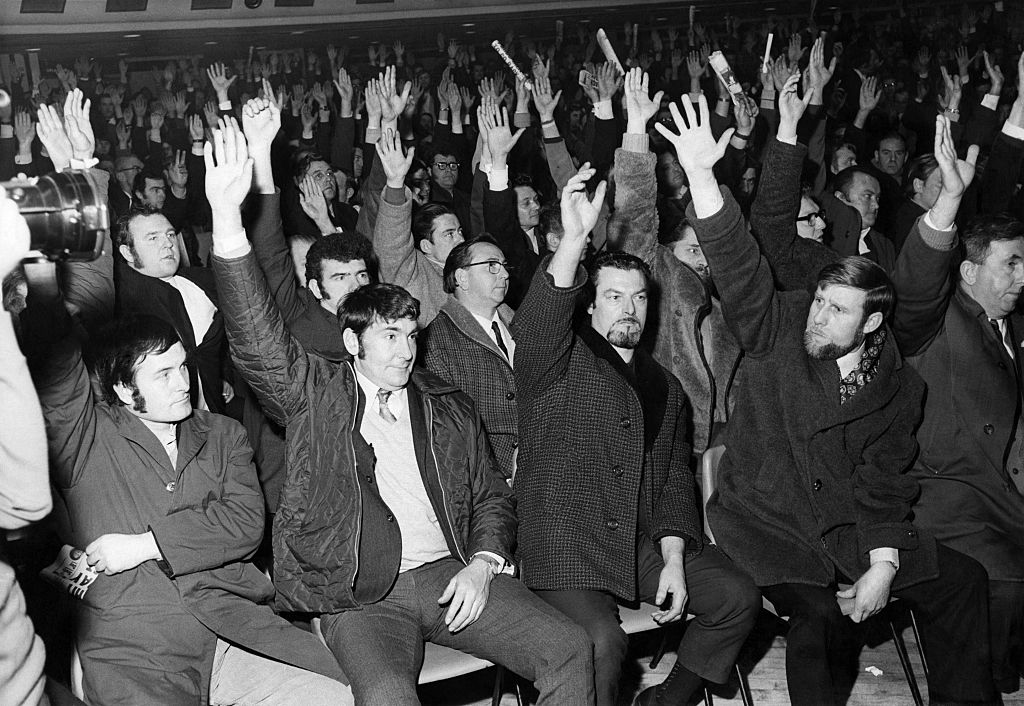
There is no socialism without worker control of the means of production and exchange. (Watford / Mirrorpix via Getty Images)
In 1872, British courts prosecuted more than seventeen thousand workers for a single offense: leaving their jobs. Under the Master and Servants Acts, wage laborers who quit before the end of an agreed term, or who merely refused to show up to work, could be sentenced to three months of hard labor.
Employers who violated the same rule, by withholding wages or firing someone without notice, owed just a civil debt. Across the 1860s and early 1870s, as the labor market tightened and approached full employment, the number of prosecutions rose.
Even before the eight-hour day became one of organized labor’s defining demands, one of the British trade union movement’s earliest sustained legislative campaigns was to end the criminal punishment of workers who left their jobs. They finally won that right in 1875, when workers were finally allowed to sell their time and withdraw at will, coerced though they still were by the mute compulsion of economic relations.
Today even socialist critics of capitalism count the freedom to leave a job as one of the basic liberties that separates a wage earner from a serf. But we need to demand more. Decisions about labor discipline, the pace of work, shift length, and how the proceeds are divvied up belong unambiguously to workers.
While past struggles secured us the freedom of exit, the freedom to not be jailed for simply walking out of our workplaces, it left untouched the question of who rules within them when we have no choice but to stay.
The Realities of Capitalist Labor Markets
At the site of extraction, the boss rules like a dictator. Labor unions and the regulatory state sanded off some of the roughest edges of workplace tyranny, but the forces of capitalist innovation generate creative ways to restore those edges every day. There’s a reason why workers at Amazon warehouses race to fulfill their quotas in an atmosphere of electronic surveillance and skip bathroom breaks for fear of falling behind.
Short of disrupting the system through collective action, the only shred of control workers have under capitalism is the power of exit. Even when workers are in a position to exercise it, though, the power of exit has serious limitations.
For one thing, workers can’t exercise this leverage often — your future job prospects suffer if there are too many gaps in your employment history. For another, in most cases, it’s far easier for a company to replace one of its workers than for the worker to replace the source of their livelihood. Things are a bit different for those workers whose skills are particularly desired by employers, but supply and demand work much the same way in the labor market as they do in any other market — rare skills confer more bargaining power precisely because they are rare. For most workers, most of the time, wage labor in what we can think of as its “natural state” is a take-it-or-leave-it proposition. Workers whose only freedom is the freedom of exit can decide which particular capitalist dominates them, but they still can’t fully control their own lives.
Labor contracts cannot provide a fully enforceable promise of what employers want to pay for. The contract is for time spent under the direction of the employer. The wage pays for time, but the employer is ultimately interested in the results of an employee’s work, which depend also on the employee’s ability and effort over the time for which they are employed. But usually neither effort nor ability is fully observable; monitoring them is costly, and the firm cannot rely on external legal enforcement.
This makes employment a contested exchange, as economists Samuel Bowles and Herbert Gintis put it. For various reasons, the results of employment cannot be contracted for explicitly, especially because much production is done by teams, often involving heterogeneous tasks, and it is difficult to identify the contribution of individuals. (Piecework and independent contracting are exceptions, but these arrangements are impossible in many fields.) Level of effort cannot be contracted for in an enforceable way either — it is even more difficult to observe. What can be contracted for is time at work, under the direction of the employer, within the parameters of a job description.
This matters to the question of whether workers can effectively express their preferences about working conditions on the labor market. It means that much about work is not determined, and so not fully priced, at the point of transaction. It is bargained for among parties already in a contractual relationship — sometimes formally, but more often informally and from day to day. It plays out in employer decisions about how to monitor, discipline, and motivate employees as well as employee decisions about how to work in response.
Terminating the contract is a move both can play in this game, and the possibility hangs over the bargain. This brings the state of the labor market back into the picture: general conditions of supply and demand for labor affect people’s willingness to take the exit option. But crucially, the labor market generally does not clear, and labor is usually on the long side of the market — that is, supply of labor typically exceeds demand at going rates of pay. Unemployment is a perennial feature of capitalism. If a worker can expect to quickly find an equivalent job at their current salary and conditions, the risk of job loss does not have much sting. But workers usually face much more uncertainty than that. Many may be reasonably confident about being able to find some work while being very nervous about finding a job that matches their current pay and conditions. This makes the exit option costly and gives management an upper hand in negotiations about how work is to be done.
How employers use this advantage varies across jobs. They have to deal with the fact that they have paid for people’s time, and that those people are not robots or tools. Employees still have to be motivated to work. In some jobs, a monitor-and-discipline approach works. The employer keeps tight surveillance over the production process or its results and threatens dismissal if the worker does not meet the benchmarks. Amazon warehouse and delivery tracking systems are a pure example, but this strategy has a long history in factories everywhere.
Many jobs, however, are not as easy to monitor. Here employers depend on some amount of internal worker motivation, which tends to be undermined by aggressive surveillance and discipline. High employee turnover is costly to employers too — it takes time to train new workers and replace lost experience. Employers are especially loath to lose their most productive employees, even if it is not always easy to identify who they are. Since it is exactly these employees that are most likely to feel confident about finding work elsewhere, employers try to make sure they have something to lose. Most employers therefore use some combination of carrot and stick, the arts of the human resources department: performance reviews with the possibility of both promotion ladders and disciplinary measures.
We Need Workplace Democracy
Workplace democracy is not in itself an alternative to the labor market; it supplements the right of exit with a voice within the firm. Exit is not enough, not only because of the limited practical freedom people often have to leave a job or to be picky about job offers but also because the cooperative nature of production makes colleagues’ preferences about work highly interdependent with one another. They cannot be accommodated in the same way as individual consumer preferences. Cooperative work needs to be coordinated: for example, in many jobs people have to be on shift at the same time.
Someone must coordinate a team process. But without an effective way for workers to voice their preferences and have those preferences be taken into account, the coordination will happen on the employer’s terms. Workers can only express objections in negative ways: by leaving, by quietly not cooperating, by working less diligently and energetically than they might. At best, collective bargaining through a union gives workers a seat at the table, but they are still usually restricted to responding defensively to employer initiative. In contrast, in a democratic workplace, administrators are accountable to their colleagues. Not only must worker preferences be taken into account, but they must be actively sought. Those preferences can now be expressed positively, with those working together also working out together how best to do the job.
Liberal philosophy typically excludes the workplace from its arguments for democracy on the grounds that it is part of a zone of voluntary exchange in which individuals are best able to freely pursue their own interests. But, as discussed above, because of unemployment, the boss finds any individual worker replaceable, whereas the individual worker cannot be sure of finding an alternative buyer for their labor power at the going wage at will. And even in conditions of full employment, a worker switching jobs is still incurring far more dislocation and inconvenience than a consumer changing purchasing habits. Because there is a relation of power rather than a relation of free and equal exchange, even considerations of liberal political justice can be used to argue that the power should be accountable to those over whom it is exercised. Workers are not inert “inputs” but agents with wills of their own, conscious subjects whose experiences and wishes should be taken into account. Liberal arguments for democracy in the political sphere apply also to the firm.
Bowles and Gintis draw on political theorist Robert Dahl’s observation that “exit” from a firm is often so costly that membership is, for all practical purposes, compulsory. When leaving one’s job entails serious loss of income and stability, the government of a firm begins to resemble the government of a state: because exit is costly, membership is not significantly more voluntary than citizenship in a country. In that sense, the same democratic principles that justify accountability in political life can be extended to economic life as well.
How Would Workplace Democracy Actually Work?
In a socialist economic order where democracy had been extended to the workplace, there could be a wide plurality of specific firm constitutions, but the standard for a midsize to large firm would involve representative democracy, with elected directors appointing and monitoring administrators who would be responsible for day-to-day management. This could be supplemented by committees and referenda as needed, but routine administration is best handled by specialist professional workers with expertise in accounting, logistics, and so on. Democracy does its job by making sure the administrators are ultimately answerable to their colleagues and that working conditions and broad questions of strategy have general approval.
In a fundamental way, democratic firms are very different from capitalist ones. Capitalist firms are ultimately controlled by their owners, who are also the claimants to the residual income left after suppliers, workers, and creditors have been paid. Labor-managed firms, on the other hand, are ultimately controlled by their workers.
Worker-members receive two forms of income from their firms. They earn a regular wage, fixed in advance, and a periodic dividend, their share of the firm’s profit.
There is no way of efficiently maintaining a complex division of labor that would guarantee everyone their dream job. In a democratic firm, membership in a workplace and appointment to specific roles both involve agreement of the worker and the democratic organization itself. Worker-members are free to leave but not to be automatically accepted in a role elsewhere.
Democracy at work would have to be, and we’re confident it will be, economically viable too. People would have little reason to embrace a system that gave them more say but left them unable to meet their needs.
Efficiency in the economic sense is broader than technical efficiency in turning inputs into outputs. It is not necessary for our argument that cooperative firms outperform nondemocratic firms in productivity. Other advantages may make up for some deficiencies in productivity. Workers may prefer less pressure on the job to higher income but be unable to effectively express such preferences in capitalist conditions. However, it is important that labor-managed firms are at least reasonably productive. If workplace democracy came at too high a price in terms of real income, the claim for economic efficiency in the broader sense would be shakier.
Empirical evidence offers little support for the idea that democratic workplaces are inherently inefficient. Cooperative firms perform at least as well as conventional ones in productivity and survival, and often better. As economist Gregory Dow notes, real labor-managed firms do not conform to the familiar caricature of chaos: Their members generally do not shirk work, fight over wages, or rebel against supervisors, nor do such firms quickly collapse or drift back into capitalist control. They manage to coordinate production and maintain discipline without replicating the coercion of capitalist management. Of course, we should be cautious about generalizing too far from these findings, since they come from cooperatives operating within capitalist markets. Even so, the evidence sharply undermines the intuition that only authoritarian management can make production work.
The intuition that democratic firms must be less disciplined than their traditional peers rests on the idea that participation will weaken managerial authority and lower effort. Bowles and Gintis point instead to several mechanisms that can raise productivity. Democracy obliges management to consider the social costs of supervision and the pace of work. While democratic firms still rely on monitoring and incentives, these must win broad consent and so tend to be less arbitrary and more legitimate. Legitimacy makes work less alienating and morale higher — conditions usually associated with better performance.
Workers are also better placed than managers to gauge one another’s effort. Peer pressure and pride in shared achievement can do more to sustain discipline than orders from above, since slacking off harms colleagues rather than distant owners. Profit sharing adds another spur: when returns go to the workforce, each member has a tangible stake in the firm’s results. The effect weakens as enterprises grow larger, but even then measures to improve efficiency are easier to support when their benefits flow to workers themselves rather than to external shareholders.
A further source of strength lies in workers’ practical knowledge of the labor process. Democratic firms give them both the means and the incentive to use that expertise to refine techniques and reorganize work. Innovations adopted through open deliberation gain legitimacy, and the direction of technological change is more likely to reflect workers’ interests than the capitalist bias toward control.
But productivity alone cannot tell us whether work is well organized. Workers also care about the time and security they have outside the workplace and about how they are treated inside it. Those interests belong in any serious accounting of economic efficiency.
Economic efficiency, properly defined, treats people’s preferences about the production process, working conditions, workload, job security, and more, on the same level as their consumption preferences. It is not necessarily an efficiency gain if a diner is able to provide coffee and lunch more cheaply while making its workers’ lives more precarious by quickly adjusting shifts according to demand. The gain to the customers comes at the expense of the security and income of the workers.
There is, however, a tension between worker preferences and consumer preferences. In many cases, better satisfying worker preferences increases the cost of production or makes it harder for firms to adjust when demand changes. And though almost everyone is both a producer and consumer, the things we produce at work are only a tiny proportion of our own consumer basket. As a consumer, other people’s working conditions affect what we can afford. Other things (like quality) being equal, we normally choose a lower-priced product over a higher one, and even if we care about the conditions of production, we usually do not have much information about them. The increased flexibility of employment at the café benefits us directly, even if we would be much worse off if the same conditions prevailed in our own workplace.
Workplace democracy structures people’s choices in ways that make it easier to reach a balance between our producer and consumer interests. It does this by democratizing decisions about work and pay. Unlike many consumption decisions, these are choices that are properly collective. In production, there are so many interdependencies between people’s preferences and formidable collective action problems in reaching generally preferred positions on the basis of individual bargaining. Because workers are also the residual claimants on firm profits, they can directly make decisions about any trade-offs between income and working conditions. To the extent that superior positions can be reached, with higher income and better conditions, democratic workplaces are better equipped to find them, given their advantages in morale, mutual monitoring, and likelihood of revealing information about labor processes in an environment of trust.
Democratic firm management would not mean that producer preferences override everything else, because in a market socialist system firms must still take into account the preferences of their customers and generate enough revenue to cover their costs. Competing firms may make different choices about the pace of work, but they sell into the same markets, and no firm can charge higher prices simply to cover higher costs. The trade-off between higher income and a more leisurely pace of work is put directly to the workers in each workplace.
For workers to exercise these choices, democratic firms need institutions that support them. If competition simply forces every workforce to cut its own pay and intensify its labor, formal control will offer too little freedom in practice. A national labor board could set wage and working-condition benchmarks, giving firms a common floor beneath which they could not compete.
These benchmarks also help to spread gains from productivity growth to workers across the economy. Some sectors, especially in manufacturing, are more prone to labor-augmenting technological change than others, such as personal services. Central benchmarks help to make sure that the incomes of daycare workers, teachers, and hairdressers are not left lagging because gains from technological improvements are captured in industry.
Investment would also need to be organized on different terms. Public banks could finance productive assets in partnership with democratic firms, so worker control would not depend on a workforce’s ability to buy out an owner with its own savings. Even many workers under capitalism who could pool together their savings in this way rationally choose not to do so, because it’s irrational to put all their financial eggs in the basket of a precarious new business venture. While defenders of capitalism might conclude that this makes capitalist labor contracts a mutually beneficial arrangement, we think no one should have to choose between economic insecurity and workplace despotism. Public banks can control enough eggs to spread them in a rational way throughout a number of baskets. Poorly performing firms will still be allowed to go under, but workers won’t lose their life savings when that happens.
The democratic firm does not need to be an isolated cooperative struggling to survive in a hostile environment. It can be a basic cell of a larger, coherent system — one where social ownership, public banking, and market coordination work together to organize production efficiently and on democratic terms.
When the Employers and Workmen Act passed in 1875, Prime Minister Benjamin Disraeli claimed that for the first time in the country’s history, employer and employed “sit under equal laws.” Formally, that was true. Equality before the law meant that neither party could be jailed for breaking a civil contract. But it meant little else in a system where one class owned the means of production and the other was forced to work for them to survive.
Today that most fundamental question of politics — that of self-determination and survival — remains unresolved. Workers already bear the consequences of decisions about production, investment, and the distribution of income. They deserve more than the freedom to protest those decisions. They deserve to be the ones to make them.