German Christian-Democrats Go Cold on LGBTQ Rights
Germany’s former Chancellor Angela Merkel recently said she had been wrong to oppose same-sex marriage. But her party colleagues are turning in the other direction, taking conservative postures in a desperate bid to imitate the far right.
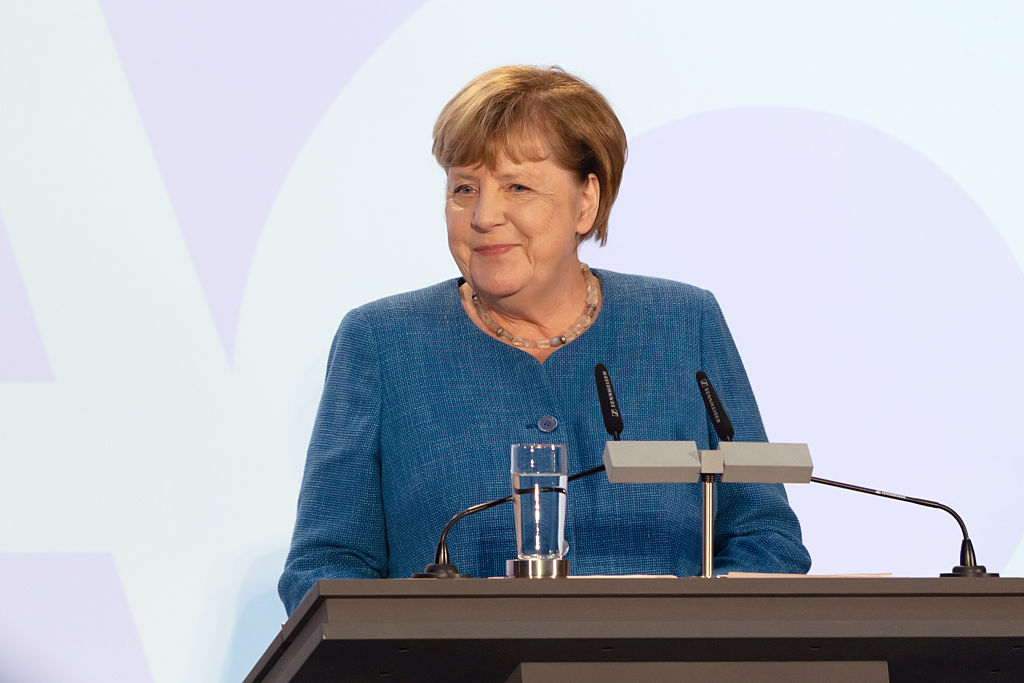
Germany was relatively late among western European countries in adopting same-sex marriage. A decade later, most Germans accept the reform, but a sizable minority is hardening around anti-queer, anti-trans positions. (Christian Ender / Getty Images)
Former German Chancellor Angela Merkel, who has occasionally reflected publicly on her political legacy, recently acknowledged another mistake from her sixteen-year tenure. If she could decide again on the issue of marriage equality, she told the Kaffee und Fluchen podcast on November 13, “I would vote for it today, yes.” At the time, she had various concerns, particularly regarding surrogacy and children. She had already taken a self-critical look at her no vote in her memoir, titled Freedom.
On June 30, 2017, the Bundestag voted 393 to 226 to expand marriage rights to same-sex couples. The majority ultimately reflected the reality in German society: In an Insa poll conducted for right-wing paper Bild the day before the vote, just under 75 percent of respondents supported marriage equality, while only about 20 percent opposed it. A majority of voters for the Christian Democrats (CDU, and their Bavarian allies CSU) were also in favor, and at least seventy of their parliamentarians voted yes; Chancellor Merkel did not. “For me, marriage as defined in the Basic Law is the union of a man and a woman,” she said after the ballot.
The Bundestag vote had only become possible a few days earlier. The Social Democrats, Greens, and liberal Free Democrats had just recently made marriage equality a condition for any future coalition, and, at an event hosted by the magazine Brigitte, Merkel declared the issue a matter of conscience. She thus resolved an issue that could have harmed her electoral fortunes and withheld her own vote. Merkel also signaled to the conservative segment of her electorate, already wary of the “shift to the left” under her leadership, that at least this bastion would hold. At the time, the prevailing view in Berlin’s political circles was that the chancellor wanted to prevent a mass exodus of Christian-Democrats to the rising Alternative für Deutschland, a party of the far right.
Marriage Equality
The chancellor did indeed seem out of step with the times. In 2015, prominent Germans addressed an open letter to Ms Merkel, calling on her to make “marriage for all” a reality. In my capacity as editor-in-chief of The European, a debate magazine I founded, I was among the signatories of that letter. Under Merkel, Germany had become a laggard on this issue in Europe. From the legalization of cannabis to modern immigration laws to marriage equality, the pastor’s daughter from the East stonewalled on every front. She cemented an antiquated worldview that was every bit as stifling as the leaden era under Helmut Kohl’s leadership.
In the same year the open letter was published, Ireland, long a conservative stronghold, had legalized same-sex marriage via referendum. It thus followed in the footsteps of likewise Catholic EU member states Spain (2005), Portugal (2010), and France (2013). Even the United States, where an influential coalition of evangelical Christians had mobilized against equality, finally followed suit in 2015 with a Supreme Court decision that made marriage equality mandatory for all states. In a 2016 New York Times article, I had the opportunity to explain why Merkel’s Germany had fallen behind the other countries mentioned.
At the time, the evangelicals’ protests also caught on in Germany. Starting in 2014, AfD politician Beatrix von Storch helped organize protests in Stuttgart against the State’s Green-Social Democratic education plan, which sought to make “acceptance of sexual diversity” a guiding principle in the classroom. Under the name “Demo für alle” (Demonstration for Everyone), hundreds — soon numbering up to two thousand — people regularly marched across Stuttgart’s Schlossplatz, warning against the “early sexualization” of children; nearly two hundred thousand people from all around Germany had previously signed a petition against the education plan. AfD politicians spoke at the rallies, as did CDU politicians, whose state party convention had demanded a revision of the education plan. The then recently created AfD and the Christian Democrats courted the same demographic, and both paid lip service to standing for the best interests of the child. Chancellor Merkel’s own use of the term “children’s welfare” must also be viewed in this context. The underlying claim — that children are being manipulated into becoming homosexuals or drag queens themselves simply by the mention of homosexual penguins in children’s books or by encountering drag queens — is utter nonsense.
This propaganda has largely failed; even today, most of the country accepts marriage equality: according to this year’s Pride Report by the Ipsos Institute, 70 percent of Germans support it and a mere 8 percent reject any legal recognition of same-sex couples. Yet openness toward sexual and gender diversity as a whole is declining. In the Robert Bosch Foundation’s Diversity Barometer, acceptance in this area fell from 77 to 69 out of 100 points between 2019 and 2025. The decline is most pronounced in acceptance of transgender people. In 2025, 23 percent strongly agreed with the statement that a gender transition is “against nature,” compared to 15 percent in 2019. According to Ipsos, only 39 percent now support health insurance companies covering gender-affirming treatments, 10 points less than the previous year. A radical rejection of transgender people has replaced the aggressive sentiment against homosexuals. Minorities must not allow themselves to be pitted against one another here, because the pattern of exclusion is always the same: people are to be socially ostracized based on a characteristic for which they themselves are not responsible.
Gay, Not Queer
And that brings us to today’s German right, from the Christian Democrats to the AfD: When leading AfD politician Alice Weidel, herself a lesbian, says: “I’m not queer; I’m married to a woman,” and CDU politician Jens Spahn makes a similar statement on the record (“I’m gay, not queer”), this is about positioning themselves on the side of those who are now accepted while simultaneously, as a supposed member of a social majority, looking down on others. Here, “queer” is understood as different, as colorful, as something that rubs people the wrong way. Which, conversely, means that homosexuality is acceptable only if it’s not visible, if it conforms to the norm, and that the astonished remark “I never would have thought you were gay” actually implies that you can tell “real” gay people are gay “a mile away.” According to this interpretation, being different is acceptable in Germany as long as it isn’t visible. Since people’s visibility reflects their social acceptance, requiring them to remain invisible means only that they are not accepted.
Enter Bundestag president Julia Klöckner, who constitutionally bears the second-highest office in the German Republic. While in recent years the rainbow flag had flown on the Reichstag for Berlin’s Christopher Street Day (CSD: the name for Berlin Pride), Klöckner has put a stop to this. Her arguments for removing the symbol were flimsy: she says CSD is a demonstration with specific political demands that go beyond a general commitment to human rights and diversity, and that the Bundestag administration, bound to neutrality, must not endorse these demands. On the International Day Against Homophobia in May, the flag is still allowed to fly. Her predecessor, Bärbel Bas, had it raised for the first time for the CSD in July 2022 and saw no conflict with neutrality in doing so. Klöckner’s critics accused her of having “limited intellectual depth.” Here, as previously with Merkel, one can only assume Christian-Democrat politician Klöckner is engaged in a strategic calculation aimed at the AfD electorate.
The fact that today’s conservative Chancellor Friedrich Merz comes to her defense by stating that the Bundestag is “not a circus tent” shows the direction in which the Christian-Democrats are headed. Mr Merz, who has shown himself completely devoid of empathy — and not only toward sexual minorities — is thereby supporting the subtle jabs aimed at those whom the far right seeks to render invisible once again.
Experience shows that wherever rhetoric shifts to the detriment of minorities, violence against them increases, as if dams break when permission to discriminate is granted from the very top. In Germany, the number of anti-LGBTQ+ crimes reached a new high in 2025. The Federal Criminal Police Office recorded 2,377 offenses, 13 percent more than the previous year. Crimes motivated by sexual orientation rose by 17 percent to 2,070, while the number of violent crimes in this category increased from 253 to 284. Since 2010, the number of cases has increased nearly tenfold.
Berlin’s Office for the Protection of the Constitution reports that right-wing extremists and Salafists are teaming up to beat up queer people. The columnist Ulf Poschardt, today a right-of-center commentator, once wrote in an opinion piece that the heterosexual man had been the biggest beneficiary of the liberation of gay men. What he meant, in essence, was that, as a man, one no longer has to conform to strict, restrictive gender roles. In this sense, queer people are a necessity for any open society. If you render them invisible, you also homogenize the majority and deprive it of the possibility of diversity.
With her change of heart on same-sex marriage, Ms Merkel is distancing herself from the CDU’s shift to the right and offering a call to action for a party that has lost its bearings. With his strategy of trying to outflank the AfD on the right, Merz promised to halve its electorate; and yet instead, his disastrous leadership has done the same to his own party, which now lags well behind the AfD in national polling. Unfortunately, it is to be expected that Merz will stick to his course, despite the devastation he has caused and despite wiser voices warning him against it.