The Americanization of European Conservatism
Europe’s conservative politicians are increasingly obsessed with online culture wars rather than broad projects for society. It reflects a postmodern shift in which once deep-rooted party organizations are replaced by skirmishes on social media.
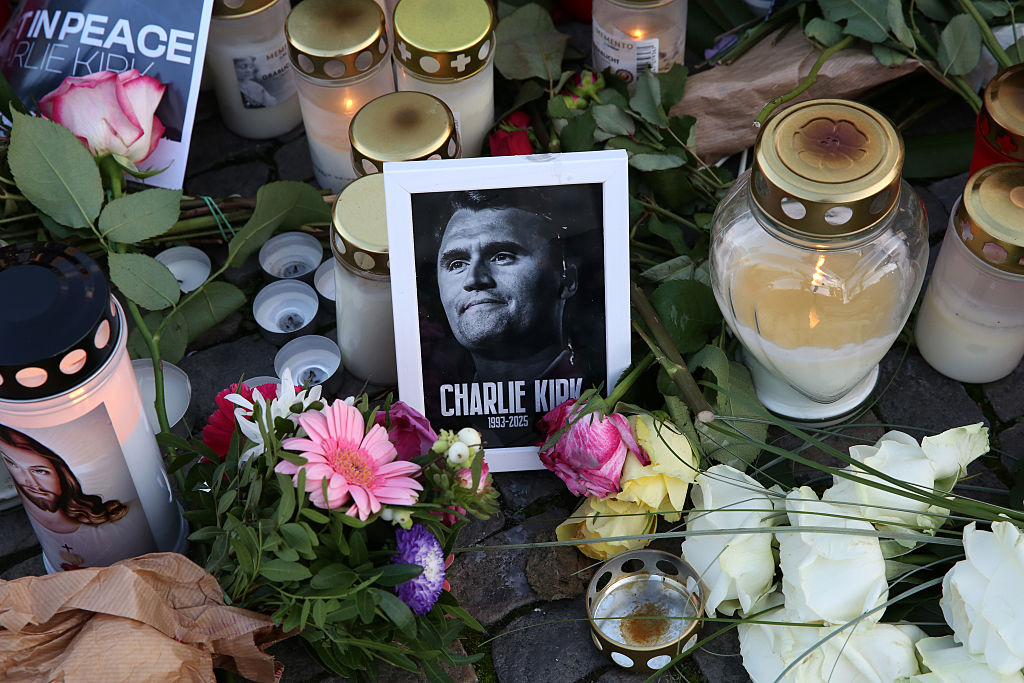
Flowers and candles are seen at a makeshift memorial for murdered American conservative activist Charlie Kirk on September 14, 2025, in Berlin, Germany. Members of the right-wing Alternative for Germany (AfD) party held a memorial service in front of the US embassy. (Adam Berry / Getty Images)
When Charlie Kirk was murdered earlier this fall, he was upheld as a martyr by conservatives not just in America but globally. He had not hitherto been an especially international figure nor was his assassination particularly unique in a United States that has seen a recent escalation of political violence. Still, conservative politicians created a transnational cult around him.
In Germany, both Chancellor Friedrich Merz’s center-right Christian Democrats (CDU) and the far-right Alternative für Deutschland (AfD) cast Kirk as one of their own: CDU legislator Caroline Bosbach presented him as a “fighter for Western values” while her colleague Johannes Volkmann called for a #JeSuisCharlieKirk movement; the ruling party’s youth organization mourned him as a slain fighter for freedom of speech.
The AfD went even further, with the nationalist party’s coleader Alice Weidel drawing attention to his murder during a debate on the federal budget and calling for an emulation of Donald Trump’s declaration of “antifa” as a terrorist entity. She even staged a vigil for Kirk in front of the US Embassy. Meanwhile, public media pressed left-wing Die Linke politician Heidi Reichinnek on her assessment of Kirk. Her apparent lack of sorrow over his death — citing his far-right views and justification of gun violence — sparked media outcry, depicting her reaction as a reflection of worsening polarization.
Yet it is unclear how much this topic truly concerns the German public. In a recent INSA poll asking Germans a rather leading question — whether they are “sorrowful” about Kirk’s murder — roughly one in three could not give any opinion; among those who self-identify as in the political “center,” 38 percent said they had no opinion. When the AfD’s deputy leader in the state of North Rhine-Westphalia sought to emulate Kirk’s speaking tours — preparing professional media to film the proceedings, organizing ads, and garnering some media attention — only fifty people attended his event in Düsseldorf, out of its two-thirds of a million residents.
This development is not limited to Germany. Italy’s deputy prime minister, Matteo Salvini, said he cried over the shooting, the Lithuanian Parliament held a moment of silence in his honor, and Serbian president Aleksandar Vučić condemned social media posters’ “sick expression of joy” in a speech at the UN General Assembly. In the Czech Republic, Cardinal Dominik Duka and various politicians commemorated Kirk in a Catholic mass.
However, these events drew few participants: In Paris, a vigil only brought in 250 attendees. In London, a similar event attracted only 500 people, even though in polling Brits said that his murder was by a wide margin the main news story they’d heard about that week.
All this expresses a transformation of conservatism, as it grows more transnational but also increasingly detached from local concerns. Recently, a legislator in one German state parliament proudly posted himself wearing an Immigration and Customs Enforcement (ICE) shirt to celebrate the anti-immigrant raids in the United States — a sign irrelevant to most citizens.
Instead of relying on local traditions and symbols used by right-wing nationalists, the AfD is increasingly appropriating the aesthetics of the American far right. Anton Jäger has described such developments in his concept of “hyperpolitics” as “a form of politicization without clear political consequences” that is “low-cost, low-entry, low-duration, and all too often, low-value” due to its inability to mobilize any constituency long enough to effect meaningful change. It is oriented toward current (often online) discourse and easily swayed by movements in the media.
After Mass Parties
In this, we can see a reversal of the historical turn from elite to mass parties that Gerhard Leibholz observed in his fundamental work Structural Problems of Modern Democracy.
When democratic politics first emerged, Leibholz argues, it was dominated by elite groups focused on winning the favor of already-engaged citizens, with success determined by the question of personality. This form of politics excluded most people from any influence, as it was structured by elite opinion-formation, determined solely by politicians and the media.
However, capitalist development made this situation untenable. The previous personal forms of domination were being eroded by industrialization, breaking down the previous structure that maintained popular consent for elite interests.
As such, Leibholz explained, the form of integration had to change, taking the form of mass parties. Workers were no longer under the thumb of feudal lords but capitalists who required a new way of activating the population, also drawing it into political life. This served to democratize politics: it was no longer just a matter of currying favor with elites, as the wider population became politically involved and sought to effect change by democratic means. From Leibholz’s perspective, this was also a way of stabilizing the democratic order against the socialist threat: the parties could discipline their followers while integrating the previously excluded masses.
Yet he also commented on his fears that this integration could end up not lasting by the 1960s. Ultimately, it was the success in integrating the mass parties into the state that led to their unraveling. Following World War II, workers were able to achieve key concessions in both the future Soviet and Western blocs. The 1973 oil crisis, however, challenged the viability of the status quo: the West confronted seemingly permanent stagflation while in the East the existing conditions could only be sustained on credit. In his The Triumph of Broken Promises, Fritz Bartel identified a key transformation in this regard. Now both blocs were competing over who could enforce economic discipline by overturning these gains without risking unrest:
After 1973, however, this new “politics of breaking promises” became the terrain on which democratic capitalism and state socialism waged their contest, and the stakes of this new struggle were nothing short of existential. Governments that could successfully impose economic discipline without inviting a destabilizing social backlash would survive; those that could not would collapse. Thus . . . the Cold War began as a race to make promises, but it ended as a race to break promises. Democratic capitalism prevailed in the Cold War because it proved capable of breaking promises and imposing economic discipline. Communism collapsed because it could not.
In the Soviet bloc, the ruling parties were already hollowed out by then, having been transformed into representatives of state power itself, instead of an institution that workers saw as a means of influencing their conditions. This was sure to isolate such parties from wider society. In the West, however, the parties were still integrated with the population. This difference was crucial. They could take back what the workers had gained in the wake of World War II without the risk of revolutionary unrest, using their means of disciplining their followers to isolate the resistance to the reforms. Yet this came at a cost: they undermined the conditions for the viability of the social institutions they relied upon to generate the loyalty of their voters. Once lost, this was not easily regained.
Isolated
This transformation has created the conditions of a reversal to the previous elitist politics — yet accompanied by a paradoxical new kind of politicization. While in 1980 only 47.9 percent of the German population reported itself as politically interested, this had increased to 67 percent by 2023.
However, this form of politicization is based around elite opinion-formation, effectively excluding the majority of the population from the political process as active participants. Whereas media used to be a tool of political movements to advance their messages, media are now actively structuring paths to politicization — and with the media largely owned by the wealthy, it’s clear who’s benefitting.
Parties’ income today is ever more reliant on state grants and donations from corporations. Citizens still meaningfully engaged in politics represent only a minority — and parties are increasingly focused on concerns irrelevant to most citizens. For instance, Germany’s CDU lost nearly half of its annual income between 1998 and 2021, its income from membership decreasing by 36 percent in this period. Nowadays a majority of its income instead comes from the state itself. A similar shift has happened in other parties, reflecting their loss of social roots.
Isolated from wider society, unable to rely on local community leaders to secure their voters, conservatives rely on culture wars to popularize their agendas. Yet the content is increasingly constituted on American terms, a consequence of both the conservative elite and the media being transnational: the British far right, for instance, is backed by evangelical donors, and ideologically reproduces a Christian nationalism hitherto largely alien to British politics. Far-right leader Tommy Robinson’s recent Unite the Kingdom march even used culturally jarring chants such as “Christ is King.”
This is also proving successful. Instead of being integrated into a local church or union local that provides an ideological structure, individuals’ politicization has become atomized. Such is the condition of the “terminally online,” where politics has become bound up with media consumption. Isolated from their local community, the audience is instead pointed to controversies in American politics — a welcome development for the right wing, ensuring that people remain demobilized and focused on events that they cannot meaningfully influence.
However, this is affecting the Left too, with anti-Trump “No Kings” demonstrations being held in Germany — as if participating in the American protests, with no adjustment to German conditions. Die Linke’s youth organization made statements on the Washington shooting of two Israeli embassy staffers, and recently multiple state chapters made posts criticizing the remembrance of Charlie Kirk, also drawing some media outcry. Yet this same party has, for instance largely avoided any activity opposing Germany’s rising militarism, as defense spending is now tripled compared to pre-2022 levels.
Is there a better way? Yes. In Belgium, the Workers’ Party (PTB), has worked on sinking roots in working-class communities, organizing networks of doctors offering free primary care, creating festivals, and leading campaigns to preserve local swimming pools from closure. This more granular presence has also given the party political autonomy to challenge the societal consensus on increased military spending. It is politicizing people in a more meaningful way, by connecting their immediate and material problems with wider political developments.
Countering the tendency to polarize around what’s happening in US media, this connection between the local and the big picture offers a way to mobilize ordinary people who aren’t addicted to the culture wars.