German Christian Democrats Are Paralyzed by a Far-Right Surge

Next month’s state elections in Germany could see the Alternative für Deutschland reach power for the first time. The ruling Christian Democrats seem paralyzed and are increasingly imitating their rising far-right rival.
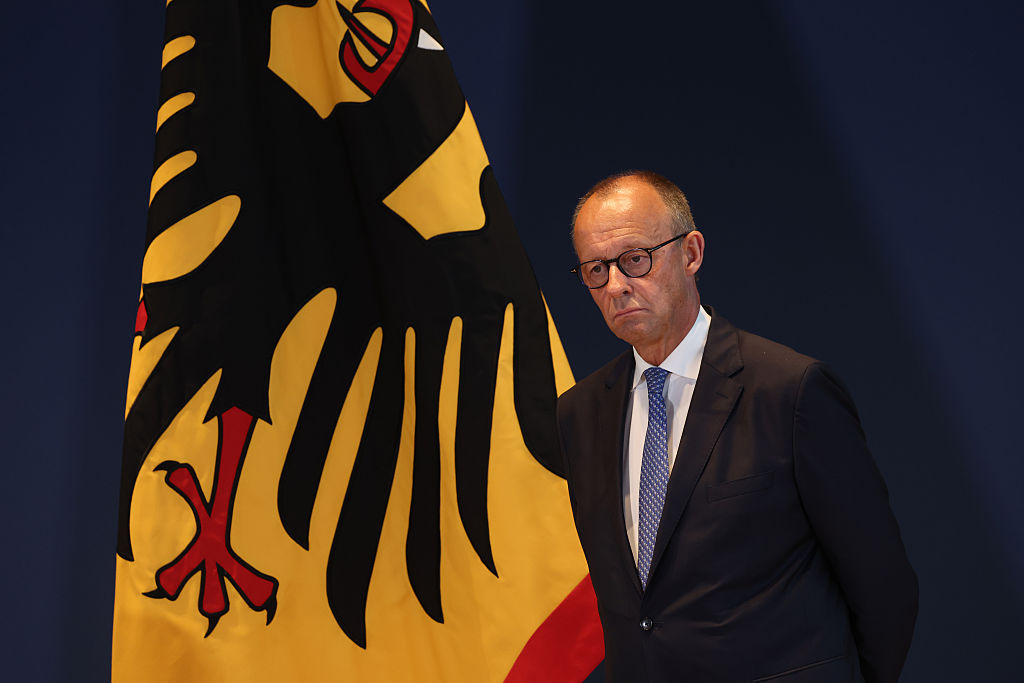
German Chancellor Friedrich Merz stands next to a flag showing the German federal eagle as he attends the dismissal and confirmation ceremony of government cabinet members on July 29, 2026, in Berlin, Germany.

Eighteen months after Germany’s federal election, Chancellor Friedrich Merz is floundering. He promised to stop the Alternative für Deutschland, but now some in his party are turning toward compromise with the far-right party. (Sean Gallup / Getty Images)


Next month, three state elections will test whether Germany’s postwar consensus against governing with the far right will survive. On September 6, roughly two million voters in Saxony-Anhalt go to the polls; two weeks later, on September 20, they’ll be followed by voters in Mecklenburg-Western Pomerania and the capital, Berlin.

In these first two contests, the Alternative for Germany (AfD) is leading polls; in Berlin it is running second. In Saxony-Anhalt, it is far ahead, polling around 40 to 42 percent. It is within striking distance of an outright majority that would let it govern alone, something no far-right party has done in any German state since 1945.

The AfD is a party whose branches in several Eastern states have been formally classified by domestic intelligence agencies as “confirmed right-wing extremist.” Yet today, it tops nationwide polls and has opened up its widest-ever lead over Chancellor Friedrich Merz’s Christian Democrats (CDU). Even in Berlin, a city that has never before been remotely within the AfD’s reach, it is now polling in the high teens, making it competitive for first place for the first time in the capital’s history.

This is the backdrop against which Merz now governs. While he took office in May 2025 promising to cut AfD support in half, national polls this summer have shown his center-right camp trailing the AfD by around 7 to 9 points. Merz’s own disapproval ratings top 80 percent in some surveys. The “Brandmauer” — the “firewall” by which Germany’s main conservative force has refused any coalition or cooperation with the AfD since its founding — is visibly under strain. While at the federal level this remains a theoretical prospect, in the East a growing number of local and state-level CDU representatives are open to working with the AfD.

Uncomfortable Allies

Behind the bad poll numbers is a deeper, more structural problem: On the conventional political spectrum, the CDU and the AfD occupy the same broad camp: the center-to-far right. However, for much of the last two decades, including under Merz’s current coalition, the CDU’s habitual governing partner has been its historic opponent, the center-left Social Democratic Party (SPD). Of the last six federal governments, four have been “grand coalitions” of this kind: arrangements born of necessity rather than conviction.

Naturally, this has led to uncomfortable compromises, as the CDU and the SPD have different views on the economy and working life. Faced with the challenge posed by the far-right AfD, Merz set out to do the impossible: to position the CDU further to the right while simultaneously forming a coalition with the Social Democrats.

That pattern is not unique to Germany. In the United States, Britain, and France, middle-of-the-road parties have increasingly been forced into uncomfortable alliances or minority governments to keep far-right movements out of power. In each case, the effect has been to hollow out the center rather than reinforce it. Germany is following the same trajectory: as the CDU and SPD have leaned on each other to govern, both have bled support — and not only to the AfD. Die Linke, the democratic socialist force in part descended from the heirs of East Germany’s ruling party, has also been gaining ground, particularly among younger and urban voters, and is now running competitively for first place in Berlin. A hollowed-out center produces strength at both ends of the political spectrum.

What is unfolding looks a bit like a Greek tragedy: an inevitable outcome arising inexorably from choices already made. In state after state in the East, the CDU is running out of viable coalition partners other than the AfD. And the SPD, the Greens (both center-left), and the libertarian Free Democrats (FDP, center-right) together would not have enough votes to scramble together a coalition. The FDP seems not to even clear the 5 percent threshold required for parliamentary representation in any of these states. In this situation, the CDU could, at best, lead a minority government but would be dependent on ever-shifting majorities.

One option for Merz’s party is to abandon the “firewall” and form a coalition with the AfD, on either the federal or the state level. Yet should such alliances ever be struck, this would almost certainly fracture the CDU. The fault line is already visible at the grassroots. While an increasing number of ordinary CDU members and local officials in the East have said publicly that they see cooperation with the AfD as inevitable, or even desirable, such a union is still anathema to most — yet not all — of the national leadership around Merz.

This situation is also creating a challenge to Merz’s own leadership, barely eighteen months after his party came first in the 2025 federal election. The chancellor seems to lack any knack for success, either in governing or in dealing with people. He is perceived as aloof and lacking in empathy. Some commentators say a “palace revolt” is at hand. We may be set for a change of chancellor without new elections, a mechanism used only three times in German postwar history, as a way to stop the party’s decline and to hinder further damage.

The name that keeps recurring in these discussions is Hendrik Wüst, the state premier of economic powerhouse North Rhine-Westphalia and, by most polls, the most popular figure in the CDU. Wüst represents the party’s more centrist wing, aligned with former Chancellor Angela Merkel. His supporters argue that only a course correction in that direction, away from Merz’s attempt to blunt the AfD’s appeal by moving right on migration and other issues, offers the CDU a way out. Wüst has not directly commented on the speculation, yet party insiders claim that he could be persuaded. The case for such a correction rests on a specific empirical claim: that Merz’s strategy of competing with the AfD on the AfD’s own terrain, for example matching its rhetorical intensity on immigration, has not won back voters but has continued to push them further right.

Normalized

Still, the strategic dilemma is not just about Merz’s own fate. In a state like Saxony-Anhalt, the AfD is far in the lead, and even its national advantage over the CDU is significant. Should Christian Democrats entertain a coalition with the AfD in such circumstances, this would likely make the party of Konrad Adenauer and Helmut Kohl the junior partner in a far-right-led government. It’s an unimaginable prospect.

Analysts say that such a gain for the AfD in Saxony-Anhalt after the September 6 vote would be more than a symbolic win. Aside from the historical milestone of a far-right government, its consequences would ripple into the Bundesrat — the federal chamber representing the different German states — and further normalize the AfD ahead of six more state-level contests due before the next federal election scheduled for 2029.

Berlin’s vote on September 20 — complicated by this January’s power-grid blackout, an unresolved housing crisis, and the withdrawal of the CDU’s own incumbent mayor from the race — adds a second, very different kind of test. It will tell us whether the AfD’s appeal, long concentrated in the former East, can also take hold in a diverse, historically left-leaning capital.

For now, the AfD’s plans for Saxony-Anhalt reveal what Germany would look like once the party comes to power. It promises the abolition of public television and radio, an end to mandatory visits to concentration camps for school kids, the exclusion of children with disabilities and foreign children from public schools, and the abolition of Christian holidays in favor of pagan-Germanic ones. The CDU could never endorse any part of this platform. However, the party is considered highly adaptable when it serves its interest to remain in power, as demonstrated by its pivot from Merkel to Merz.

Whatever happens in September’s elections, the underlying tension will remain. The CDU built its postwar identity on being the moderate anchor of the German center-right. Chancellor Merz could not keep his promise to halve the AfD’s results; in fact, the trend has moved the other way, and quickly. The result will either be a CDU that governs with the AfD or a CDU that finds salvation in picking up where Merkel left off.

In any case, it will be a CDU without Friedrich Merz. He will go down in history as the chancellor who enabled the far right to triumph over the CDU.