Under Capitalism, Socialism Will Never Disappear
The Left won the midterms not by inventing a new politics but by reopening old fights the Right thought it had won. As long as capitalism exists, socialism can’t be consigned to the past.
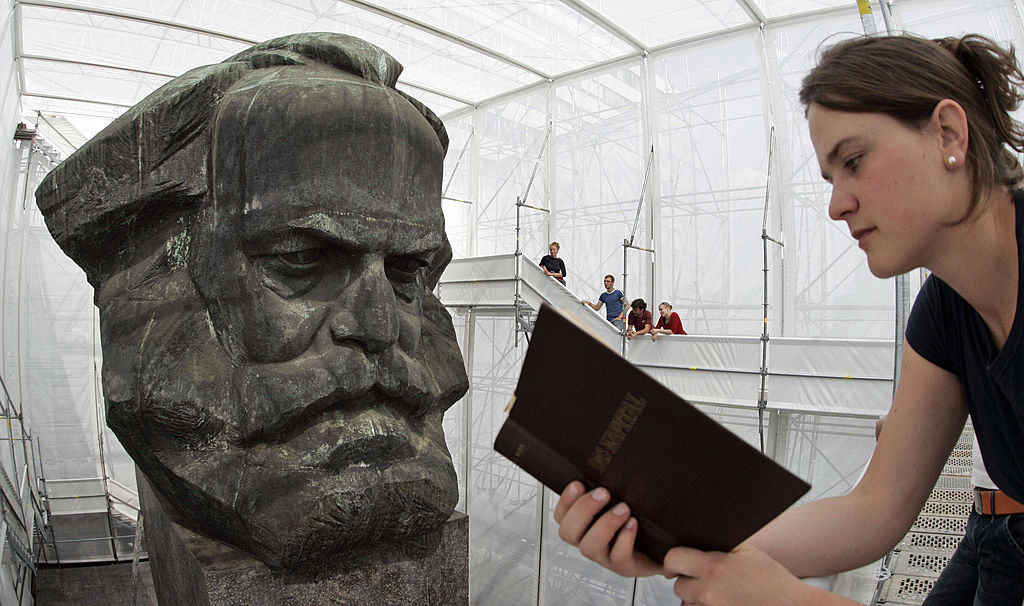
Capitalism keeps raising its own gravediggers from the grave. The Left’s victories are proof that socialism is no more a relic of the past than capitalism is. (Uwe Meinhold / DDP / AFP via Getty Images)
If socialists and progressives had a good night on November 3, it wasn’t so much because they brought new ideas to the election, but because it was a chance to relitigate fights the Right thought it had won years ago: universal health care, Palestinian solidarity, and the expansion of the labor movement. We even got a rematch between George W. Bush–era Islamophobia and two of the Muslim Americans who had to live in its shadow, Adam Hamawy and Abdul El-Sayed.
Many have lauded Zohran Mamdani’s novel use of the term “affordability” for the recent shift in political common sense. But while his branding is new, his politics are not. Mamdani has never styled himself as a new kind of politician. He seems to be constantly locating himself in history, comparing himself to Milwaukee’s sewer socialists and New Dealers like Fiorello La Guardia. This makes sense when you consider that his policies represent decades of struggle: the project of expanding democracy into the workplace dates to the late nineteenth century, and the fight to guarantee health care as a right dates to the early twentieth.
Critics often ask why socialists are bringing a nineteenth-century ideology to bear on twenty-first century problems. The simple answer is that it seems to be what’s working. Since the turn of the twenty-first century, a series of global social movements have sought a new kind of political orientation, one that would allow for a break with the politics of the last century and the historical culs-de-sac they crashed into. Every few years brings a new form of right, center, and left politics: Occupy, Abundance, the Yellow Vests, the Movement of Squares, prison abolitionism. These movements all respond to real problems, but what’s new about them is mostly just branding. Few offer genuinely new critiques or build lasting political constituencies or institutions. Their strength is being novel enough to draw a crowd, drive a news cycle, or launch an academic career. Such innovations move to the same rhythm as capitalism’s own churning drive to simulate invention, revolution, and disruption across the economy.
At the same time, one sees the appeal. We can’t exactly blame radicals for wanting a disruption of their current institutions. Everywhere you look, leftists are trying to overcome the NGOization of the Left and searching for a common ground between their alienated, specialized critiques. Ecologists want to talk about the environmental catastrophe of the genocide in Gaza, while anti-racists want to connect their work to the extreme weather events that disproportionally effect the Global South. This is the basic drive of left-wing politics: to establish continuities between spheres of knowledge and to build connections between people.
The 20th Century Never Died
To find that meeting place in socialism is to recognize that what is happening to you has been happening to you for a very long time. Embracing the old language means realizing that you’re settling unfinished business rather than facing a new foe. Comparing the capitalist class to the aristocracy that came before it enables a person to see how arbitrary and contingent ruling-class power really is. One can understand why Bernie Sanders traded loaded terms like “bourgeoisie” and “proletariat” for the “1 percent” and “99 percent.” But it was just as important that he held onto “democratic socialism.” The term signaled that he was continuing a struggle and adding to an existing tradition of critique rather than declaring a year zero for left politics.
We are likely to be haunted for years by how dynamic, inventive, and exciting the twentieth century was. Every decade brought a new way of dressing, a new style of painting, and new stage in the maturation of cinema and popular music. Our hunger for political novelty is not just a reflection of market forces. It’s also a long shadow of that era of continuous revolution in politics and culture.
Look closely, though, and you’ll find many of the twentieth-century movements that sought a break with tradition did so while grabbing hold of another tradition buried even deeper in history. Le Corbusier claimed his form of architecture would clear “the charnel house of past ages” that our homes had become, but he did so by marrying the mathematical proportions of the Parthenon to the logic of mass production. As much as Henri Matisse and Pablo Picasso wanted to carry Paul Cézanne’s project into the future, they were also looking for a way to reconnect Western painting to the animism of African sculpture. The French New Wave paid an equally backhanded compliment to the “naive” genre films of Americans like Raoul Walsh and Sam Fuller, whose primitivism could liberate French filmmakers from their own pretensions and refinement.
As Long as There’s Capitalism, There Will Be Socialists
Even Karl Marx had this moment of paradox. In The Eighteenth Brumaire of Louis Bonaparte, he writes that “the social revolution of the nineteenth century cannot take its poetry from the past but only from the future.” A few lines later, he quotes the Gospel of Luke 9:60: “Let the dead bury their dead.” Marx was inveighing against the tendency of revolutionaries to reach for the words and costumes of past eras when faced with the task of changing the world: Rome for the French Revolution, the Old Testament for the English Civil War. This awkward LARPing is what turns history’s repetitions into farce. Yet Marx’s famous line about history occurring “first as tragedy, the second time as farce” is itself framed as an amendment to Georg Wilhelm Friedrich Hegel. Even the poetry of the future has a few allusions in it.
The difference between the French revolutionaries’ idealized Rome and today’s democratic socialism is that socialism is no more a thing of the past than capitalism is. Capitalism constantly calls the concept back into existence, raising its own gravediggers out of the grave, over and over again. As long as capitalism exists, it will exploit workers and destroy the planet, and the masses will find a way to fight back. Our present sits on a much longer timeline than the twenty-four-hour news cycle has accustomed us to. One day we’ll have new words and new costumes, but those belong to a new world, and we’re not there yet.