Anthropic’s IPO Is a Bid to Manufacture Confidence
The firm behind AI software Claude is offering shares to the public. It’s meant to boost confidence in Anthropic’s future at the moment when most Americans are turning against data centers.
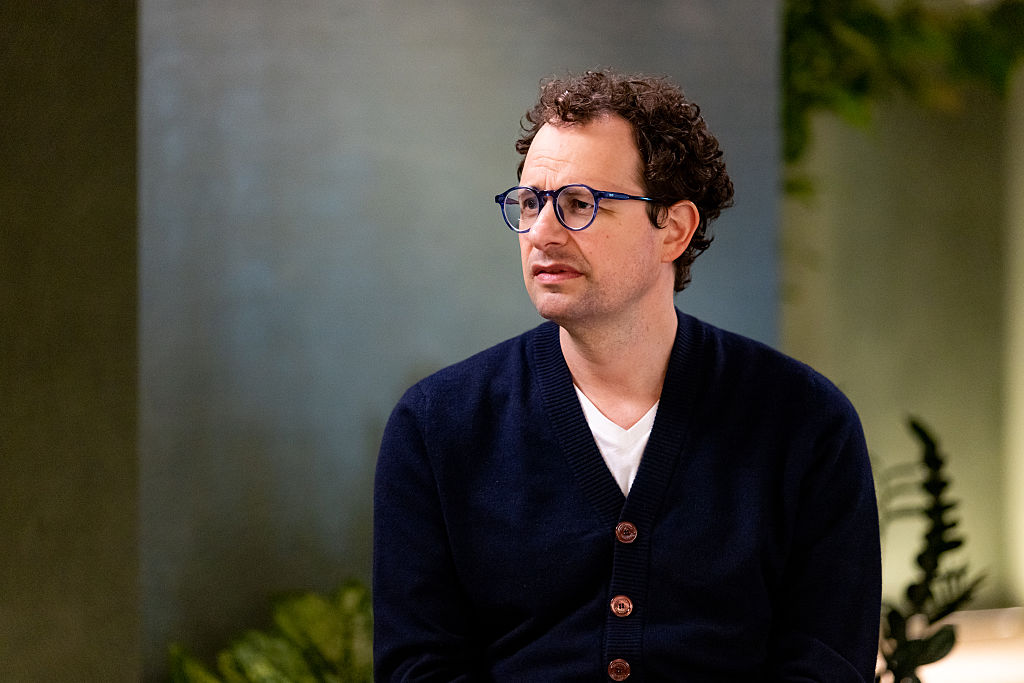
AI’s market success relies on the promise of future transformative change. But increasingly, the boosterism is meeting resistance from an alliance of ordinary Americans concerned about who is really benefiting. (Jason Henry / Bloomberg via Getty Images)
Anthropic, maker of artificial intelligence software Claude, is going public this Thursday. The initial public offering (IPO) could top the record SpaceX set earlier this year, once a concurrent private stock placement is counted. In February, Anthropic raised capital at a $380 billion valuation, and it is now seeking buy-in at $1.4 trillion. The rise has only been matched by the demand from investors, as Bloomberg reported the IPO road show was oversubscribed by six times the available shares. In other words, institutions will be crowding out individual investors vying for early gains.
Anthropic aims to raise $64 billion from the IPO in a nontraditional coming-to-market event. It has already been widely noted how the IPO’s role has changed over the last decade, with the flipping of public and private functions. Previously companies went public when their growth depended on it, raising capital from the public in order to continue expansion. But today, exponential growth takes place across multiple rounds of buy-in for private credit and venture capital (VC) funds. When those investors are ready to sell, the IPO works, in part, as an exit opportunity. Meaning: the people in the know, inside Anthropic, are rushing to market in order to offload their shares at peak value into your hands.
Anthropic is aware of the problem with how this looks. For this reason, out of its IPO of 825 million shares, over 800 million (97 percent) are fresh issuance — newly formed slices of the company that dilute previous shareholders’ stock but have the benefit of providing capital upfront to the company. This is not a normal distribution for a large IPO but does mimic the earlier framework of SpaceX — that is, another company that oriented its price and offering around retail interest. Essentially, these companies are duping investors with the facade of fresh issuance as proof of internal confidence, understanding that selling pressure will spike in the months after the firm goes public.
Obscure lockup terms mark out twenty-three liquidity events — days when insiders can sell shares — beginning on the first day of trading. Typically, early investors would wait six months to a year before being able to sell. The thinking is presumably the following: increase public confidence by smoothing out the change of hands, in order to avoid a deluge of shares going live at any one time.
Forever Young
In preparation for going public, Anthropic filed its S-1 prospectus document with the US Securities and Exchange Commission (SEC). The tech-and-VC All-In Podcast with Chamath Palihapitiya and Jason Calacanis opened its post-S-1 commentary with David Sacks by calling this the greatest wealth-creation event in the history of Silicon Valley. Indeed, more than a thousand Anthropic employees are in line to make $10–$100 million post-IPO. Calacanis followed up by questioning whether this was the “greatest business in the history of capitalism.” Irony aside, I found the comment thought-provoking. Could it be that Anthropic is the greatest misallocation of capital and the greatest company capitalism has ever produced?
This is one of an array of dialectics defining the development of American frontier AI labs. Together they merge imagery from utopic and dystopic futures: we are told that these developments will either eliminate half the workforce, or “create more jobs than they destroy”; solve the climate crisis, or burst the environmental constraints of water, electricity, and critical minerals asunder; they’re either a word-order prediction machine, or an army of banal geniuses. We might be either in the first inning or the ninth: Who can tell? The element in common is that few people in the public eye hold any position in between these extremes. Bifurcated opinion is an accumulation mechanism for these companies; the unknown is the elixir of their success. The moment they become a known quantity is the moment when corporate accounting standards mean something.
Palihapitiya of All-In demonstrates the value of AI by citing the fact that a company like Microsoft grew its revenue by two-thirds ($198 billion to $332 billion) in the past four years without increasing its workforce. The company recently sent buyout offers to 60,000 employees: revenue per worker has skyrocketed, and yet it still sees dead weight everywhere. It’s a story seen across the tech industry. Torsten Slok at Apollo recently found that revenue per employee in the sector is up around 40 percent since the 2022 turning point in AI and has flatlined in the S&P’s remaining 493 companies.
We can assume 2022 really was the turning point, after ChatGPT was introduced to the public that November. Yet what happened a month earlier was, I’d argue, far more important to Slok’s findings. Elon Musk acquired Twitter in October 2022, and within the week he halved its workforce and issued work-intensity ultimatums to thousands more. A 7,500-person company was reduced to a little over 1,000 staff. On Twitter (soon renamed X) and in the media, most speculated about the collapse of user experience and platform viability. Instead, nothing really changed; vulgar and racist tweets were widespread, explicit usage of the platform proliferated, but if we’re being honest, nothing collapsed in the way we expected. Bluesky, save for a cohort of academics, has not supplanted X as the place where news headlines are disseminated.
Slok’s headline read “No Signs of AI Payoff Outside the Tech Sector,” but this fabricated an impact where it was yet to be observed. The tech sector, led by Musk and backed up by the Effective Altruism crew thereafter, slashed employees and found an unfortunate truth about “bullshit jobs” — that millions of prestigious white-collar positions weren’t materially involved in the production process. The apparent productivity gains owed rather less to a revolutionary AI workforce.
The Spectacle of an AI Economy
As Anthropic comes to market, we might look for insight from Guy Debord’s Society of the Spectacle. A Marxist and prominent figure among the French situationists in the 1960s, Debord saw the circulation of images as a final evolution in the accumulation process. Surplus ultimately finds itself reinvested as signage, representation, and aesthetics as opposed to the productive economy.
Leading up to the IPO, Anthropic deployed a yearlong advertising campaign stretching from the Super Bowl to the FIFA World Cup and every major TV event in between. The tagline? “Keep Thinking.” With a Rolodex of apocalyptic images, the voices of everyday Americans can be heard questioning the future of AI, saying things from “If they end up taking all the jobs, then what does it really mean to work?” to “Could AI help people stop feeling misunderstood?” The images shift from catastrophe to connection, showing mothers holding daughters and whales breaching water.
Debord wrote in 1967 that “the spectacle is the nightmare of imprisoned modern society which ultimately expresses nothing more than its desire to sleep. The spectacle is the guardian of sleep.” Essentially, the spectacle exists as a way of whispering to society: keep sleeping. In response, a revolutionary leader like Malcolm X used to warn his audiences that they must wake up and think for themselves — the subtext being that society will dictate what thoughts are permissible, in order to control how they act.
The irony today is that capital no longer cares what we think. We are free now, liberated (encouraged even) to think whatever thoughts we’d like. Our aggregated impressions, worries, and conundrums are catalogued and commodified. We can all be communists, socialists, or anti-capitalists at heart; anything, so long as we keep thinking using their models.
When we fear that AI means the end of critical thinking, we may be fearing the wrong thing. Claude and ChatGPT are not the end of our capacity to critique or analyze. If anything, the opposite is true: we enter a mind-numbing labyrinth of critical thoughts, questions, and opinions. These are anti-relational machines, not anti-thinking ones. I was on the phone with my dad the other day; how cool is it, he said, that he can put an image of his struggling plants into ChatGPT and get back a protocol for caretaking. I asked, what would you have done before? I’d probably have called my brother, he answered.
AI and Big Tech capital integrated the lessons of postmodernist discourse with surprising effectiveness. Back in a 2013 blog post, author and media theorist Nathan Jurgenson called this the “anti-capitalism-capitalism” of Silicon Valley. Thus far, the debates surrounding Anthropic chief Dario Amodei’s obsession with extinction-level AI events have been somewhat surface-deep. Skeptics like Ed Zitron and Steve Eisman of The Big Short believe it’s a smoke screen for regulatory capture for a company with no economic moat around it. Others take it literally. It’s both and it’s neither: it’s the construction of a discursive world, a spectacle, that distracts us from confronting the distributional politics of AI’s advancement.
Dual-Zone Economy
In 1987, the stock market crashed on Black Monday at the behest of newly automated computer-programmed trading algorithms, which simultaneously sold stocks as they began to fall due to the macro environment. Some of the conditions from back then again seem familiar — what was then a skirmish with Iranian forces is today a full-blown war; again today, the dollar is weakening both nominally and politically, and global energy markets are stressed. Still, after crashing 20 percent, the indexes finished in 1987 slightly higher than they started it. The temperature of the times blew hot and cold.
That same year, German automaker BMW introduced “dual-zone automatic climate control” into its premium vehicles. For the first time, the driver could dial the heat up as their passenger turned the air conditioning on. By the turn of the millennium, most models included some iteration of this. Industry commentators at the time dubbed it “the marriage saver.” The same moving car could now hold two divergent conditions. Today Anthropic chief Amodei, fellow AI kingpins like Sam Altman, and newly disgraced former Nvidia chief Jensen Huang are sitting on each other’s laps in the driving seat and running it hot, even despite last week’s drawdown. But we’re in the passenger seat, and the data says it’s cold as can be in here. These companies are public or will be public soon; they, more than anything, will decide the fates of our retirement accounts; their collapse would spell a more widespread recession. They expect us to join them for the ride, for the sake of the marriage.
And yet the recent US midterms saw forty of forty-one ballots related to data centers reject them by wide margins. Capitalism’s greatest business is, as Karl Marx predicted, birthing its own gravediggers. Deskilled white-collar labor, though highly paid, is learning of its own immateriality. Working-class Americans are saying no to having their communities repurposed for the sake of technological progress. AI’s advancement and its discontents, as a particular technological revolution distinct from others, are setting the stage for a once-in-a-century kind of cross-class, cross-identity, cross-party opposition.