The Political Economy of the Restaurant
Political organizer and chef Lewis Bassett’s The Full English offers a firsthand account of how English food has been shaped by industrialization, empire, and class from the vantage point of restaurants across the country.
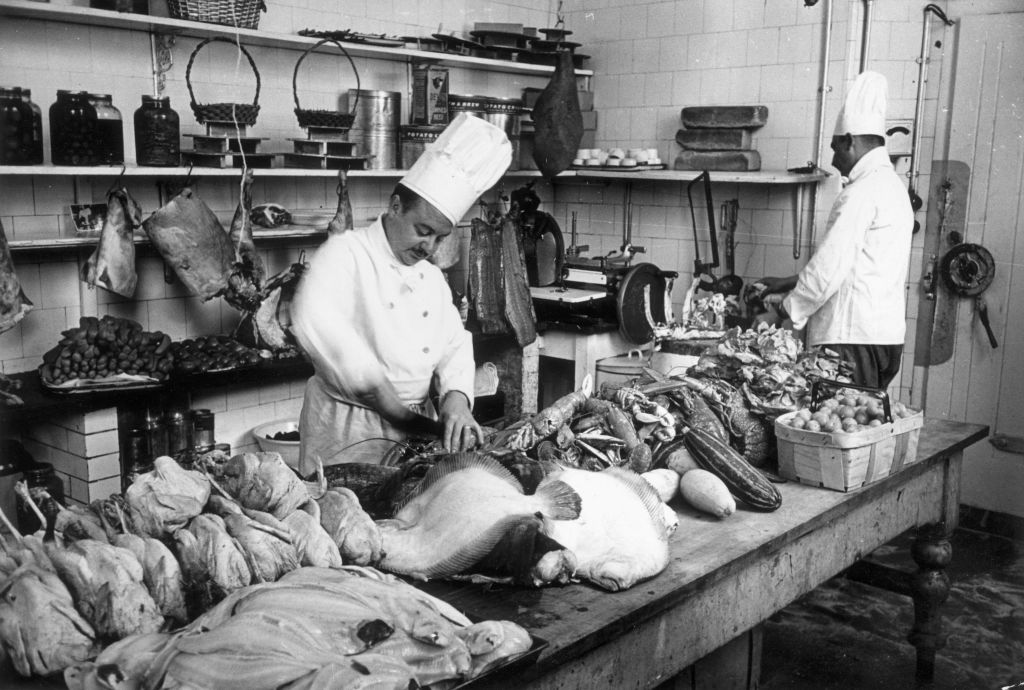
A socialist organizer turned chef looks at England’s restaurant industry in a new book. Along the way, he sheds light on the ecosystem upon which food production relies — from the private ownership of large swaths of land to the exploitation of workers. (Bert Hardy / Picture Post / Hulton Archive via Getty Images)
English food does not have a good reputation. In 1806, Grimod de La Reynière, a pioneering French food critic, wrote that “[England’s] cooking is limited to boiled chickens.” More than two hundred years later, stereotypes about the country’s food have hardly improved.
Looking at the staple icons of English cuisine today — fish and chips, the Sunday roast, the full English breakfast — one might agree with Grimod’s point. These dishes are brutish mounds of meat and carbs, the product of a culture that has often seemed more interested in excess than culinary refinement. They hardly suggest the level of technique and attention to simple, high-quality ingredients associated with French or Japanese food.
It’s not only the nation’s cuisine that’s in a sorry state. Ultraprocessed food accounts for more than half of the calories consumed in the UK each year, while obesity rates remain substantially higher than the European Union average. How did England come to eat this way? In his first book, The Full English: The Ways We Eat and Why, the chef and writer Lewis Bassett examines the country’s culinary traditions and eating habits in order to understand the peculiar history that produced them.
Making a loaf of sourdough in a North London bakery, learning how to cook a balti in a Birmingham curry house, fishing off the shores of Eastbourne: the reader follows Bassett as he improves his technique and expands his repertoire of “English” dishes — a category that is distinctly more multicultural than its marketing suggests. Loosely, the book is structured around a series of stages (from stagiaire, the French term for a professional kitchen internship), with each placement and dish giving Bassett another vantage point from which to investigate English society. He not only moves between restaurants but also across roles, switching from worker to reporter and researcher.
Bassett began working in kitchens at sixteen, first making sandwiches before shucking oysters and frying burgers in Melbourne at eighteen; at twenty, he worked in a London fish restaurant where he was taught how to cook professionally. His other education was political. During the Jeremy Corbyn years he became involved in the Labour left, undertaking grassroots organizing and campaigning while completing a PhD at the University of Manchester on Corbynism and democracy under neoliberalism. He has since written about politics and organizing for this publication and others.
Cooking and socialist organizing became two different forms of education. As a chef working in London, Bassett has cooked for some of the wealthiest people in the world. As a socialist, he lives in a society in which access to good food made from fresh ingredients remains profoundly uneven. The book is situated inside the tensions that emerge when you do something you truly love in an exclusionary industry.
After completing his PhD, and during the pandemic, the culinary work on which the book draws was an attempt to return to what Bassett calls “the careful, physical work that is done with human hands.” What the hands do, the brain wants to understand. The Full English uses the practical knowledge of cooking as the starting point for an investigation into the particular development of British society, its early industrialization, and its imperial expansion.
The world of gourmet restaurants depends upon a mostly hidden system of large and highly specialized teams. Behind a Michelin-starred meal are chefs carrying out exacting, repetitive tasks at speed: tweezing fragments of shell from crab meat, slicing paper-thin sheets of apple with a mandolin, coordinating dozens of preparations at the peak of service. The refinement associated with haute cuisine can obscure the conditions required to produce it. Luxury arrives at the table looking effortless only because so much effort has been organized elsewhere, through an intense division of labor.
The same tension between refinement and material conditions can be seen in something as ordinary as bread. Sourdough is often treated as a return to an older, more authentic way of eating, yet the highly standardized loaf made from carefully controlled ingredients is product of modern abundance. In preindustrial England, bread was necessarily more of a motley affair, made from whatever grains or substitutes were available, sometimes including peas, and fermented with beer rather than a modern sourdough starter.
Industrialization has made food more uniform and predictable; that consumable standardization has helped create the middle-class boom in desire for the artisanal and handcrafted. What looks like a rejection of industrial food is, in part, one of its consequences, one that exists for consumers who want to pay to feel like they’re opting out.
English eating habits were transformed unusually early by urbanization and industrialization. Through dispossession and the consolidation of land, England lost much of its peasantry earlier than other European countries. By the middle of the nineteenth century, it was already heavily urbanized, with large numbers of people buying bread rather than baking it themselves. The dishes that people ate were shaped by the new rhythms of industrial life. At the same time, British naval and commercial power opened up new systems of trade and consumption. English taste emerged from this “peculiar insistence of modernity,” as Bassett puts it: industrial, urban, and imperial all at the same time.
The later sections of The Full English move outward from the kitchen into questions of class, migration, and national identity. The Balti, a Pakistani curry, becomes a way of thinking about the anglicization of so-called South Asian food and the colonial histories behind it; Italian food, meanwhile, is tied to the rise of a new middle class in the 1990s and the cultural politics of New Labour.
Elsewhere, the language of dieting and optimization enters the kitchen through food alternatives like Huel and calorie-counting apps, turning eating into another activity to be measured and disciplined. This is perhaps the least surprising part of the book: the critique of neoliberal self-management is familiar even if the examples themselves are revealing. More compelling is the way these examples accumulate into a history of how English tastes have been shaped by empire, class formation, and changing ideas of aspiration.
The investigations in the book become most politically urgent when they turn to land. Britain remains dependent on food imports, while the shocks of war, trade disruptions, and rising prices have shown the fragility of the food system. Yet huge swaths of the countryside remain concentrated in the hands of a landed aristocracy, with estates able to attract public money for heritage and wild-farming projects. At the very moment when questions of food security and agricultural production are becoming harder to ignore, the ownership of land itself is often treated as beyond political discussion.
The environmental stewardship of heritage projects can therefore be a way of modernizing the image of inherited wealth without disturbing the structure beneath it. The more radical questions, such as who should own land, what it should produce, and whether farming should be organized around national need rather than market return, remain largely outside respectable debate.
The tension between luxury, labor, and poverty runs through the book. There is something almost peripatetic about its movement between kitchens, farms, and fisheries, as though the act of working itself were generating the argument, and we were listening to Bassett talk at his prep station. Cooking is treated neither as pure pleasure nor simply as exploitation. It is skilled, exhausting, communal, and often badly paid; it can also produce extraordinary things that remain inaccessible to much of the population. The core political problem is the access to and distribution of good food. Why should refinement, abundance, and pleasure be restricted to those who can afford them?
That question is how The Full English uses food to raise questions of broader political significance. For many socialists of Bassett’s generation, the defeat of Corbynism left open the question of where political energies and intellectual habits might go next. One answer offered here is to return to work to apprenticeship and to the material world, and to produce knowledge from those experiences.
There is an older leftist tradition behind this: the self-education of industrial workers, or E. P. Thompson teaching adults outside the university, in which political understanding is produced by immersing yourself in a life built around other workers. The Full English belongs, however loosely, to that tradition. It turns the experience of work into a way of telling stories about the nation and makes food a means of asking who Britain is organized for.